Are Lab-Grown Diamonds Real?
Real vs Fake Explained • Published July 25, 2026
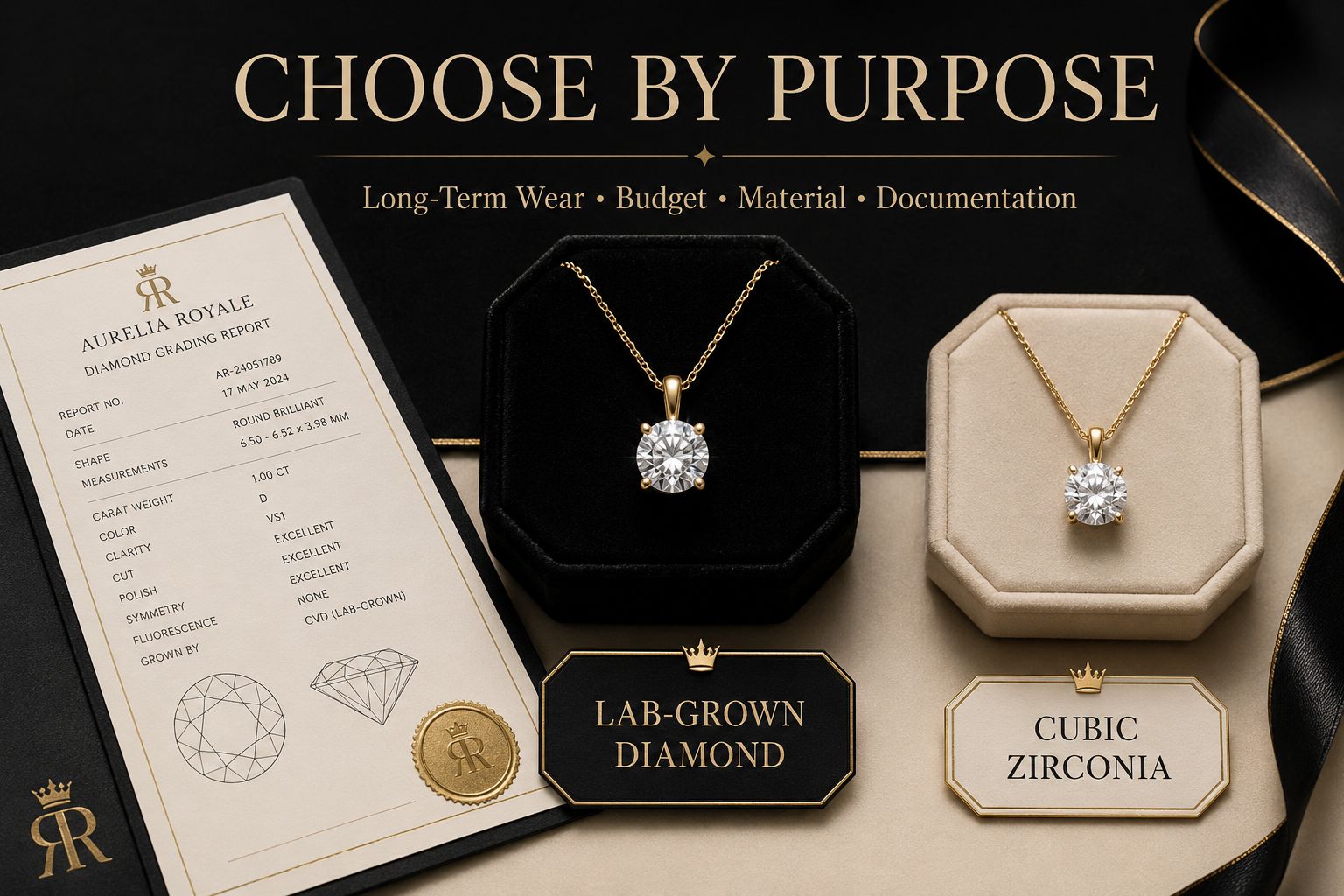
Laboratory-grown diamonds are diamond material — the difference from natural diamonds is origin, not material identity.
Yes — laboratory-grown diamonds are diamond material.
They are made of crystallised carbon and possess essentially the same chemical, physical and optical properties as diamonds that form naturally within the Earth. They are not cubic zirconia, moissanite, glass or another material designed merely to imitate the appearance of diamond.
But there is an equally important distinction:
A laboratory-grown diamond is not a natural diamond.
The difference is its origin. Natural diamonds formed through geological processes within the Earth, whereas laboratory-grown diamonds are manufactured using controlled technology, principally High Pressure High Temperature (HPHT) or Chemical Vapour Deposition (CVD).
That distinction matters when diamonds are described, sold and independently identified.
So the most accurate answer to "Are lab-grown diamonds real?" is:
Quick Answer: Are Lab-Grown Diamonds Real or Fake?
Lab-grown diamonds are not fake diamonds or diamond simulants.
Their defining material is diamond: carbon atoms arranged in the characteristic diamond crystal structure. Gemmological organisations including GIA and IGI recognise laboratory-grown material as diamond while clearly distinguishing its manufactured origin from naturally formed diamond.
A fake or simulated diamond is different.
Materials such as cubic zirconia and moissanite can resemble diamond visually but are different substances with different chemical and physical properties.
| Category | Origin | Material |
|---|---|---|
| Natural diamond | Geological formation | Diamond |
| Laboratory-grown diamond | Technological synthesis | Diamond |
| Diamond simulant | Various | Different material (e.g. cubic zirconia, moissanite) |
The words may sound similar in jewellery marketing, but gemmologically they describe very different products.
What Makes a Lab-Grown Diamond a Diamond?
A diamond is defined primarily by its material and crystal structure rather than simply by where it formed.
Diamond consists essentially of carbon crystallised into a particular three-dimensional structure. That structure produces many of diamond's familiar physical and optical characteristics, including its exceptional hardness and its interaction with light.
Laboratory-grown diamonds reproduce that diamond crystal structure through controlled manufacturing processes.
GIA describes laboratory-grown diamonds as possessing essentially the same chemical composition and crystal structure as natural diamonds, along with essentially the same physical and optical properties.
That is why a laboratory-grown diamond is fundamentally different from an imitation material.
Cubic zirconia may look clear and brilliant when faceted, but it is zirconium dioxide rather than diamond. Moissanite is silicon carbide. Both can be attractive gemstones, but neither is diamond.
Are Lab-Grown Diamonds the Same as Natural Diamonds?
They are the same type of material, but they are not identical in origin.
This distinction is important because statements such as "there is absolutely no difference" can be misleading.
Natural diamonds develop in geological environments over immense periods of time. Laboratory-grown diamonds form under controlled manufactured conditions over much shorter periods.
Those different growth environments can produce differences in crystal-growth structures, trace elements, inclusions, fluorescence, phosphorescence and other features that trained laboratories can detect.
To somebody looking at a finished diamond in normal jewellery conditions, however, those differences may not be visible.
A well-cut natural diamond and a well-cut laboratory-grown diamond of comparable specifications can look extremely similar to the unaided eye.
So the accurate distinction is not: real diamond vs fake diamond — but rather: laboratory-grown diamond vs natural diamond.
For a broader origin-by-origin comparison, see Lab-Grown vs Natural Diamonds.
Where Do Lab-Grown Diamonds Come From?
Most gem-quality laboratory-grown diamonds are produced using one of two principal technologies: HPHT or CVD.
HPHT stands for High Pressure High Temperature. The process uses high pressure and high temperature to create conditions in which carbon can crystallise around a diamond seed. The technique is related to the conditions under which natural diamond formation occurs, although the manufacturing environment and growth process are different from geological formation.
CVD stands for Chemical Vapour Deposition. In this process, carbon-containing gas is introduced into a controlled chamber and activated so that carbon can progressively deposit onto a diamond seed and develop into diamond crystal.
Both methods can produce gem-quality laboratory-grown diamonds.
One method is not automatically "real" while the other is somehow less genuine. HPHT and CVD describe manufacturing routes, not different gemstone identities.
The resulting stone still needs to be assessed individually for its characteristics and quality.
For the complete process, read How Are Lab-Grown Diamonds Made?, and for a detailed comparison see CVD vs HPHT Lab-Grown Diamonds.
Are Lab-Grown Diamonds Synthetic Diamonds?
Scientifically, synthetic diamond is an established term for diamond produced artificially rather than naturally.
Consumer-facing terminology varies by jurisdiction and industry standard.
In the United States, the Federal Trade Commission allows descriptors such as laboratory-grown and laboratory-created when the material has essentially the same optical, physical and chemical properties as mined diamond. It also requires the manufactured origin to be disclosed clearly so consumers are not led to believe they are buying a mined diamond.
In the UK, advertising guidance similarly requires a clear qualifier such as laboratory-grown, laboratory-created or synthetic rather than simply presenting the product as an unqualified natural diamond.
The terminology is evolving internationally as well. In September 2026, CIBJO's Board approved a recommendation that its international Blue Books use synthetic as the primary descriptor for manufactured products with the same chemical composition, physical properties and structure as their natural counterparts. CIBJO also acknowledged that national legislation and accepted terminology take precedence within individual jurisdictions.
For a consumer, the most important principle is therefore not which marketing phrase sounds best.
It is clear disclosure of origin.
A product should make it immediately understandable that the diamond is laboratory-grown rather than naturally formed.
Why UK Buyers Should Be Careful with the Phrase "Real Diamond"
The search phrase "Are lab-grown diamonds real?" is completely reasonable for an educational article because it reflects the question consumers actually ask.
But jewellery advertising requires more precise language.
In UK advertising guidance, the term "real diamond" can carry an implication that the stone is naturally formed. The Advertising Standards Authority has therefore advised advertisers not to rely on "real diamond" as a description of a laboratory-grown product.
For Aurelia Royale, the clearest terminology is consequently: laboratory-grown diamond rather than simply: real diamond.
This keeps the material identity accurate without obscuring its origin.
Can You Tell a Lab-Grown Diamond from a Natural Diamond by Looking at It?
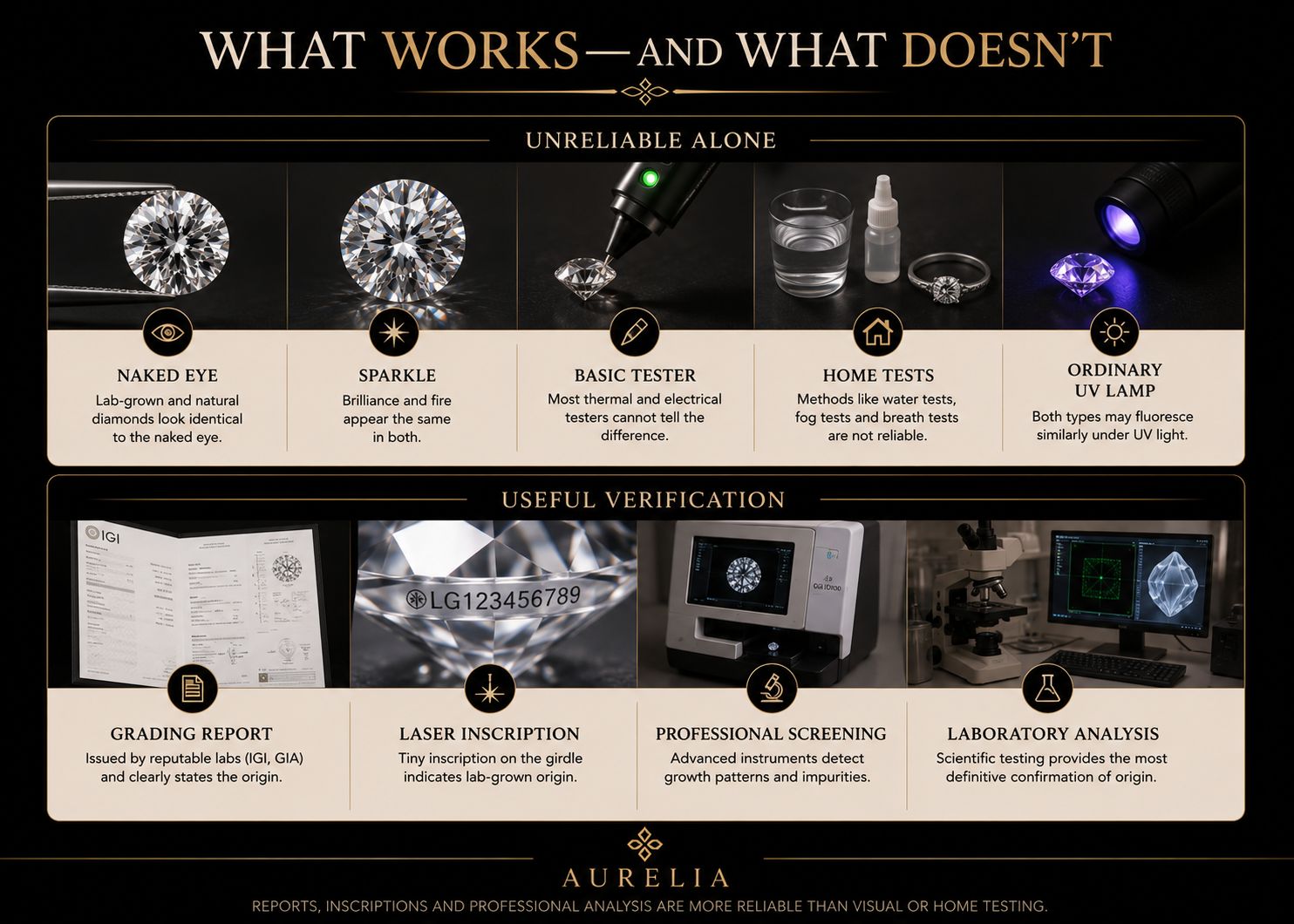
Usually, not reliably with the unaided eye.
Natural and laboratory-grown diamonds can have extremely similar appearance, transparency, brilliance, fire and overall visual character.
A person's ability to see an inclusion, tint or unusual feature does not prove the diamond's origin.
Even trained professionals cannot establish origin reliably simply by looking across a jewellery counter.
GIA explains that because laboratory-grown diamonds are essentially chemically and optically the same as natural diamonds, traditional gemmological observations and older-style diamond detectors are insufficient for definitive separation.
Professional identification may require sophisticated analytical equipment.
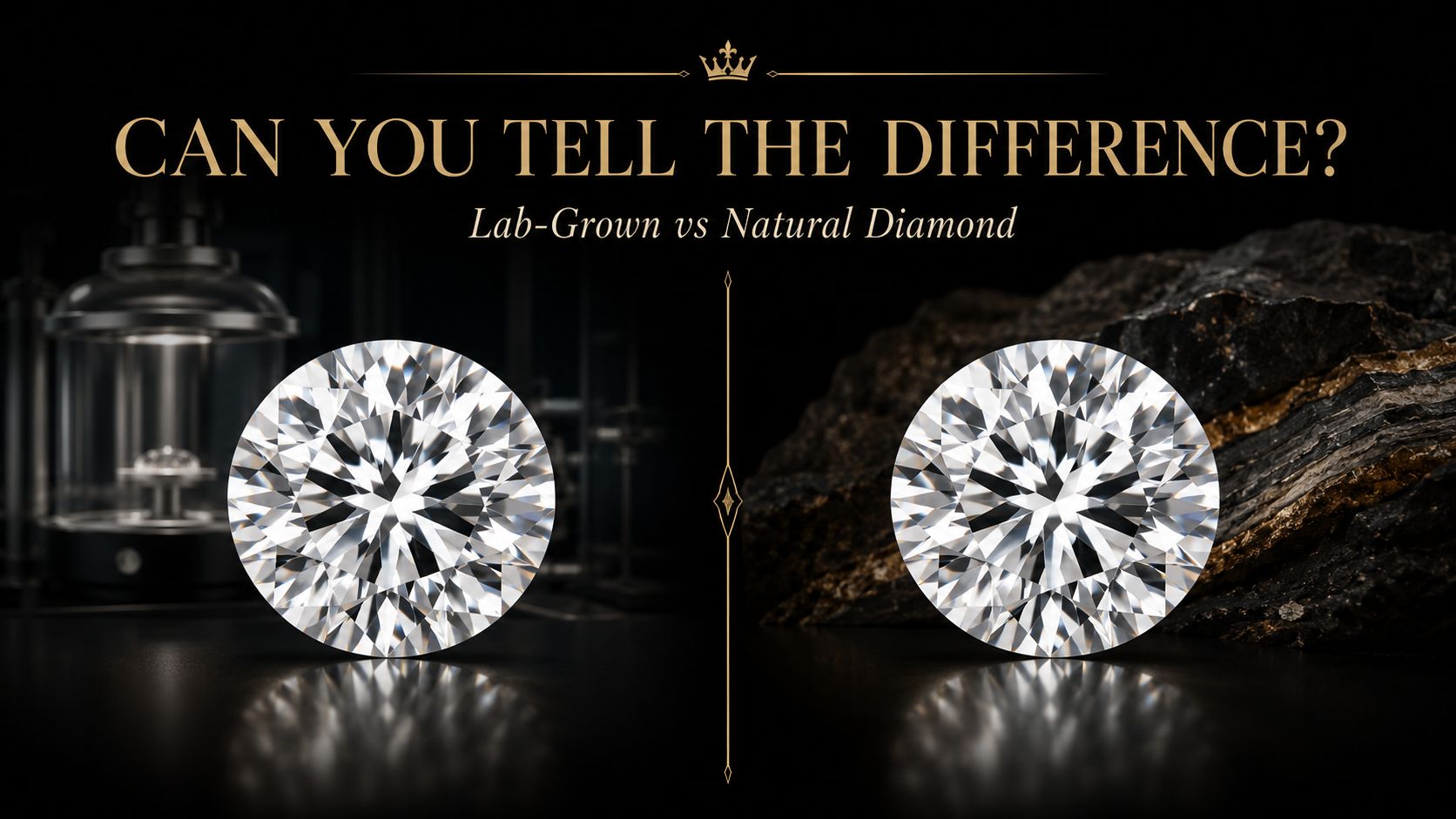
Visual inspection alone cannot reliably distinguish a laboratory-grown diamond from a natural diamond — advanced testing is required.
How Do Gemmological Laboratories Tell the Difference?
Natural and laboratory-grown diamonds develop in different environments, and those growth histories can leave detectable evidence within the crystal.
Gemologists may evaluate combinations of features such as:
- growth structures;
- characteristic inclusions;
- fluorescence and phosphorescence patterns;
- trace-element-related defects;
- absorption spectra;
- photoluminescence; and
- reactions under specialised ultraviolet imaging.
No single visible characteristic should automatically be treated as proof.
For example, certain metallic inclusions may suggest HPHT growth, while particular growth patterns or spectroscopic features may be associated with CVD material. But modern production is increasingly sophisticated, and individual characteristics can overlap.
This is why major gemmological laboratories use multiple testing techniques rather than relying on one clue.
GIA's current research specifically notes that conclusive laboratory-grown identification typically requires a combination of gemmological characteristics and advanced analysis.
For buyers who want a detailed guide to identification methods, read Can You Tell a Lab Diamond from a Natural Diamond?
Can a Jeweller Tell Whether a Diamond Is Lab-Grown?
A jeweller may sometimes observe features that raise suspicion about a diamond's origin, particularly with appropriate screening equipment and experience.
But suspicion is different from definitive identification.
GIA advises that confirmation of natural versus laboratory-grown origin can require examination at a gemmological laboratory using advanced instruments.
This distinction becomes particularly important with modern high-quality laboratory-grown diamonds because manufacturing techniques have improved considerably.
A professional jeweller can help inspect documentation, examine inscriptions and screen the stone, but a formal laboratory report provides much stronger evidence of origin than a visual opinion alone.
Do Lab-Grown Diamonds Pass a Diamond Tester?
Many common diamond testers will recognise a laboratory-grown diamond as diamond.
That makes sense because the stone possesses diamond's physical properties.
However, this does not mean a basic diamond tester can establish whether the diamond is natural or laboratory-grown.
Traditional testers frequently measure properties such as thermal conductivity. They can be useful for separating diamond from some simulants, but they are not designed to establish the diamond's geological or manufactured origin.
This is a crucial distinction:
Can a Lab-Grown Diamond Fool a Diamond Tester?
The word "fool" is misleading.
If a laboratory-grown diamond causes a standard diamond tester to indicate "diamond", the device is not necessarily malfunctioning.
The tester is identifying a physical property associated with diamond material.
What the device normally cannot tell you is how that diamond formed.
Therefore, a positive diamond-tester result should not be interpreted as evidence that the stone is naturally mined.
Likewise, it should not be treated as evidence that a laboratory-grown diamond is somehow pretending to be something it is not.
It simply demonstrates why material identification and origin identification are separate gemmological questions.
What Does a Laboratory Report Tell You?
Independent laboratory documentation can provide evidence about diamond identity and origin.
IGI, for example, states that it screens diamonds using specialist technology to determine whether they are naturally mined, laboratory-grown or simulants. Its reports can document laboratory-grown origin along with relevant gemmological characteristics.
GIA also identifies whether submitted material is laboratory-grown and uses specialised analysis to distinguish manufactured diamonds from naturally formed diamonds.
A report can therefore answer a much more useful question than "Does this look real?"
It can establish: What material is this, and what is its origin?
Report formats vary between laboratories, and laboratory services have also changed over time, so buyers should read the specific document rather than assuming every report contains identical fields.
For more detail, see How to Read a Lab-Grown Diamond Certificate.
What Is a Diamond Laser Inscription?
Many individually documented laboratory-grown diamonds have microscopic information laser-inscribed on the girdle, the narrow outer edge of the polished diamond.
Depending on the laboratory and service, the inscription can include a report number and an indication of laboratory-grown origin.
The inscription can often be viewed under sufficient magnification.
It can provide an important connection between a physical diamond and its grading or identification report.
However, seeing a report number on a girdle is only one step.
The number should be checked against the issuing laboratory's official database, and the report details should correspond with the diamond being examined.
A report being genuine does not by itself prove that every stone presented alongside it is the stone described in that report.
For the detailed process, see What Is a Diamond Laser Inscription? and How to Verify an IGI Certificate Number.
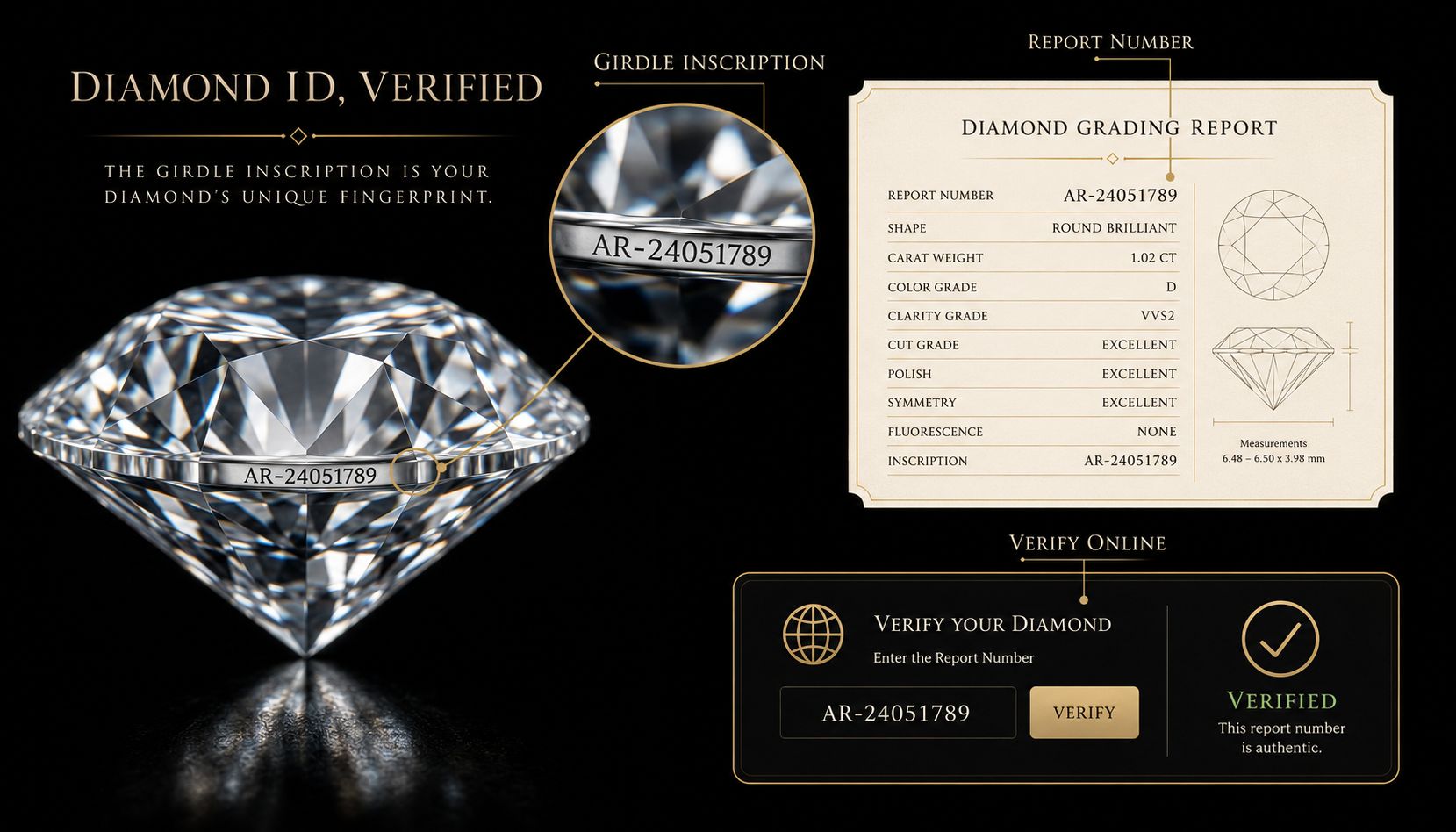
A laser inscription links a diamond to its report — both should be verified against the issuing laboratory's official records.
Are Lab-Grown Diamonds Cubic Zirconia?
No.
Cubic zirconia, usually abbreviated to CZ, is a diamond simulant made from zirconium dioxide.
It can be colourless and cut to resemble a diamond, but it has a different composition, crystal structure and set of optical and physical properties.
A laboratory-grown diamond is carbon crystallised as diamond.
This is why referring to laboratory-grown diamonds as "CZ" is technically incorrect.
For a complete comparison, read Lab-Grown Diamond vs Cubic Zirconia.
Lab-grown diamonds are diamond material — cubic zirconia and moissanite are different substances entirely.
Are Lab-Grown Diamonds Moissanite?
No.
Moissanite is silicon carbide.
It is a distinct gemstone with different optical behaviour, refractive properties and physical characteristics from diamond.
Some people choose moissanite specifically because they enjoy its strong fire and different visual character, but it should not be confused with either laboratory-grown or natural diamond.
A laboratory-grown diamond is still diamond; moissanite is not.
For the full comparison, see Lab-Grown Diamond vs Moissanite.
Are Lab-Grown Diamonds Perfect or Flawless?
No.
Laboratory production does not mean every diamond emerges flawless, colourless or perfectly cut.
Lab-grown diamonds can contain inclusions and other characteristics associated with their growth process. They also still need to be cut and polished after growth, which means their proportions, symmetry, polish and overall light performance can vary.
Origin tells you how the diamond formed.
It does not tell you whether it is a good diamond.
That is why quality information should still be examined when choosing an individual laboratory-grown stone.
For the broader quality framework, read What Are the 4Cs of a Lab-Grown Diamond?
Do Lab-Grown Diamonds Look Fake?
A properly cut laboratory-grown diamond should not look fake simply because of its origin.
The visible appearance of a diamond depends on factors including its cut, proportions, colour, clarity, size and the conditions under which it is viewed.
A poorly cut lab-grown diamond can look less attractive than a well-cut natural diamond.
Equally, a well-cut lab-grown diamond can display excellent brilliance and fire.
The source of the diamond does not determine whether its cutting quality is good.
Are Lab-Grown Diamonds as Hard as Natural Diamonds?
Laboratory-grown diamonds possess the characteristic hardness of diamond.
That makes them suitable for jewellery, including pieces intended for regular wear.
But this topic should not be confused with identification.
Hardness tells us something about the material. It does not reveal whether the diamond formed naturally or through laboratory production.
It is also important to distinguish hardness from indestructibility. Diamond is exceptionally resistant to scratching but can still chip or fracture under certain impacts.
For detailed durability guidance, see Do Lab Diamonds Last Forever?
Do Lab-Grown Diamonds Lose Their Sparkle?
Their laboratory origin does not cause them to gradually stop behaving like diamond.
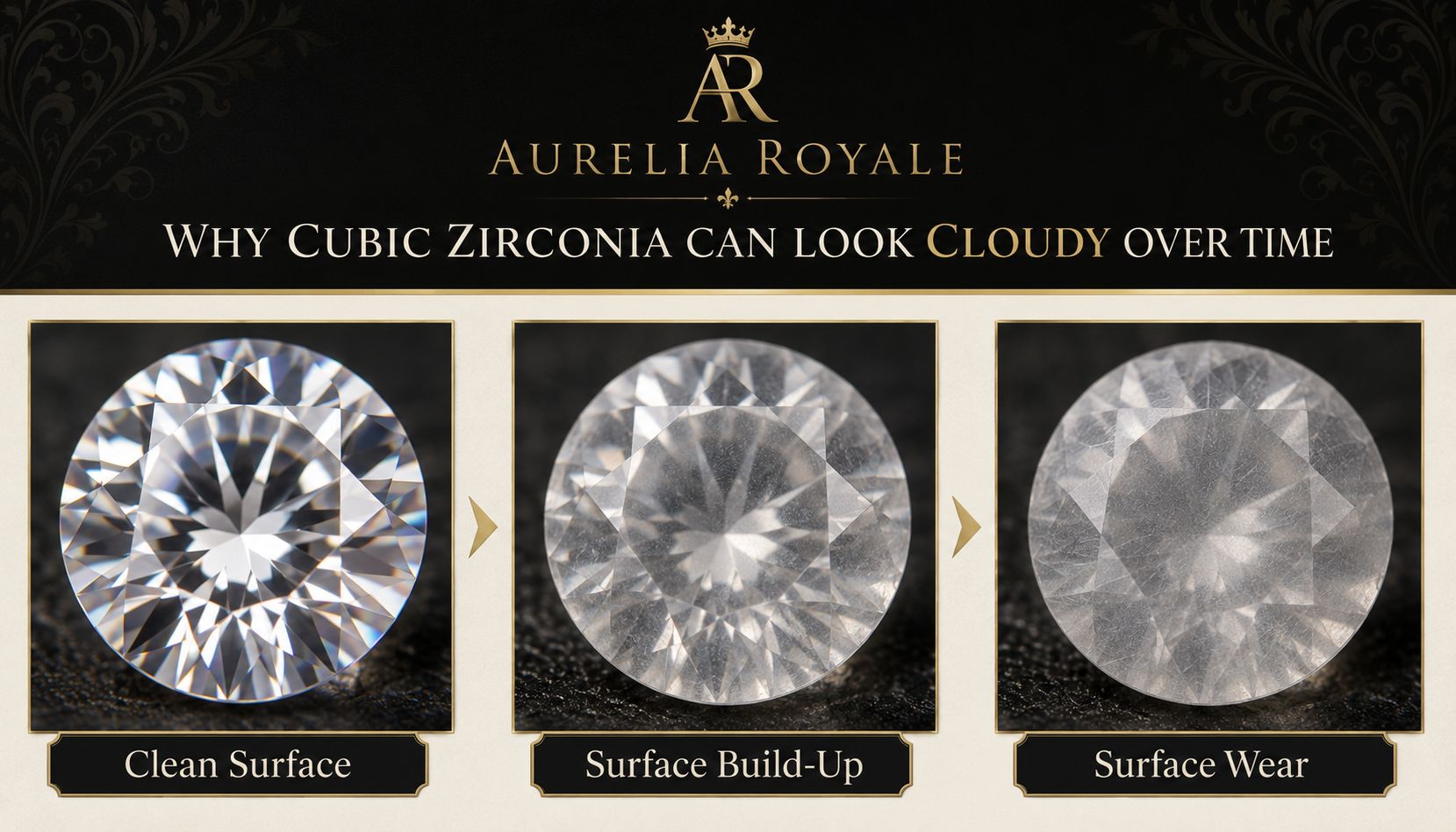
If diamond jewellery looks dull, the cause may instead be surface oil, cosmetics, soap residue or dirt interfering with the way light enters and exits the stone.
That is a care issue, not evidence that the diamond is "fake".
For that specific question, see Do Lab Diamonds Lose Their Sparkle? and How to Clean Lab-Grown Diamond Jewellery.
Are Lab-Grown Diamonds Cheaper Because They Aren't Real?
No.
Their lower market price does not mean they are imitation diamonds.
Natural and laboratory-grown diamonds operate under different production, scarcity and supply structures, which contributes to their different prices.
The pricing question deserves its own analysis and should not be used as an authenticity test.
Read Are Lab-Grown Diamonds Cheaper Than Natural Diamonds? for the full explanation.
How Can You Confirm That a Lab-Grown Diamond Is Genuine?
Instead of relying on appearance alone, look for evidence that clearly identifies both the material and its origin.
For a significant individual diamond, useful checks can include reviewing the independent laboratory report, verifying the report through the issuing laboratory, inspecting any corresponding laser inscription where appropriate and making sure the specifications on the report match the stone being presented.
For finished jewellery containing many smaller diamonds, documentation can work differently because every small accent stone may not have an individual report.
The important principle is transparency.
The seller should clearly state whether the diamonds are laboratory-grown, and any grading or identification claims should be supported by the appropriate documentation.
Lab-Grown Diamond, Natural Diamond and Simulant: The Key Difference
The terminology becomes much easier once the three categories are separated.
| Laboratory-Grown Diamond | Natural Diamond | Diamond Simulant | |
|---|---|---|---|
| Material | Diamond | Diamond | Different material |
| Main composition | Crystallised carbon | Crystallised carbon | Depends on simulant |
| Origin | Manufactured | Geological | Manufactured or natural |
| Looks like diamond | Yes | Yes | Designed to |
| Normal viewing identifies origin? | No | No | Sometimes distinguishable |
| Examples | CVD, HPHT diamond | Naturally formed diamond | CZ, moissanite |
The most important distinction is therefore not whether one diamond is genuine and the other is an imitation.
It is whether the diamond is natural or laboratory-grown.
Final Answer: Are Lab-Grown Diamonds Real?
Laboratory-grown diamonds are genuine diamond material, but they are not naturally formed diamonds.
They consist of diamond crystal and possess essentially the same core chemical, physical and optical properties as natural diamonds.
Their defining difference is origin.
Natural diamonds formed through geological processes within the Earth. Laboratory-grown diamonds are produced through HPHT or CVD technology.
Because the finished stones can look extremely similar, visual inspection or a basic diamond tester cannot reliably determine origin. Specialist gemmological testing, appropriate documentation and clear disclosure are the proper ways to distinguish them.
For consumers, that leads to the simplest rule:
Verification comes from documentation, laser inscriptions and clear seller disclosure — not visual inspection alone.
Are lab-grown diamonds real diamonds?▼
Lab-grown diamonds are diamond material with essentially the same chemical, physical and optical properties as natural diamonds. Their origin is different: they are manufactured rather than formed naturally within the Earth.
Are lab-grown diamonds fake?▼
No. A lab-grown diamond is not a diamond imitation such as cubic zirconia. However, its laboratory-grown origin should always be disclosed clearly rather than allowing buyers to believe it is a natural diamond.
Are lab-grown diamonds considered real in the UK?▼
They are recognised as laboratory-grown or synthetic diamond material, but UK advertising guidance requires that their manufactured origin be made clear. Advertisers should not describe them simply as unqualified "real diamonds" in a way that could imply natural origin.
Are lab-grown diamonds considered real in the US?▼
US FTC guidance permits terms such as laboratory-grown and laboratory-created for material with essentially the same optical, physical and chemical properties as mined diamond, but requires clear disclosure that the product is not mined.
Can you tell a lab-grown diamond from a natural diamond by eye?▼
Not reliably. They can appear extremely similar under normal viewing conditions. Professional laboratories use specialised equipment and multiple gemmological tests to determine origin.
Can a jeweller tell if a diamond is lab-grown?▼
A jeweller may identify suspicious characteristics or use screening equipment, but definitive origin identification can require advanced gemmological laboratory testing.
Do lab-grown diamonds pass a diamond tester?▼
Standard testers can register laboratory-grown diamonds as diamond because they possess diamond's physical properties. A conventional tester generally cannot determine whether that diamond is natural or laboratory-grown.
Are lab-grown diamonds the same as natural diamonds?▼
They are both diamond material, but they are not the same in origin. Natural diamonds are geologically formed; laboratory-grown diamonds are manufactured using technological processes.
Are lab-grown diamonds cubic zirconia?▼
No. Cubic zirconia is zirconium dioxide and is a diamond simulant. Laboratory-grown diamonds are crystallised carbon.
Are lab-grown diamonds moissanite?▼
No. Moissanite is silicon carbide and is a different gemstone. Laboratory-grown diamonds are diamond.
What are CVD and HPHT diamonds?▼
CVD and HPHT are the two principal methods used to manufacture gem-quality laboratory-grown diamonds. They describe how the diamond grew, not whether the resulting material is diamond.
Do lab-grown diamonds have inclusions?▼
Yes. Laboratory-grown diamonds can contain inclusions, growth features and other characteristics. Lab-grown does not mean flawless.
Can laboratory reports identify a lab-grown diamond?▼
Yes. Major gemmological laboratories use specialist testing to determine whether diamond material is natural or laboratory-grown and issue reports or assessments identifying its origin.
Does a laser inscription prove a diamond is lab-grown?▼
An inscription can help link a diamond to a laboratory report and may identify laboratory-grown origin, but the report number and stone details should still be checked against the issuing laboratory's official records.
Why does clear origin disclosure matter?▼
Natural and laboratory-grown diamonds can look extremely similar while differing substantially in origin and market characteristics. Clear disclosure lets buyers understand exactly what they are purchasing.
The best diamond purchase is an informed one.
Aurelia Royale clearly presents its jewellery as laboratory-grown diamond jewellery, allowing the distinction between diamond identity and diamond origin to remain transparent.
Explore Aurelia Royale's laboratory-grown diamond jewellery and, where a design is not currently available for direct purchase, Join the Waitlist or submit an enquiry to register your interest.
Understand What You Are Buying
Aurelia Royale clearly identifies all jewellery as laboratory-grown diamond — transparent origin, genuine diamond material.

Stay Connected
Get Our Latest Updates
Be first to discover new collections, exclusive events, and the quiet privileges reserved for our inner circle.