How to Clean Lab-Grown Diamond Jewellery at Home
Safe Methods, What to Avoid and When to Seek Professional Inspection • Published September 10, 2026
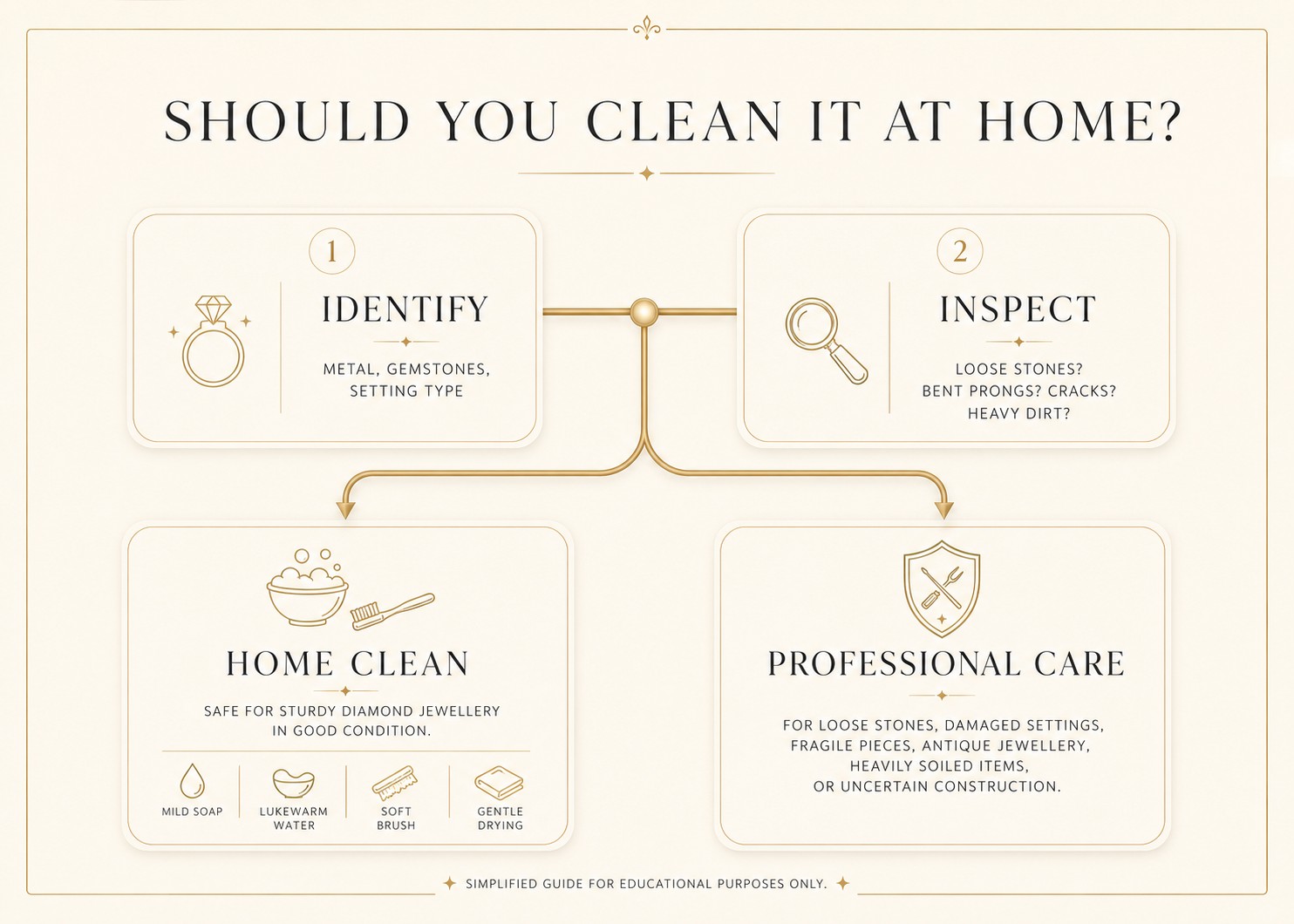
The right sequence: check the jewellery → identify the materials → use the gentlest suitable cleaning method → rinse carefully → dry completely → inspect again.
Lab-grown diamond jewellery can lose some of its visible sparkle when oils, skincare products, soap residue, dust and everyday dirt build up across the surface of the diamond and around its setting. That does not mean the diamond itself has permanently become dull.
Diamonds attract grease readily, so even handling the surface with your fingers can leave a film that affects brilliance. The safest response is usually straightforward: clean the jewellery gently, pay attention to the setting as well as the diamond, and avoid aggressive household chemicals or cleaning methods that could damage the metal or loosen an already weakened stone.
For straightforward diamond jewellery with secure settings and no delicate additional materials, a conservative home-cleaning method is: warm water + a small amount of mild soap + a very soft brush + a thorough rinse + a soft lint-free cloth. However, the jewellery must be assessed as a complete piece. The diamond may tolerate a cleaning method that the surrounding metal, plating, antique finish, treated gemstone or delicate setting does not. That is why the right sequence is: check the jewellery → identify the materials → use the gentlest suitable cleaning method → rinse carefully → dry completely → inspect again.
Quick Answer: How Should You Clean Lab-Grown Diamond Jewellery?
Before cleaning, check that the diamonds appear secure. If a stone looks tilted, a prong is bent, a pavé diamond appears displaced, or you notice unusual movement, clicking or a visible gap around the setting, do not continue with home cleaning. Stop wearing the jewellery and arrange professional inspection.
If the jewellery appears secure and contains only materials compatible with ordinary gentle cleaning, prepare warm—not excessively hot—water with a small amount of mild soap. Allow dirt to soften briefly if needed, then use a soft toothbrush or similar soft brush to clean gently around the diamond, underside of the setting and other areas where residue collects. Rinse thoroughly so no soap remains. If cleaning near a sink, close or cover the drain before you begin. Dry the jewellery with a soft lint-free cloth and allow inaccessible areas to dry completely before storing it. Avoid bleach, chlorine, toothpaste, abrasive powders and aggressive scrubbing. Do not use ultrasonic or steam cleaning as a routine home method simply because the jewellery contains diamonds.
Lab-Grown Diamonds Do Not Need a Special Cleaning Chemical
The important cleaning question is not whether the diamond was laboratory-grown. It is: What materials and construction make up the complete piece of jewellery? The diamond itself may be durable, while the setting can include precious metal, plating, delicate pavé, fine prongs or additional gemstones that need more cautious treatment. This means there is no need to search for a special chemical simply because the diamond is lab-grown. Instead, choose a method that is safe for the entire piece.
Why Diamond Jewellery Starts Looking Less Sparkly
A diamond's optical performance depends partly on light entering and leaving the stone. When grease or residue collects on the diamond, particularly around the pavilion or underside, it can interfere with that clean optical appearance. Common sources of surface build-up include: skin oils, hand cream, moisturiser, soap residue, cosmetics, hair products, dust, and cooking oils. GIA notes that diamonds readily attract grease and that even oils from fingers can affect their brilliance. The solution is therefore often removing the surface film—not assuming the diamond itself has changed.
The top of a diamond is easy to see and easy to wipe. The underside of the stone can collect far more residue. In rings, this can happen beneath the centre setting. In stud earrings, material can collect behind the diamond and around the basket. In pendants, residue can accumulate around the back of the setting. In tennis bracelets and pavé jewellery, dirt can collect between many small settings.
Before Cleaning: Inspect the Setting
| What You Notice | Recommended Action |
|---|---|
| Jewellery appears secure, only surface residue visible | Gentle home cleaning may be appropriate |
| Diamond appears tilted | Stop and seek inspection |
| Prong visibly bent or missing | Do not clean aggressively |
| New clicking/rattling | Stop wearing and inspect |
| Pavé stone displaced | Professional inspection |
| Unknown delicate material present | Check material-specific care first |
| Antique or fragile setting | Prefer conservative/professional care |
If something looks wrong, cleaning can wait. Use How to Check Diamond Jewellery for Loose Stones first.
Safe Basic Home-Cleaning Method
For straightforward, securely set diamond jewellery where the materials are suitable for mild soap and water, begin with a clean bowl rather than holding the jewellery directly over an open drain. Add warm water and a small amount of mild soap. Place the jewellery in the solution briefly so surface oils and residue can soften. Then use a clean, very soft toothbrush to work gently around accessible surfaces. Do not apply heavy pressure. Pay particular attention to the back of the diamond and the setting where greasy residue commonly accumulates. Rinse the jewellery thoroughly with clean water. Dry it gently using a soft lint-free cloth. Allow any difficult-to-reach areas to finish drying before placing the piece into storage.
| Stage | What to Do |
|---|---|
| 1. Inspect | Confirm stones/settings do not show obvious damage |
| 2. Prepare | Warm water + small amount of mild soap |
| 3. Soften residue | Allow surface build-up to loosen |
| 4. Brush gently | Use a very soft clean brush |
| 5. Focus underneath | Clean around backs/settings carefully |
| 6. Rinse | Remove all soap residue |
| 7. Dry | Use soft lint-free cloth |
| 8. Recheck | Look at settings before wearing again |
Cover the Sink Drain and Clean Earring Backs Separately
Jewellery should not be cleaned over an unprotected open drain. If you use a sink for rinsing, close or cover the drain first. A small ring, stud earring, earring back or loose component can disappear quickly. This becomes particularly important with earrings because their backs are separate small components. Where the backing can be safely removed, clean it separately using a method appropriate for its actual material. Do not assume every earring back is made from the same metal as the front setting. Aurelia should not promise replacement backings in this article unless the client confirms that service.
Cleaning by Jewellery Type
Rings: Inspect the setting before cleaning. Then clean gently around the gallery, underside of the centre diamond, shoulders and any accent stones. Avoid scraping between prongs with a pin or other hard object. Studs: Remove the backs carefully. Clean the fronts, sides and backs gently. Pay attention to the basket beneath the diamond. Rinse and dry both the stud and backing thoroughly before reassembling.
Drop earrings: Do not pull articulated joints straight or force them beyond their normal movement while cleaning. Support the earring rather than holding it by one delicate link. Dry carefully around articulation points. Necklaces: Clean the chain gently without stretching it. For a pendant, clean around the rear of the setting. Tennis bracelets: Lay on a soft surface, check that the stone line looks consistent, then clean gently. Do not twist or flex beyond normal articulation. Pavé: Use a soft brush rather than hard pressure. Do not use pins, needles or hard tools to clean between stones.

Clean for the most sensitive material in the piece, not the toughest — the diamond's hardness does not protect the surrounding metal or plating.
What Should You Never Use on Diamond Jewellery?
| Product or Method | Why to Avoid It |
|---|---|
| Chlorine bleach | Can damage some precious-metal alloys |
| Toothpaste | Abrasive; can scratch metal |
| Powdered household cleaners | Abrasive |
| Hard brushes | Can scratch/strain delicate areas |
| Pins/needles | Can damage settings |
| DIY acid mixtures | Entire jewellery construction may not tolerate them |
| Home steam cleaning | Not recommended as routine consumer care |
| Home ultrasonic cleaning | Can dislodge already-loose stones and damage unsuitable materials |
GIA specifically advises against abrasive products such as toothpaste on diamond jewellery because they can scratch or erode metals. Chlorine bleach can damage or pit some gold alloys. Do not use vinegar, baking soda or alcohol as default recommendations — the complete jewellery construction matters. Commercial jewellery cleaner can be used only if specifically suitable for all materials in the piece and its instructions are followed.
Ultrasonic and Steam Cleaners
Do not make a home ultrasonic cleaner the default recommendation. Ultrasonic cleaners use vibration to loosen accumulated dirt but can also dislodge stones if a setting is already compromised. GIA specifically notes that professional jewellers inspect jewellery for loose stones before using ultrasonic or steam equipment. Never put jewellery into an ultrasonic cleaner to see whether the stones stay in place. If you do not know the exact materials and condition of the piece, avoid using one at home. If deeper cleaning is required, professional assessment is the better route.
Material Exceptions Matter
A piece may contain: diamond + gold, diamond + platinum, diamond + silver, diamond + plating, diamond + enamel, diamond + another gemstone, or other decorative materials. The diamond may be compatible with a cleaning method while another component is not. Therefore: clean for the most sensitive material in the piece, not for the toughest.
Do not automatically apply the standard diamond method to pieces containing other gemstones. Some gemstones are porous, sensitive to heat, or contain fracture fillings, oil or other treatments. Some organic gem materials such as pearls require substantially different care. A piece containing both diamonds and pearls should be treated according to the more delicate pearl component — do not place it into an ultrasonic cleaner. Antique or delicate jewellery: use very gentle handling and prioritise professional inspection before deeper cleaning.
Why Prevention Is Better Than Constant Deep Cleaning
The less contamination that reaches the jewellery, the less frequently aggressive cleaning becomes tempting. Simple habits can reduce build-up substantially: avoid repeatedly touching the face of the diamond; remove jewellery where practical before using strong household cleaners; keep fine jewellery away from chlorine; apply cosmetics, perfume, hairspray and skincare before putting on delicate jewellery where possible; wipe visible surface oils gently after wear; store pieces so they do not rub unnecessarily against one another.
GIA specifically warns that everyday products can damage certain metals, gems and delicate materials. A practical routine is: skincare/cosmetics first → allow them to settle/dry → jewellery afterwards. Fine jewellery should also be removed before entering chlorinated pools — the concern is not simply whether the diamond survives; the complete jewellery needs protection.

Clean when residue begins to affect appearance — the dedicated frequency guide owns the full discussion of cleaning intervals.
How Often Should You Clean Lab-Grown Diamond Jewellery?
There is no need to force one universal schedule into this page. How quickly jewellery becomes visibly dirty depends on: how frequently it is worn, where it is worn, whether it contacts skincare or cosmetics, the type of setting, and the wearer's habits. Clean it when residue begins to affect appearance and whenever safe maintenance is needed.
The dedicated How Often Should You Clean Diamond Jewellery? article owns the frequency question in depth.
What if the Diamond Still Looks Dull After Cleaning?
First make sure the jewellery has been rinsed thoroughly — residual soap can create its own film. Then inspect the back and underside of the diamond. If the stone still looks significantly different after careful cleaning, stop escalating to harsher chemicals. A persistent appearance problem is a reason for inspection rather than increasingly aggressive home experiments. Cleaning removes contamination from the surface. It does not increase carat, colour grade, clarity grade, or cut grade. Cleaning Is Not a Repair — it cannot fix a bent prong, loose stone, broken clasp, worn chain, damaged hinge, missing pavé diamond, or deformed setting.
Aurelia Should Not Promise Complimentary Cleaning or Free Earring Backs
Do not write: "Bring your Aurelia piece back for complimentary cleaning" or "Every order includes jewellery cleaner" unless the client has confirmed those services and their conditions. Instead use: Contact Aurelia to ask what after-sales cleaning or inspection support is currently available for your piece. Likewise, do not state that replacement earring backs are supplied free of charge until confirmed — different earring designs use different posts, friction backs, screw backs or locking mechanisms.
Home Cleaning vs Professional Attention
| Situation | Home Cleaning | Professional Attention |
|---|---|---|
| Normal surface oil | ✓ | Optional |
| Light soap/cosmetic residue | ✓ | Optional |
| Dirt beneath secure setting | ✓ gently | If persistent |
| Bent prong | No | ✓ |
| Loose diamond | No | ✓ |
| Missing pavé stone | No | ✓ |
| Unknown delicate gemstone | Not until care method confirmed | Often useful |
| Antique/fragile setting | Very cautious | Preferred |
| Heavy inaccessible build-up | Limited | ✓ |
| Damaged clasp/backing | Cleaning won't fix it | ✓ |
Frequently Asked Questions
How do I clean lab-grown diamond jewellery at home?▼
For securely set jewellery made from compatible materials, use warm water, a small amount of mild soap and a very soft brush. Rinse thoroughly and dry with a soft lint-free cloth.
Is cleaning a lab-grown diamond different from cleaning a natural diamond?▼
The diamond itself does not require a special lab-grown cleaning solution. The cleaning method should be chosen according to the entire jewellery piece, including its metal, setting and any additional materials.
Can I clean a lab-grown diamond ring with toothpaste?▼
No. Toothpaste is abrasive and can damage the jewellery metal.
Can I use bleach?▼
No. Chlorine bleach can damage jewellery metals and alloys.
Can I use baking soda?▼
Aurelia should not recommend it as a routine cleaning method. Mild soap and water provide a more conservative approach without unnecessary abrasion.
Can I put diamond jewellery in an ultrasonic cleaner?▼
Do not use an ultrasonic cleaner as a default home method. It can dislodge already-loose stones and may be unsuitable for other materials or treatments in the piece.
How do I clean behind a diamond?▼
Use a soft brush gently around accessible areas beneath the setting. Do not use pins, needles or sharp tools.
Should I clean jewellery if a diamond feels loose?▼
No. Stop wearing it and have the setting inspected before cleaning.
How often should I clean diamond jewellery?▼
Clean when visible build-up affects the jewellery, with frequency depending on wear and exposure. Use the dedicated cleaning-frequency guide for the full discussion.
Why does my diamond look dull even after cleaning?▼
Soap residue or remaining dirt may still be present. If careful rinsing and gentle cleaning do not improve the appearance, seek professional assessment instead of using harsher chemicals.
How can I keep diamond jewellery sparkling for longer?▼
Minimise direct contact with oils and cosmetics, remove jewellery around strong household chemicals and chlorine, wipe accessible surfaces gently after wear and store it clean and dry.
Does Aurelia provide free jewellery cleaner or replacement earring backs?▼
Do not assume so. Those services or inclusions should only be stated when Aurelia has confirmed them for the relevant product or after-sales programme.
Final Answer: How Should You Clean Lab-Grown Diamond Jewellery?
Start by checking that the jewellery is mechanically secure. If a diamond is loose, a prong is bent or a setting looks damaged, do not clean it aggressively. For ordinary secure diamond jewellery made from compatible materials, use: warm water, a small amount of mild soap, and: a very soft clean brush. Clean the diamond and setting gently, including accessible areas underneath the stone where oils commonly collect. Rinse thoroughly. Dry with a soft lint-free cloth.
Avoid: bleach, chlorine, toothpaste, abrasive powders, and aggressive DIY chemical mixtures. Do not make ultrasonic or steam cleaning a routine home method. Most importantly, remember that cleaning guidance applies to the complete piece, not just the diamond. If the jewellery includes another gemstone, plating, coating, antique construction or another delicate material, follow the care requirements of the most sensitive component.
For loose-stone warning signs, use How to Check Diamond Jewellery for Loose Stones
For cleaning frequency, use How Often Should You Clean Diamond Jewellery?
For persistent cloudiness, use Can Lab-Grown Diamonds Become Cloudy?
For storage, use How to Store Diamond Jewellery Properly
Explore Aurelia Royale Lab-Grown Diamond Jewellery
Keep your diamonds sparkling — clean gently, prevent build-up and store properly.

Stay Connected
Get Our Latest Updates
Be first to discover new collections, exclusive events, and the quiet privileges reserved for our inner circle.