
Lab-Grown vs Natural Diamonds
Differences in Origin, Price, Quality and Value • Published September 10, 2026
Lab-grown and natural diamonds are both diamonds, but they have fundamentally different origins.
A natural diamond formed through geological processes deep within the Earth over immense timescales before being mined, cut and polished.
A lab-grown diamond was produced technologically, principally through High Pressure High Temperature (HPHT) or Chemical Vapour Deposition (CVD), before also being cut and polished into a gemstone.
Once polished, the distinction can be extremely difficult or impossible for an ordinary shopper to establish simply by looking at the stone. That is because laboratory-grown diamonds have essentially the same fundamental chemical, physical and optical properties as natural diamonds.
Both are diamond crystal. Both can have a Mohs hardness of 10. Both can display diamond brilliance, fire and scintillation. Both can occur in different carat weights, colours, clarity levels and cuts.
But they should not be described as completely identical. Their growth histories are different, and those different environments produce growth structures and atomic-level characteristics that specialist gemmological laboratories can identify.
Their market economics are also different. Lab-grown diamonds can generally be purchased at substantially lower prices than otherwise comparable natural diamonds, while natural diamonds occupy a different rarity, supply and secondary-market structure.
Neither category is automatically the correct choice for everyone. The right decision depends on whether you value geological origin and natural rarity, or whether you prefer diamond material with laboratory origin and typically lower initial purchase cost.
Quick Answer: What Is the Difference Between Lab-Grown and Natural Diamonds?
The primary difference is origin. Natural diamonds form through geological processes within the Earth. Lab-grown diamonds are manufactured through controlled HPHT or CVD diamond-growth processes.
Their fundamental diamond properties are extremely similar, which is why unaided visual inspection generally cannot reliably tell them apart. However, specialist laboratories can identify their origin by examining growth structures, inclusions, fluorescence behaviour, spectroscopy and other characteristics associated with how each diamond formed.
Their prices and resale markets also differ. Lab-grown diamonds generally cost less to purchase than comparable natural diamonds, while natural diamonds generally participate in a more established secondary market. That does not mean every natural diamond is an investment or every lab-grown diamond has no resale value. It means their market structures are different, just as their origins are different.
Lab-Grown vs Natural Diamond Comparison
| Characteristic | Lab-Grown Diamond | Natural Diamond |
|---|---|---|
| Material | Diamond | Diamond |
| Primary composition | Carbon in diamond crystal structure | Carbon in diamond crystal structure |
| Origin | Manufactured using HPHT or CVD | Formed through geological processes |
| Formation time | Typically days to weeks for laboratory crystal growth | Geological formation over immense timescales |
| Mohs hardness | 10 | 10 |
| Basic optical properties | Essentially the same as natural diamond | Diamond standard |
| Visible sparkle | Can display normal diamond brilliance, fire and scintillation | Can display normal diamond brilliance, fire and scintillation |
| Can ordinary eyesight reliably identify origin? | Usually no | Usually no |
| Specialist laboratory identification | Yes | Yes |
| Carat system | Standard metric carat | Standard metric carat |
| Quality variation | Yes | Yes |
| Typical initial price | Usually lower than comparable natural diamond | Usually higher than comparable lab-grown diamond |
| Secondary market | Exists but can be limited and highly variable | More established, but resale is still not guaranteed |
| Geological rarity | No | Yes |
| Production method | Industrial diamond growth | Mining and natural-diamond supply chain |
| Environmental/ethical outcome | Depends on energy, facility and supply chain | Depends on mine, producer and supply chain |
The comparison should therefore never be reduced to "real versus fake". Both are diamond. Origin is the defining difference.
Are Lab-Grown Diamonds Real Diamonds?
Yes. A lab-grown diamond is not cubic zirconia and it is not moissanite. Those materials can act as diamond simulants because they resemble diamond visually while having different chemical and physical properties.
Lab-grown diamond is different. It is diamond material. Gemological Institute of America research describes laboratory-grown diamonds as having essentially the same chemical, physical and optical properties as naturally formed diamonds.
That means a lab-grown diamond can possess diamond's characteristic hardness, refractive properties and ability to interact with light. The distinction is how it formed.
For the dedicated authenticity explanation, continue with Are Lab-Grown Diamonds Real?
Are Natural and Lab-Grown Diamonds Exactly Identical?
No. Saying they are "exactly identical" goes too far. Their fundamental material properties are extremely similar, but their growth histories are completely different.
Natural diamonds develop through geological processes. HPHT lab-grown diamonds form under controlled high-pressure and high-temperature conditions. CVD diamonds grow from carbon-containing gases on diamond substrates at much lower pressures.
Those different growth environments create differences in growth structure, trace elements, inclusions and atomic-level defects. Those differences are precisely why a properly equipped gemmological laboratory can determine whether a diamond formed naturally or was grown technologically.
A better statement is: Natural and lab-grown diamonds are the same type of gemstone material with different origins and identifiable growth histories.
What Are Natural Diamonds?
Natural diamonds are diamonds formed through processes occurring within the Earth. Many gem-quality natural diamonds originated within Earth's mantle under the high-pressure and high-temperature conditions required for diamond stability. They were later transported closer to the surface by geological processes and eventually recovered through mining.
A polished natural diamond is therefore the end result of both geological formation and human manufacturing. Nature creates the rough diamond. Humans still have to recover, sort, plan, cut and polish it into jewellery.
Natural origin is central to why many buyers value natural diamonds: each stone represents a geological material that cannot simply be manufactured on demand.
What Are Lab-Grown Diamonds?
Lab-grown diamonds are diamond crystals created technologically. The two principal commercial processes are: HPHT — High Pressure High Temperature and CVD — Chemical Vapour Deposition.
Both processes begin with diamond material acting as a seed or substrate and grow additional diamond crystal from carbon. The resulting rough diamond is then planned, cut and polished in the same broader sense that natural rough must be transformed into a finished gemstone.
A lab-grown diamond therefore does not emerge from a machine already shaped into an engagement-ring stone.
For the full production sequence, read How Are Lab-Grown Diamonds Made?
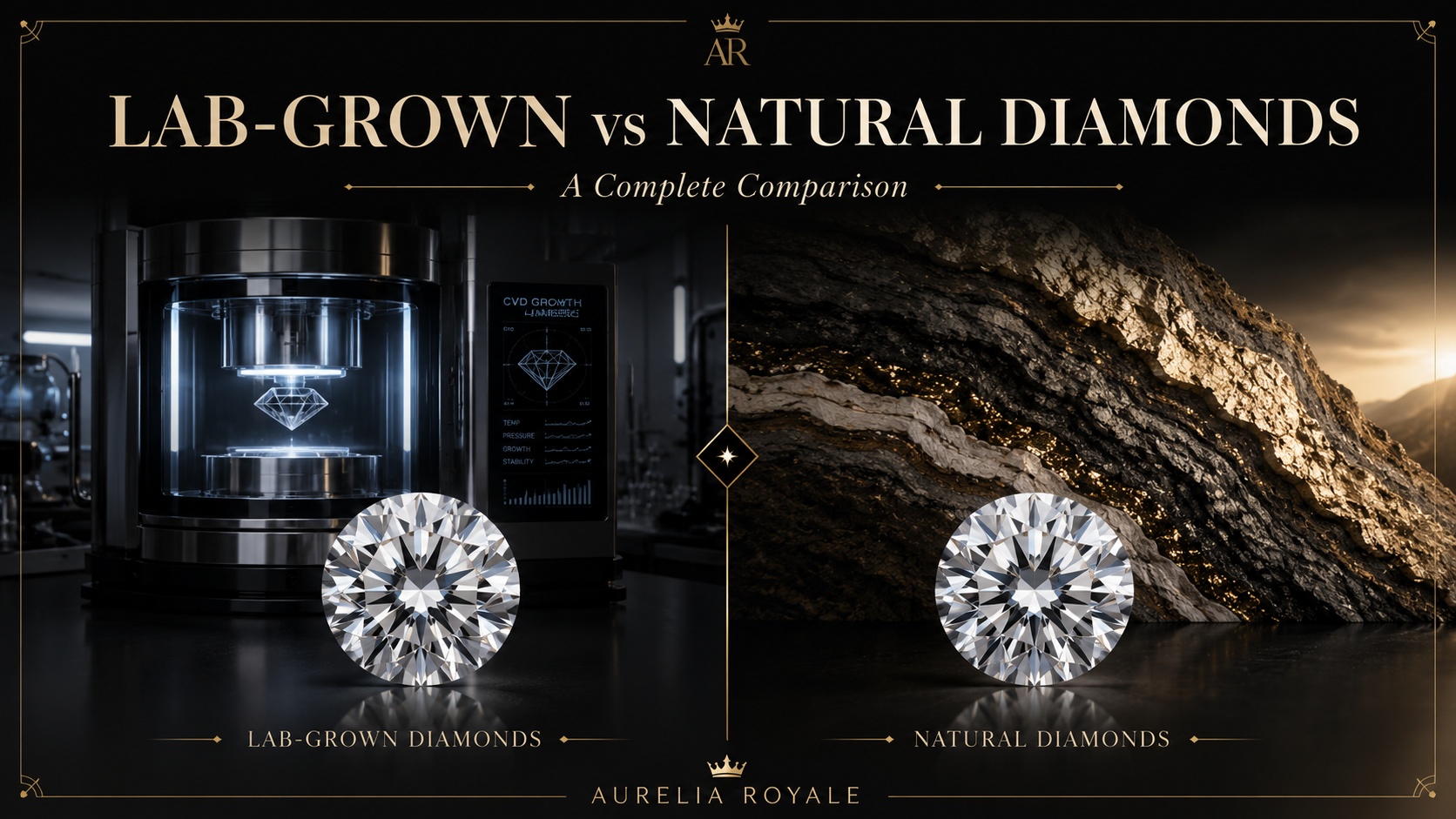
Natural diamonds form over geological timescales within the Earth. Lab-grown diamonds are grown through HPHT or CVD processes — but both are diamond crystal.
How Long Do Natural Diamonds Take to Form?
Natural diamond formation occurs over geological timescales. Many natural diamonds are hundreds of millions to billions of years old. Their age is part of their origin story and a major distinction from laboratory-produced diamonds.
However, avoid simplifying that into: "Every natural diamond took billions of years to grow." A diamond's geological age and the exact duration of its individual crystal-growth events are more complex scientific questions.
For buying purposes, the meaningful distinction is that natural diamonds are ancient geological materials, while commercial lab-grown diamonds are recently manufactured products.
How Long Do Lab-Grown Diamonds Take to Grow?
Laboratory crystal growth takes dramatically less time. Depending on the method, size and production objective, crystal growth can occur over periods ranging from days to weeks. That does not include every subsequent manufacturing stage.
After growth, the rough crystal still needs to be evaluated, cut, polished, tested and potentially submitted for laboratory reporting before being placed into jewellery.
Therefore, comparing "billions of years versus two weeks" as though every stone has exactly those timelines is unnecessarily simplistic. The accurate distinction is: natural diamond formation happens on geological timescales; laboratory-grown crystal production happens on industrial timescales.
Do Lab-Grown and Natural Diamonds Have the Same Chemical Composition?
Both are fundamentally diamond, consisting primarily of carbon atoms arranged in the diamond crystal structure. However, natural and laboratory-grown diamonds can contain different trace elements, crystal defects and growth-related features.
For example, some diamonds contain detectable nitrogen or boron. Growth processes can also create characteristic structures visible through specialised instrumentation.
This is another reason "chemically similar" or "essentially the same fundamental composition" is more precise than claiming every individual lab-grown and natural diamond is atom-for-atom identical.
Are Lab-Grown Diamonds as Hard as Natural Diamonds?
Yes in terms of diamond hardness. Diamond ranks 10 on the Mohs hardness scale, and laboratory-grown diamond has diamond's exceptional scratch resistance. That makes both natural and lab-grown diamonds highly suitable for frequently worn jewellery.
But hardness does not mean indestructibility. Both types can still chip or fracture under sufficient impact. A pointed pear or marquise, for example, may need appropriate setting protection regardless of whether the diamond is natural or laboratory-grown.
For the full durability discussion, see Do Lab-Grown Diamonds Last Forever?
Which Is Stronger: Lab-Grown or Natural Diamond?
There is no useful consumer rule that natural diamond is inherently stronger or lab-grown diamond inherently stronger. Both are diamond. Their individual durability can depend on crystal characteristics, inclusions, shape, cut and where an impact occurs.
A heavily included individual diamond may present different durability considerations from a cleaner stone regardless of origin. Therefore, choose durability based on the actual diamond and jewellery design, not a blanket origin claim.
Do Lab-Grown Diamonds Sparkle Like Natural Diamonds?
Yes. Because laboratory-grown diamond has essentially the same fundamental optical properties as natural diamond, it is capable of the same type of diamond brilliance, fire and scintillation. A well-cut lab-grown round brilliant can be extremely lively. A poorly cut natural diamond can have weak light performance.
Likewise, a beautifully cut natural diamond can outperform a poorly proportioned lab-grown stone. Sparkle is therefore not an automatic origin test. The quality of the cut is far more relevant.
For that subject, use Lab-Grown Diamond Cut Explained.
Does Natural Diamond Sparkle More?
Not simply because it is natural. There is no inherent rule that geological origin creates superior brilliance. Light performance depends strongly on how the polished diamond's facets and proportions interact with light.
A natural and laboratory-grown diamond with similar optical characteristics and cut can look extremely similar. If one appears more lively than another, examine cut, cleanliness, lighting and individual stone characteristics before assuming origin caused the difference.
Can You Tell Lab-Grown and Natural Diamonds Apart by Eye?
Usually not reliably. High-quality colourless-to-near-colourless laboratory-grown diamonds can appear indistinguishable from natural diamonds to the unaided eye. Even ordinary gemological observation may not always establish origin confidently.
That means visual tricks such as: looking for rainbow flashes; checking whether the diamond "looks too perfect"; or judging its edges are not reliable methods for determining laboratory versus natural origin. Specialist testing is the correct method.
Can a Jeweller Tell the Difference?
A jeweller may have screening equipment or access to gemmological laboratory services. But ordinary experience and a jeweller's loupe alone do not guarantee reliable origin identification.
Professional laboratories use advanced instrumentation because natural and laboratory-grown diamonds share so many fundamental properties. If origin needs to be conclusively established, specialist gemmological testing is much stronger than an unaided opinion.
For the dedicated identification guide, read Can You Tell a Lab-Grown Diamond from a Natural Diamond?
Can a Basic Diamond Tester Tell Lab-Grown From Natural?
Not reliably. Traditional diamond testers are primarily designed to distinguish diamond from certain simulants. A lab-grown diamond is diamond, so simply confirming diamond-like thermal behaviour does not establish whether the stone is mined or laboratory-grown.
Modern screening instruments can do much more, but screening and definitive identification should still be distinguished. A "refer" result from screening equipment does not automatically mean the stone has been proven laboratory-grown. It means further analysis may be required.
How Can Laboratories Tell Them Apart?
Natural, HPHT-grown and CVD-grown diamonds form under different conditions. Those conditions can create differences in: crystal-growth structures; inclusion types; trace elements; fluorescence and phosphorescence; and atomic-level optical centres.
Specialist laboratories analyse these characteristics using techniques including spectroscopy and advanced imaging. This makes the difference scientifically detectable even when the diamonds look extremely similar to a consumer.
Do Lab-Grown Diamonds Have Inclusions?
Yes. Controlled manufacturing does not mean every lab-grown diamond is flawless. CVD and HPHT diamonds can contain growth-related characteristics. Natural diamonds also contain inclusions and blemishes formed through their geological history and subsequent manufacturing.
Both categories therefore occur across different clarity levels. The nature of their inclusions can sometimes help gemmologists identify growth origin, but buyers should not assume: natural = included and: lab-grown = flawless.
For clarity in detail, see Lab-Grown Diamond Clarity Grades Explained.
Do They Have the Same Colour Grades?
Colour can vary in both natural and laboratory-grown diamonds. Historically, familiar D–Z terminology has been used extensively across diamond grading. However, laboratory-specific reporting systems need to be checked carefully.
IGI currently provides detailed colour and clarity information on applicable lab-grown diamond reports. GIA changed its principal colourless-to-near-colourless lab-grown service in October 2025 and now classifies eligible stones using Premium or Standard Quality Assessments rather than simply issuing its traditional natural-diamond nomenclature.
That reporting distinction does not mean the underlying concept of diamond colour suddenly stopped existing. It means the reporting systems differ.
For current colour terminology, use Lab-Grown Diamond Colour Grades Explained.
Are Lab-Grown and Natural Diamonds Graded the Same Way?
Not necessarily anymore. This is an area where older articles can become misleading. Natural diamonds continue to use established grading systems covering characteristics such as colour, clarity, cut where applicable and carat weight. IGI also continues to provide detailed 4Cs-style reporting for lab-grown diamonds.
But GIA changed its standard eligible colourless-to-near-colourless lab-grown service on 1 October 2025. GIA now gives those stones an overall Premium or Standard Quality Assessment based on specified colour, clarity, polish, symmetry and round-brilliant cut criteria.
Therefore, do not state: "Every natural and lab-grown diamond receives exactly the same GIA grading report." That is no longer correct.
Does a Lab-Grown Diamond Need a Certificate?
Not every tiny diamond in every jewellery item needs its own individual laboratory report. For significant loose stones or centre diamonds, independent documentation can be very useful. A pavé ring, tennis bracelet or necklace containing many small diamonds can require a different documentation approach.
For that complete decision, use Do Lab-Grown Diamonds Need Certification?
Do Natural Diamonds Need Reports?
The same practical reasoning applies. For a significant natural diamond, an independent grading report can provide useful information about identity and quality. For very small accent diamonds, individual grading reports for every stone may be impractical.
The absence of an individual report is therefore not automatically proof that a gemstone is fake. The documentation expectation should reflect the stone and purchase.
Lab-Grown vs Natural Diamond Price: Which Costs More?
Natural diamonds generally cost substantially more than otherwise comparable lab-grown diamonds. The reason should not be reduced to: "Lab-grown diamonds are cheaper because they are lower quality." That is not the correct explanation.
The two categories have very different supply economics. Natural diamond supply depends on geological deposits, mining, recovery, sorting and the wider natural-diamond market. Laboratory-grown diamond supply depends on manufacturing capacity, technology, energy, production yields and increasingly scalable industrial processes.
As lab-grown production technology has developed, supply has expanded and prices have fallen substantially. That does not alter the material identity of the diamond. It alters its market economics.
How Much Cheaper Are Lab-Grown Diamonds?
There is no fixed percentage that should be published as an evergreen rule. The gap varies by: carat weight; colour; clarity; shape; cut; laboratory documentation; retailer; country; taxes; and current market conditions. A percentage published today can become inaccurate later.
The responsible evergreen conclusion is: otherwise comparable lab-grown diamonds generally sell at significantly lower prices than natural diamonds.
For the dedicated price explanation, read Are Lab-Grown Diamonds Cheaper Than Natural Diamonds?
Does a Lower Price Mean Lower Quality?
No. Price category and quality are different concepts. A laboratory-grown diamond can have excellent colour, clarity and cut characteristics. A natural diamond can have lower-quality characteristics. Likewise, a poorly cut lab-grown stone should not be called high quality simply because it has a desirable origin for the buyer.
When comparing quality, compare the actual: cut; colour; clarity; carat; measurements; and relevant laboratory information. Do not use retail price as a substitute for those specifications.
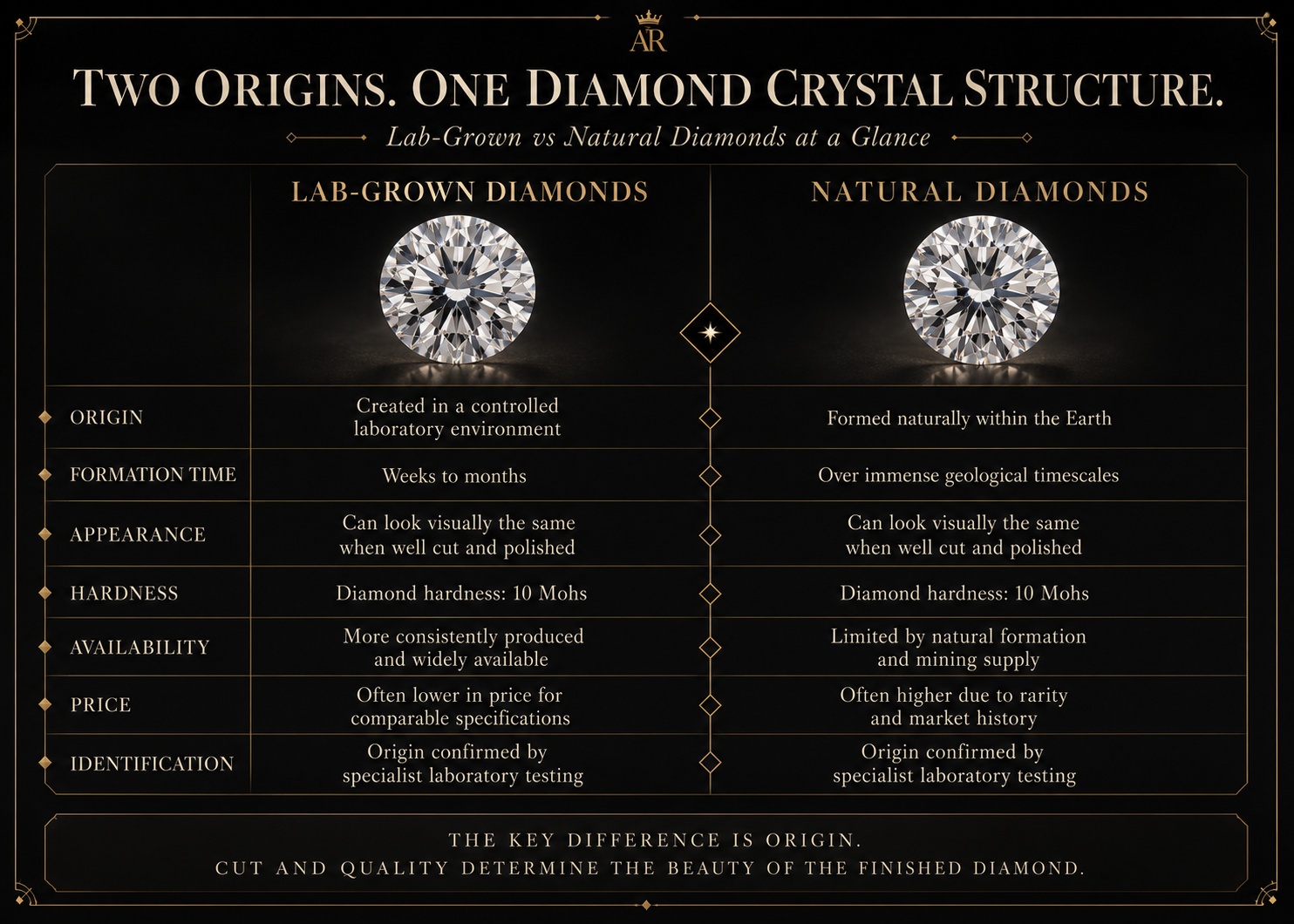
Natural diamonds command higher prices because of geological scarcity and supply constraints — not because lab-grown diamonds are lower quality.
Why Are Natural Diamonds More Expensive?
Natural diamonds exist within a different scarcity and supply structure. Gem-quality natural diamond crystals must first occur geologically in commercially recoverable deposits. Mining operations then have to recover and process large amounts of material before suitable diamonds are sorted, traded, cut and distributed. Each polished natural diamond is therefore tied to a finite geological resource.
Laboratory-grown diamonds are manufactured. Production capacity can increase as more equipment and facilities are added and technologies improve. That difference in supply elasticity plays a major role in their different market pricing.
Does Natural Rarity Automatically Mean Better?
No. Rarity is a characteristic, not a universal definition of beauty. Some buyers place substantial personal value on owning a naturally formed geological object. For them, natural origin is part of the reason for buying the diamond. Other buyers care more about obtaining the visual and physical properties of diamond while spending less on the stone. For them, lab-grown origin may be more appropriate.
The comparison only becomes misleading when one set of preferences is presented as objectively correct for everyone.
Is a Lab-Grown Diamond Better Value?
It can provide more diamond carat weight or higher paper specifications for the same purchasing budget than a comparable natural diamond. That can create strong purchase value for buyers focused on the jewellery itself.
But value has several meanings. Purchase value is not the same as resale value. Emotional value is not the same as financial scarcity. A natural diamond may provide greater value to someone who specifically wants geological origin. A lab-grown diamond may provide greater value to someone prioritising visible size or specifications for the purchase budget.
For the full value decision, read Are Lab-Grown Diamonds Worth Buying?
Lab-Grown vs Natural Diamond Resale Value
This is one of the biggest decision differences, but it should not be oversimplified. Natural diamonds operate within a more established secondary market. That does not mean a natural diamond automatically retains its retail purchase price or should be purchased as a guaranteed investment. Consumers often sell natural diamonds for substantially less than their original retail cost.
Lab-grown diamonds can also be resold, but their secondary market is newer, more variable and affected by changing replacement prices for newly manufactured stones. Some buyers may not purchase second-hand lab-grown stones at all. Others may make offers.
The correct conclusion is therefore not: "Lab-grown diamonds have zero resale value." Nor is it: "Natural diamonds always hold their value."
For the complete analysis, use Do Lab-Grown Diamonds Have Resale Value?
Are Natural Diamonds a Good Investment?
Ordinary retail natural diamonds should not be universally presented as investment assets. Certain exceptional natural diamonds can operate in specialist collector and auction markets. That does not mean every engagement-ring diamond will appreciate.
Retail markup, market demand, diamond characteristics and selling channel all affect future outcomes. If financial return is the primary objective, jewellery should not be presented as though appreciation were guaranteed.
Are Lab-Grown Diamonds an Investment?
They should not be marketed as guaranteed appreciating investments either. Their production economics and declining replacement prices can create significant resale challenges.
Many buyers therefore choose lab-grown diamonds primarily for wearing value, design, carat size or lower initial purchase cost, rather than scarcity-based investment value. That is a legitimate purchasing reason. It simply needs to be distinguished from financial investment.
Which Has Better Long-Term Value?
If "value" means established scarcity and secondary-market structure, natural diamonds generally have the advantage. If "value" means the amount of diamond appearance or specification obtainable for the initial purchase price, lab-grown diamonds can have the advantage.
Those are different definitions of value. A balanced comparison needs to state which one is being discussed.
Are Lab-Grown Diamonds More Ethical?
Not automatically. This claim needs particular care. A laboratory-grown diamond does not involve diamond mining. That eliminates mining as one stage of its supply chain. But laboratory production still requires: energy; industrial equipment; raw materials; facilities; workers; cutting and polishing; transport; and a wider supply chain.
Working conditions, electricity sources and traceability can vary between producers. Therefore, laboratory-grown origin alone does not prove that every ethical criterion has been satisfied. A seller making specific ethical claims should be able to substantiate them.
Are Natural Diamonds Unethical?
That would also be too broad. Natural-diamond supply chains differ substantially by country, mining operation, company and trading system. The Kimberley Process regulates the international trade in rough diamonds with the specific objective of preventing rough diamonds that finance certain armed rebel conflicts from entering legitimate trade.
However, that is a defined conflict-diamond mechanism, not a universal certification covering every possible labour, environmental, human-rights or community-impact question. Therefore, a responsible retailer should not turn "Kimberley Process" into a blanket claim that every ethical concern has automatically been resolved.
What Is the Kimberley Process?
The Kimberley Process Certification Scheme regulates international trade in rough diamonds between participating jurisdictions. Its specific conflict-diamond definition concerns rough diamonds used by rebel movements or their allies to finance armed conflict against legitimate governments. It is an important part of the natural-diamond supply framework.
But buyers should understand its scope. It does not individually certify every jeweller. And it is not intended as a complete environmental or social-impact score for every polished diamond. Where broader sourcing claims are made, separate due diligence may be necessary.
Are Lab-Grown Diamonds More Sustainable?
Do not assume so without evidence. Lab-grown production avoids mining the diamond itself, but it uses energy-intensive industrial processes. Environmental outcomes can differ substantially depending on: the growth technology; electricity source; energy efficiency; factory location; post-growth treatment; cutting and polishing; and transport.
A diamond grown using low-carbon electricity can have a different footprint from one manufactured primarily using carbon-intensive power. Similarly, natural-diamond mines vary substantially in energy source, extraction method, land impact and environmental management.
The word lab-grown by itself therefore does not provide a complete life-cycle assessment.
Can Natural Diamonds Be More Sustainable Than Lab-Grown Diamonds?
It is possible for specific products and supply chains to perform differently on particular environmental metrics. That is why comparing categories using absolute claims such as: "lab-grown is always sustainable" or: "natural is always more sustainable" is weak methodology.
A meaningful comparison requires defined boundaries and evidence. Are we measuring greenhouse-gas emissions? Land disturbance? Water consumption? Energy mix? Biodiversity? Waste? Community impacts? Those questions need product- or supply-chain-specific data.
For Aurelia, do not publish universal green superiority claims unless the evidence genuinely supports them.
Why Environmental Claims Need Evidence
Terms such as: "eco-friendly"; "sustainable"; "green"; "zero-impact"; and "carbon neutral" can communicate strong environmental promises. Those claims need appropriate substantiation.
Aurelia should therefore describe verified facts rather than converting "lab-grown" itself into an environmental certification. For example: "Laboratory-grown diamond" is an origin description. "Carbon-neutral laboratory-grown diamond" is a separate environmental claim requiring evidence. Keep those categories distinct.
Which Diamond Has Better Traceability?
Neither origin category guarantees perfect traceability by itself. For a natural diamond, traceability can involve mine origin, rough-diamond documentation, manufacturer records and supply-chain systems. For a lab-grown diamond, traceability can involve the growth facility, producer, growth method, cutting facility, laboratory report and retailer records.
A highly documented lab-grown diamond could have strong traceability. A highly documented natural diamond could also have strong traceability. The relevant question is: What evidence accompanies this particular diamond?
Does a Laboratory Report Prove Ethical Sourcing?
No. A grading report primarily describes gemmological characteristics and origin according to the laboratory service. It does not automatically certify every claim about: energy source; worker conditions; mine practices; factory conditions; carbon emissions; community impact; or transport.
Those claims require their own evidence.
Which Is Better for an Engagement Ring?
Both can be suitable. A lab-grown diamond makes sense when the buyer wants diamond material, high visual specifications and typically lower initial cost, while not requiring natural geological origin.
A natural diamond makes sense when geological rarity, natural provenance and the traditional natural-diamond category matter enough to justify the higher purchase cost.
Both offer diamond hardness and can be used in jewellery intended for daily wear. Both can also be cut poorly or beautifully. Both can have different colour and clarity characteristics. The decision is primarily about origin, economics and personal meaning, not whether one can technically function as an engagement-ring gemstone.
Is a Lab-Grown Engagement Ring Less "Real"?
No. An engagement is a personal and social commitment, not a gemmological category. If the ring contains laboratory-grown diamond, it contains diamond material. The relevant disclosure is simply that the diamond is laboratory-grown rather than mined.
Some couples specifically choose lab-grown. Others specifically prefer natural. Neither preference needs to be disguised.
Why Do Some Buyers Prefer Natural Diamonds?
Common reasons include appreciation for: natural geological origin; rarity; traditional diamond provenance; established natural-diamond market structures; and the idea of owning an ancient material formed within the Earth. For such a buyer, laboratory-grown diamond may reproduce the gemstone material but not the origin story they value. That distinction is legitimate.
Why Do Some Buyers Prefer Lab-Grown Diamonds?
Common reasons include: lower initial stone cost; ability to consider larger carat weights within a given budget; ability to prioritise higher paper specifications without paying natural-diamond pricing; and preference for diamond material without a mined geological origin.
Again, those are purchasing preferences rather than proof of universal superiority.
Lab-Grown vs Natural Diamond for Earrings
For earrings, the optical similarity can make lab-grown diamonds especially attractive to buyers prioritising appearance and size for the purchase budget. Natural diamond earrings may appeal more to buyers who value natural provenance throughout the jewellery collection. Because earrings usually experience less direct impact than rings, both types of diamond can perform very well. The choice remains primarily one of origin and economics.
Lab-Grown vs Natural Diamond for Necklaces
The same principle applies to pendants and necklaces. Both materials provide genuine diamond optical properties. For a substantial pendant centre stone, lab-grown may allow a larger visible diamond for the same spending level. Natural diamond offers the geological-origin proposition. Design and personal preference should decide which advantage matters more.
Lab-Grown vs Natural Diamond for Tennis Bracelets
Tennis jewellery can contain many diamonds and therefore considerable total carat weight. Using laboratory-grown stones can dramatically change the cost structure of producing a high-carat diamond line. Natural-diamond tennis jewellery operates in a different price and rarity category. Neither should be compared solely by headline total carat weight. Stone matching, setting quality, clasp construction, individual stone sizes and documentation also matter.
Lab-Grown vs Natural Diamond for Stud Earrings
A pair of lab-grown diamond studs can offer larger individual stones or higher specifications for a given budget. Natural studs may carry greater appeal for buyers specifically seeking natural diamonds. Where the two principal stones are significant, individual grading documentation may also help assess matching. Remember to check whether the stated carat figure means per stone or total carat weight.
Do Lab-Grown Diamonds Look Bigger?
Not inherently at the same carat weight and proportions. A one-carat lab-grown diamond does not gain extra physical volume simply because it is laboratory-grown. Carat remains a weight measurement.
However, because lab-grown diamonds typically cost less, a buyer may be able to select a higher carat weight for the same budget, which can result in a larger-looking stone. That is an economic effect, not a different law of diamond size.
For the technical size discussion, use Diamond Carat Weight vs Size.
Do Lab-Grown Diamonds Weigh the Same?
Yes. One metric carat equals 0.20 grams regardless of whether the diamond is natural or laboratory-grown. There is no separate lab-grown carat system. A 1.00 ct lab-grown diamond and a 1.00 ct natural diamond both weigh 0.20 grams.
Their dimensions can still differ because cut, shape and proportions distribute the weight differently.
Are Natural Diamonds Better Quality?
Not automatically. "Natural" identifies origin. It is not a quality grade. Natural diamonds can occur across broad ranges of colour, clarity, cut and carat weight. The same is true for laboratory-grown diamonds.
A high-quality lab-grown diamond can therefore have better measurable quality characteristics than a lower-grade natural diamond. Likewise, an exceptional natural diamond can outperform an average lab-grown stone. Compare quality separately from origin.
Are Lab-Grown Diamonds Better Quality?
The same answer applies in reverse. Manufacturing does not automatically mean superior quality. Some laboratory-grown diamonds have exceptional colour, clarity and cut. Others do not. Growth-related characteristics, post-growth treatment and cutting quality can all vary. Choose the individual stone rather than buying the manufacturing category as though it were a quality grade.
Can Lab-Grown Diamonds Become Cloudy While Natural Diamonds Do Not?
No such simple origin rule exists. A properly grown lab-grown diamond does not normally become internally cloudy merely because it gets older. Both lab-grown and natural diamond jewellery can look dull if oils, lotions, soap residue or other surface contamination accumulate. Either can also contain internal clarity characteristics or suffer physical damage.
If a lab-grown diamond appears hazy, diagnose the actual cause rather than attributing it automatically to laboratory origin. For that question, use Can Lab-Grown Diamonds Become Cloudy?
Do Lab-Grown Diamonds Lose Their Sparkle Faster?
No. There is no normal mechanism by which lab-grown diamond sparkle simply expires because the diamond is manufactured. The same diamond material has the ability to retain polished surfaces extremely well. Apparent dullness is much more commonly connected with cleanliness, lighting, cut or physical condition.
For the dedicated guide, read Do Lab-Grown Diamonds Lose Their Sparkle?
Are Natural Diamonds More Durable Over Generations?
The geological age of a natural diamond is not the same as jewellery durability. Natural diamonds have already existed for immense periods before being mined. But once used in jewellery, both natural and laboratory-grown diamonds share diamond's exceptional hardness.
The part of the jewellery most likely to require attention over decades can instead be the setting, prongs, chain, clasp or other metal components. Both diamond origins can therefore be suitable for long-term jewellery.
Can a Lab-Grown Diamond Become an Heirloom?
Yes. "Heirloom" describes how an item is retained and passed between generations. It is not a geological classification. A well-made lab-grown diamond ring can physically be passed to future generations just as other jewellery can.
However, if a family's concept of heirloom value specifically depends on natural geological rarity or long-term market scarcity, they may prefer natural diamond. The emotional meaning belongs to the family.
What Happens to Lab-Grown Diamond Prices Over Time?
Laboratory-grown diamond production continues to evolve technologically. Greater production efficiency and expanding supply have contributed to falling prices over time. That matters to buyers because the future replacement cost of a comparable new stone can affect second-hand demand.
No article should predict an exact future price decline. Technology and markets change. The safe conclusion is that lab-grown diamond pricing behaves differently from natural-diamond pricing because its supply can expand through manufacturing.
Can Natural Diamond Prices Also Fall?
Yes. Natural diamonds are not immune to market cycles. Demand, economic conditions, inventory, fashion, currencies and broader luxury-market conditions can influence prices. Natural scarcity does not create a guarantee that every diamond's price must rise. This is another reason neither category should be sold as a risk-free investment.
Natural vs Lab-Grown: Which Is More Valuable?
That depends on what the word valuable means. If it means current market price for otherwise comparable stones, natural diamonds generally command more. If it means how much visible diamond can be purchased for a budget, lab-grown may provide more. If it means geological rarity, natural diamonds provide something laboratory production cannot reproduce: natural geological origin. If it means emotional value, that is entirely personal.
The strongest article should separate these concepts rather than pretending one number settles them.
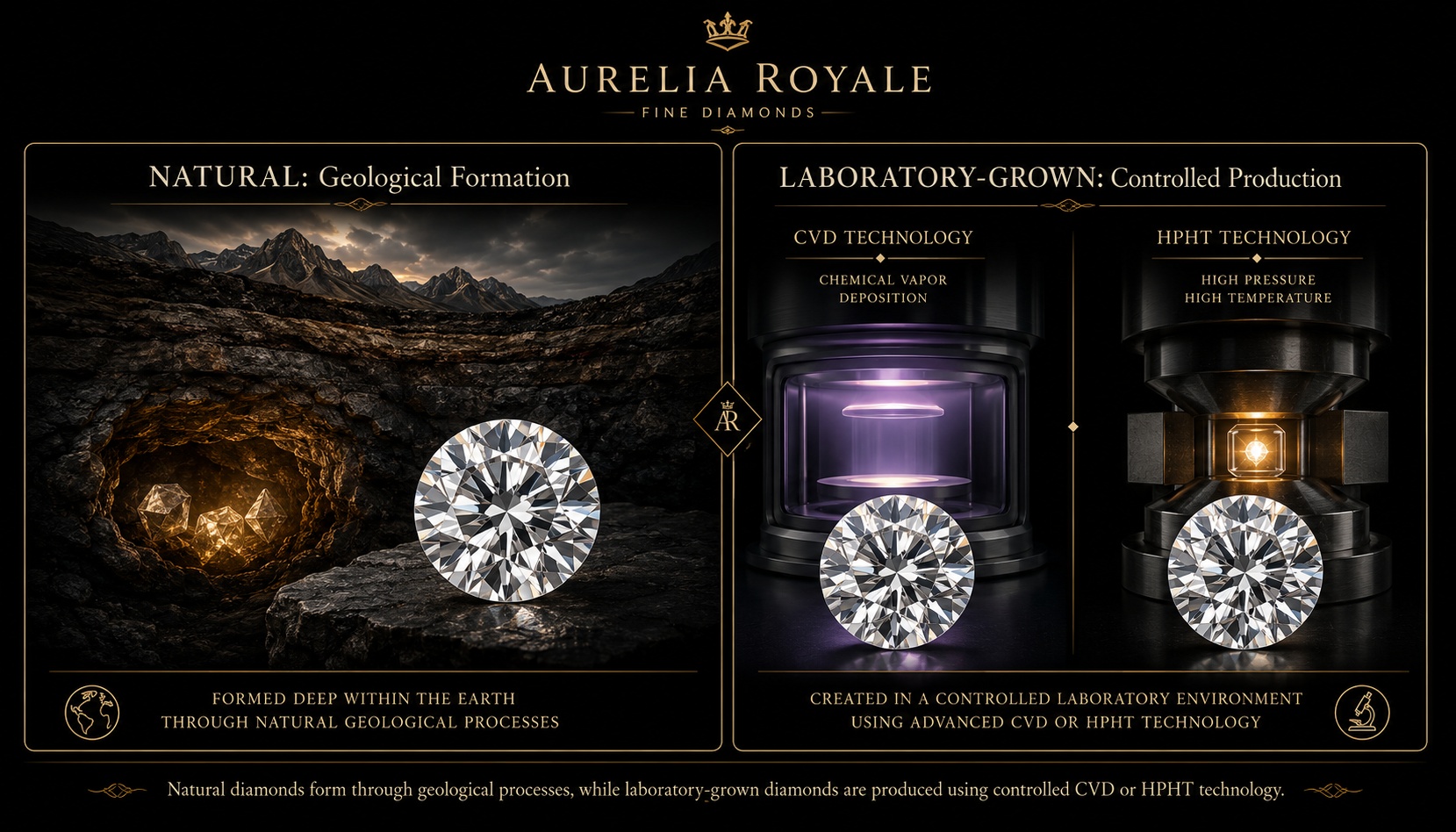
Neither category wins every comparison — the right choice depends on which criteria matter most to you.
Lab-Grown vs Natural: Pros and Cons
Lab-Grown Diamond Advantages: The major advantage is typically purchase economics. Buyers can often consider larger stones or stronger specifications at a lower initial price than comparable natural diamonds. They also receive diamond material rather than a simulant. Laboratory production can potentially offer traceability advantages where the producer provides detailed manufacturing information. However, those claims should be verified rather than assumed.
Lab-Grown Diamond Limitations: Lab-grown diamonds lack natural geological rarity. Their prices have declined substantially as production technology has expanded. Their secondary market is less established and can be inconsistent. And broad claims that every lab-grown stone is automatically sustainable or ethical are not justified without supply-chain evidence.
Natural Diamond Advantages: Natural diamonds provide geological rarity and an origin story that laboratory manufacturing cannot recreate. They operate within a long-established global market and generally have a more mature secondary-market structure. For buyers who value natural provenance, those characteristics can be highly meaningful.
Natural Diamond Limitations: Comparable natural diamonds generally cost substantially more. Mining creates environmental and social considerations that vary by source and producer. And natural-diamond status does not guarantee investment returns, perfect sourcing or superior gem quality.
Which Is Better: Lab-Grown or Natural Diamond?
Neither is objectively better across every buying criterion. The correct answer depends on the criterion.
Choose lab-grown diamond if: you want diamond material, care strongly about initial purchase value, want more flexibility around carat or paper specifications, and do not require natural geological origin.
Choose natural diamond if: geological rarity and natural provenance are central to your idea of diamond ownership and you are comfortable paying the market premium associated with that category.
If resale is a major concern, investigate it before buying rather than relying on sales claims. If environmental or ethical sourcing is a major concern, ask for actual evidence about the specific supply chain rather than choosing solely from the words "natural" or "lab-grown".
How to Compare Two Diamonds Fairly
A fair price or quality comparison needs stones that are genuinely similar. Do not compare: a 2 ct lab-grown VS1 diamond with: a 1 ct natural SI2 diamond and then conclude that the difference is caused only by origin.
Compare as closely as possible on: carat weight; shape; measurements; colour; clarity; cut or relevant finish; laboratory documentation; and jewellery setting. Only then can you see more clearly how origin affects the price.
Do the 4Cs Still Matter for Both?
Yes as quality concepts. Carat, colour, clarity and cut remain useful ways to understand diamond characteristics. But the reporting terminology may differ by laboratory and diamond type, particularly following GIA's 2025 change to lab-grown reporting. Therefore, use the actual document rather than assuming natural and lab-grown reports are formatted identically.
For the complete framework, read What Are the 4Cs of Lab-Grown Diamonds?
What Should You Check Before Buying Either Type?
Begin with origin. Know whether you are considering natural or laboratory-grown diamond. Then check the relevant stone specifications. Understand the laboratory document where one is included. Compare actual measurements rather than relying only on carat. For fancy shapes, inspect visual characteristics that may not be captured by a single grade.
Then examine the finished jewellery. A superb centre diamond in a weak setting does not automatically make a superb ring. Finally, understand price, returns and documentation before committing. The same disciplined buying process benefits both categories.
Should Retailers Clearly Disclose Lab-Grown Origin?
Yes. A consumer should not need to guess whether a diamond is natural or laboratory-grown. In the United States, FTC guidance states that laboratory-created diamonds should be clearly described using an appropriate qualifier such as laboratory-grown or laboratory-created so buyers understand they are not mined diamonds.
UK advertising guidance similarly emphasises clear qualification of laboratory-grown diamond products.
For the full terminology and compliance discussion, use How Should Lab-Grown Diamonds Be Disclosed?
Is "Natural Diamond vs Real Diamond" the Correct Comparison?
No. Using real diamond as the opposite of lab-grown diamond implies that laboratory-grown diamond is fake or a simulant. That is scientifically misleading. The clearer comparison is: natural diamond vs laboratory-grown diamond because both belong to the diamond material category while differing in origin.
Cubic zirconia and moissanite belong in separate simulant comparisons.
What About "Mined Diamond"?
"Mined diamond" is commonly understood and can be useful conversationally. However, natural diamond is generally the cleaner technical counterpart to laboratory-grown diamond. Natural describes how the material originated. Mining describes the process used to recover it.
Both can appear in search-focused educational text, but Aurelia should use natural diamond consistently as the main comparison terminology.
What is the main difference between lab-grown and natural diamonds?▼
Origin. Natural diamonds form through geological processes, while lab-grown diamonds are manufactured using technologies such as HPHT and CVD.
Are lab-grown diamonds real diamonds?▼
Yes. They are diamond material rather than cubic zirconia or moissanite.
Are lab-grown and natural diamonds chemically the same?▼
They share essentially the same fundamental carbon diamond structure and chemical properties, although trace elements, defects and growth-related characteristics can differ.
Are they exactly identical?▼
No. Their different growth histories create scientifically detectable structural and atomic-level differences.
Do lab-grown diamonds look the same as natural diamonds?▼
They can appear indistinguishable to the unaided eye.
Do lab-grown diamonds sparkle like natural diamonds?▼
Yes. Both have diamond optical properties. Individual cut quality has a major influence on sparkle.
Which sparkles more?▼
Neither origin automatically sparkles more. Compare the cut and actual light performance of the individual diamonds.
Can a jeweller tell lab-grown from natural by looking?▼
Not reliably in every case. Specialist testing may be required.
Can a diamond tester tell the difference?▼
Basic diamond testers generally cannot reliably establish natural versus lab-grown origin.
How do laboratories tell them apart?▼
They analyse growth structures, trace elements, inclusions, fluorescence behaviour, spectroscopy and other characteristics.
Are lab-grown diamonds as hard as natural diamonds?▼
Yes. Both have diamond's Mohs hardness of 10.
Are lab-grown diamonds less durable?▼
Not simply because of their origin. Both are diamond and can be suitable for long-term jewellery wear.
Can lab-grown diamonds chip?▼
Yes. Diamond is extremely hard but not indestructible.
Are lab-grown diamonds flawless?▼
No. They can contain inclusions and occur in different quality levels.
Are natural diamonds always higher quality?▼
No. Natural origin is not a quality grade.
Are lab-grown diamonds always higher quality?▼
No. Controlled production does not mean every polished diamond is perfect.
Which is cheaper?▼
Lab-grown diamonds generally cost substantially less than comparable natural diamonds.
Why are lab-grown diamonds cheaper?▼
Their manufacturing supply can expand as production technology and capacity increase, giving them different scarcity and production economics from natural diamonds.
How much cheaper are lab-grown diamonds?▼
There is no reliable evergreen percentage. The gap varies by specifications, market conditions and retailer.
Which has better resale value?▼
Natural diamonds generally operate in a more established secondary market, but neither category has a guaranteed future resale price.
Do lab-grown diamonds have zero resale value?▼
No. They can be resold, although offers and market liquidity can vary substantially.
Are natural diamonds guaranteed to hold their value?▼
No.
Are natural diamonds investments?▼
Ordinary retail diamonds should not be marketed as guaranteed investments.
Are lab-grown diamonds investments?▼
They should not be marketed as guaranteed appreciating investments either.
Are lab-grown diamonds more ethical?▼
Not automatically. Ethical outcomes depend on energy, manufacturing, labour and wider supply-chain practices.
Are natural diamonds unethical?▼
Not automatically. Natural-diamond sourcing conditions vary by producer, mine and supply chain.
What does the Kimberley Process cover?▼
It regulates international trade in rough diamonds with a specific focus on preventing defined conflict diamonds from entering legitimate trade.
Does Kimberley Process participation guarantee every ethical issue is solved?▼
No. Its mandate is narrower than a complete assessment of every labour, environmental or human-rights concern.
Are lab-grown diamonds more environmentally friendly?▼
That cannot be concluded from origin alone. Environmental impact depends on factors such as energy source, manufacturing efficiency, mining method and supply chain.
Which is better for an engagement ring?▼
Both can work extremely well. Choose according to origin preference, budget, specifications, resale expectations and personal meaning.
Can a lab-grown diamond be an heirloom?▼
Yes. Jewellery containing lab-grown diamond can physically be retained and passed between generations.
Is lab-grown diamond the same as moissanite?▼
No. Moissanite is silicon carbide.
Is lab-grown diamond cubic zirconia?▼
No. Cubic zirconia is a different zirconium-oxide material used as a diamond simulant.
Does one carat mean the same for natural and lab-grown diamonds?▼
Yes. One metric carat equals 0.20 grams for both.
Does a lab-grown diamond look bigger at the same carat weight?▼
Not inherently. Visible size depends on shape and proportions rather than origin.
Are natural and lab-grown diamonds graded identically?▼
Not necessarily. Laboratories use different services, and GIA's current lab-grown Quality Assessment differs from its natural-diamond grading nomenclature.
Does GIA grade lab-grown diamonds?▼
Yes. Since October 2025, eligible colourless-to-near-colourless lab-grown diamonds receive GIA Premium or Standard Quality Assessments under its current service.
Does IGI grade lab-grown diamonds?▼
Yes. IGI provides detailed laboratory-grown diamond reports and also offers finished-jewellery reporting.
Final Answer: Lab-Grown or Natural Diamond?
Both are diamonds. The defining difference is where and how they formed. Natural diamonds are ancient geological materials recovered from the Earth. Lab-grown diamonds are recently manufactured through controlled HPHT or CVD processes.
Their fundamental diamond properties are extremely similar, which is why a polished lab-grown diamond can look like a polished natural diamond and why both can deliver diamond hardness, brilliance, fire and scintillation.
But their origins create real differences. Specialist laboratories can identify their growth histories. Natural diamonds carry geological rarity. Lab-grown diamonds can be manufactured in expanding supply. That contributes to substantially different purchase prices and different secondary-market dynamics.
Neither category automatically wins every comparison. If your priorities are lower initial cost, diamond material and the ability to consider more carat weight or higher specifications within your budget, lab-grown diamond may make more sense. If your priorities are natural geological origin, rarity and participation in the established natural-diamond category, natural diamond may make more sense.
If resale is important, investigate that separately. If ethical or environmental impact is important, ask for evidence about the actual product and supply chain rather than assuming either origin is automatically superior.
Most importantly, compare like with like. Look at the actual diamond's specifications, dimensions, cut, documentation and finished jewellery quality. Then make the origin decision according to what matters to you.
Continue With the Aurelia Royale Diamond Guides
For the economics behind the price gap, continue with Are Lab-Grown Diamonds Cheaper Than Natural Diamonds?
For the broader purchase-value decision, read Are Lab-Grown Diamonds Worth Buying?
For resale, use Do Lab-Grown Diamonds Have Resale Value?
For identification, read Can You Tell a Lab-Grown Diamond from a Natural Diamond?
For manufacturing, continue with How Are Lab-Grown Diamonds Made?
For CVD versus HPHT specifically, use CVD vs HPHT Lab-Grown Diamonds.
For laboratory documentation, see Do Lab-Grown Diamonds Need Certification?
And for disclosure terminology, continue with How Should Lab-Grown Diamonds Be Disclosed?
When reviewing an Aurelia Royale piece, use the verified specifications and documentation for that specific design or diamond rather than assuming one grading laboratory, growth method, sourcing claim or report format applies across the entire catalogue.
Where a design is not currently available for direct purchase, Join the Waitlist or submit an enquiry to register your interest.
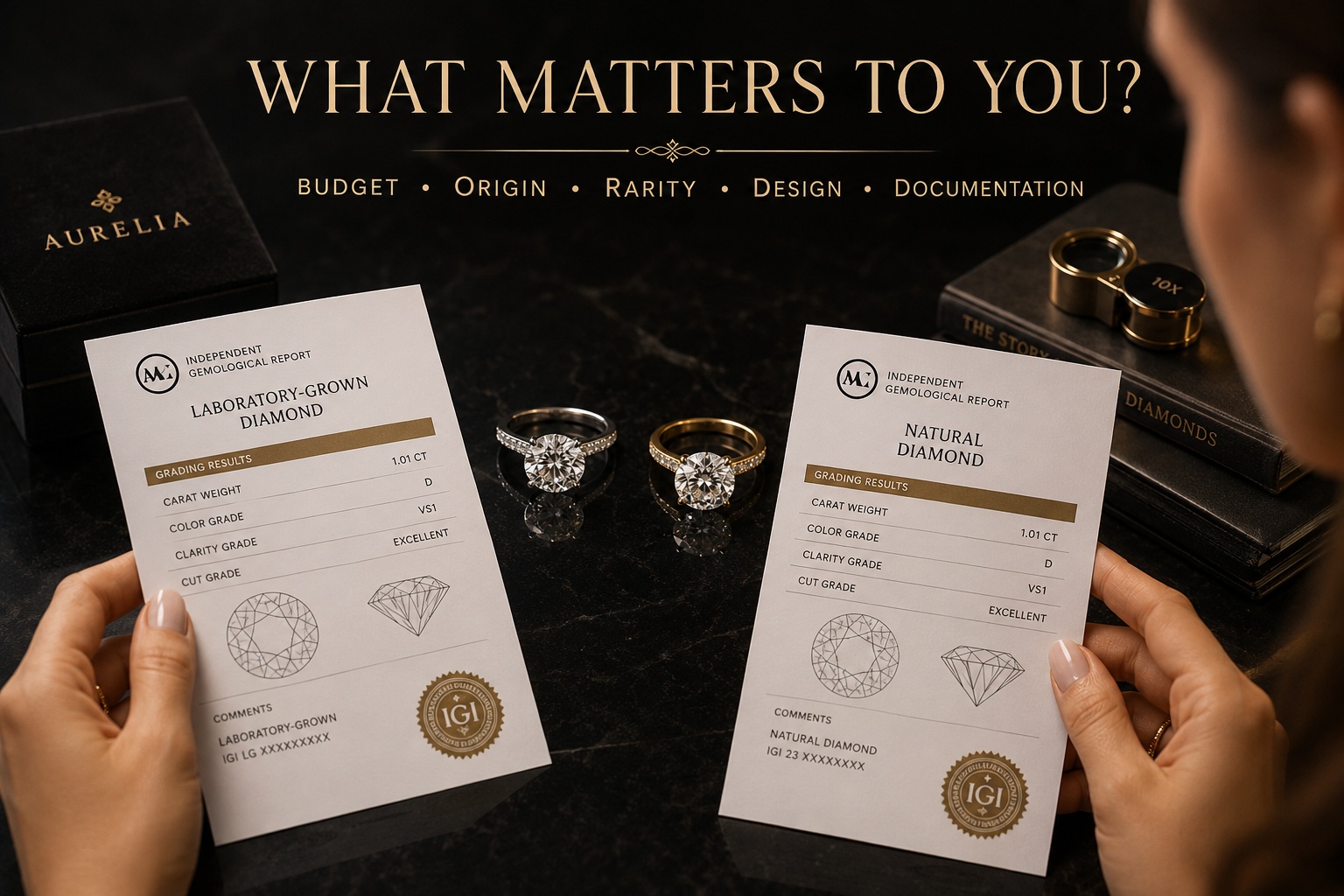
Choose according to what matters to you — lab-grown diamond, natural diamond or a combination across different pieces.
Explore Aurelia Royale Laboratory-Grown Diamond Jewellery
Both lab-grown and natural diamonds are diamond — your choice depends on which origin and economics suit you.

Stay Connected
Get Our Latest Updates
Be first to discover new collections, exclusive events, and the quiet privileges reserved for our inner circle.