How Often Should Diamond Jewellery Be Cleaned?
Rings, Earrings, Necklaces and Bracelets — Frequency by Wear Pattern • Published September 10, 2026
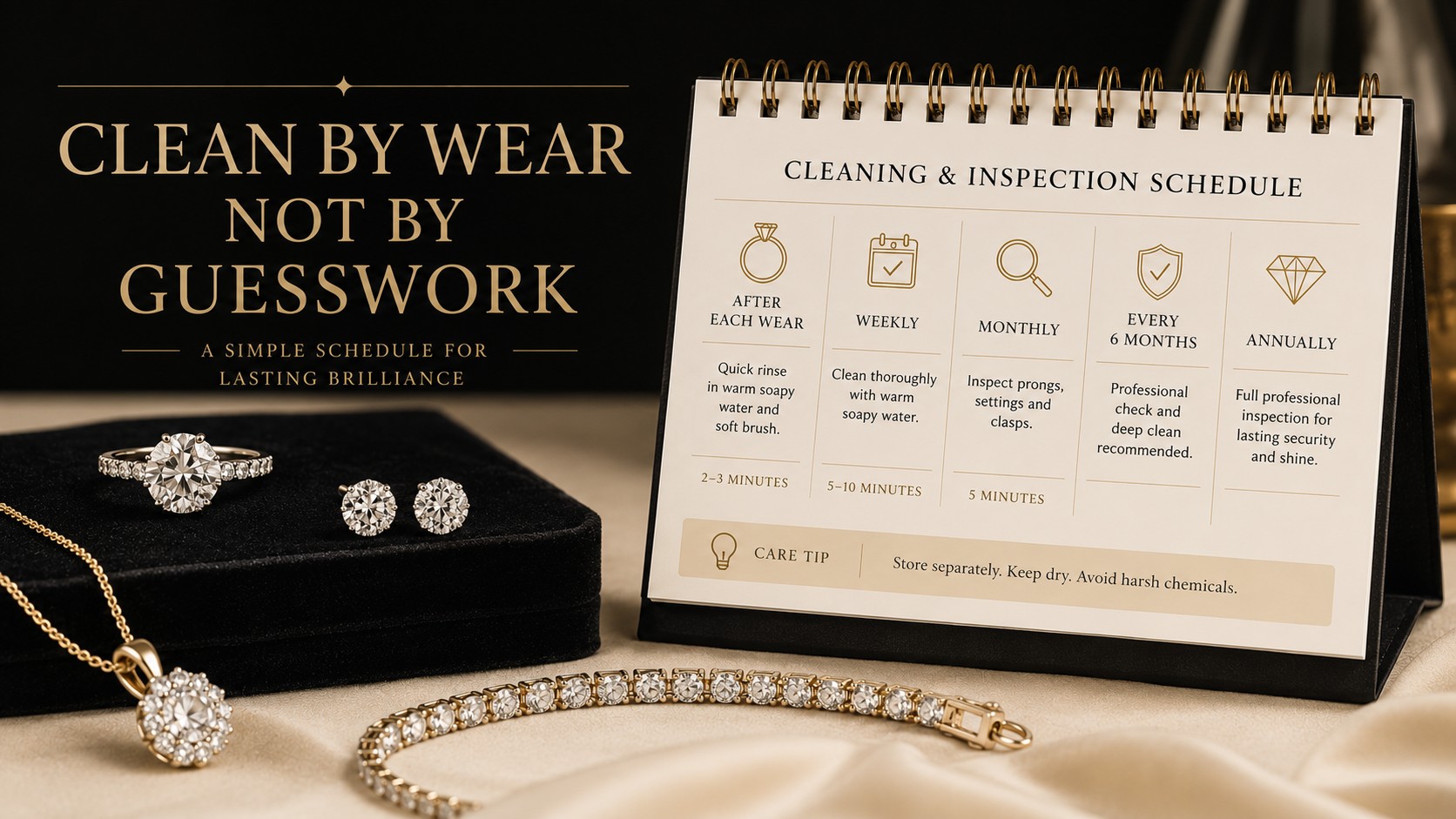
Cleaning frequency should be based on how often you wear the jewellery, what it is exposed to, how quickly visible residue builds up, and whether its construction is suitable for home cleaning.
There is no single cleaning interval that suits every piece of diamond jewellery. A diamond ring worn every day and exposed to hand cream, soap and skin oils can accumulate residue much faster than a pendant worn twice a month. Stud earrings can collect oils and cosmetic residue behind the setting. A tennis bracelet may pick up skincare products across dozens of individual diamond settings. Jewellery stored clean and worn only occasionally may need very little routine washing.
For that reason, cleaning frequency should be based on: how often you wear the jewellery, what it is exposed to, how quickly visible residue builds up, and whether its construction is suitable for home cleaning. For frequently worn diamond jewellery, a reasonable starting point is gentle home cleaning approximately weekly to every few weeks, adjusted according to actual build-up. For jewellery worn only occasionally, cleaning when it begins to look dull, after significant exposure, or before longer-term storage may be sufficient. Professional cleaning and structural inspection are separate decisions and should not be confused with ordinary home cleaning.
Quick Answer: How Often Should You Clean Diamond Jewellery?
If you wear a diamond ring every day, inspect its appearance regularly and clean it gently when skin oils, soap or lotion begin to affect its sparkle. For some people that may mean around once a week; for others, every few weeks is enough. Frequently worn earrings, bracelets and necklaces can usually be assessed on a similar every-few-weeks starting rhythm, but the actual need depends on how much skin contact, cosmetics and environmental residue they encounter.
Occasionally worn jewellery may go several months without needing a full home cleaning if it was stored clean and dry. You do not need to clean jewellery simply because a calendar date has arrived. More importantly, cleaning is not a replacement for structural inspection. If a diamond appears loose, a claw is bent, a clasp is damaged or the jewellery has experienced a significant impact, stop wearing it and seek inspection rather than simply cleaning it.
Practical Diamond Jewellery Cleaning Frequency Table
| Jewellery / Wear Pattern | Home Cleaning Starting Point | Clean Sooner When… |
|---|---|---|
| Everyday diamond ring | About weekly to every few weeks | Lotion, soap or visible film builds up |
| Frequently worn stud earrings | Every few weeks | Residue collects behind stone/post/backing |
| Frequently worn pendant necklace | Every few weeks | Cosmetics or skin oils reduce sparkle |
| Frequently worn tennis bracelet | Every few weeks | Residue builds around multiple settings |
| Frequently worn diamond band/pavé | Weekly to every few weeks, gently | Dirt accumulates between small settings |
| Occasionally worn fine jewellery | When visibly needed; often much less frequently | Piece looks dull or was exposed to cosmetics |
| Jewellery stored for long periods | Clean before storage if dirty; check again before wear | Residue was left on piece before storage |
| After heavy cosmetic/product exposure | Clean sooner if the materials permit | Film is visible |
| After significant impact | Do not treat cleaning as the first step | Setting may be damaged—inspect instead |
The interval should become longer or shorter according to the actual piece, not according to one universal rule.
Why Some Diamond Jewellery Needs Cleaning More Often
Diamonds readily attract grease. That makes a diamond especially good at collecting oils from fingers, skincare and everyday wear. A surface film can interfere with how cleanly light interacts with the stone, making it appear less brilliant even when nothing has changed about the diamond itself. A ring worn daily can therefore need cleaning much more often than a necklace that barely touches cosmetics or skin products.
The correct maintenance question is not: "Has it been exactly seven days?" It is: "Is residue building up enough to affect the jewellery?" GIA has published a simple diamond-care routine using a gentle degreasing solution as often as once or twice a week, while more recent commercial jewellery-care guidance commonly suggests every few weeks for everyday pieces. Someone who uses hand cream frequently may need more regular gentle cleaning. Someone who removes the ring before lotions and household tasks may need less.
Weekly Cleaning Is Not a Requirement
If a diamond ring still looks clean and has had little exposure to oils or products, there is no benefit in cleaning it aggressively simply because one week has passed. Over-cleaning with a mild method is not necessarily catastrophic, but unnecessary handling can create its own risks, particularly with intricate or delicate settings. The aim is appropriate maintenance, not the maximum possible cleaning frequency.
Cleaning Frequency by Jewellery Type
Stud earrings can appear clean from the front while residue builds behind the setting, the post and earring back. For earrings worn frequently, inspect the back of the diamond and the fastening every few weeks. If residue is visible sooner, clean sooner. A necklace often experiences less direct impact and hand contact than a ring — that can make its cleaning needs lower. However, necklaces can still collect body oils, perfume, moisturiser, make-up, hair products, and environmental residue. A frequently worn pendant necklace may benefit from cleaning every few weeks, especially around the back of the pendant.
Tennis bracelets contain many individual diamonds and metal settings. Frequently worn tennis bracelets should be checked regularly for cleanliness, but they should also be checked for setting condition before cleaning. Pavé jewellery can accumulate dirt between many small stones — if a pavé ring is worn every day, a light cleaning weekly or every few weeks may be reasonable. Occasionally worn jewellery does not need an everyday schedule — pieces worn only for dinners or events may need cleaning only every several months depending on exposure.
| Jewellery Type | Why Frequency May Differ |
|---|---|
| Ring | High hand/product exposure |
| Stud earrings | Skin contact + residue behind setting/back |
| Drop earrings | Usually less skin contact with diamond section |
| Pendant necklace | Cosmetics/skin contact vary by length |
| Line necklace | Many settings but often lower hand contact |
| Tennis bracelet | Frequent skin contact + many settings |
| Occasional statement jewellery | Lower total exposure |
Clean Before Long-Term Storage When Necessary
If jewellery is visibly dirty after wear, clean it appropriately before putting it away for a long period. Do not intentionally store a heavily coated ring or necklace for months. After cleaning, make sure the jewellery is thoroughly dry before storage.
For the full storage process, use How to Store Diamond Jewellery Properly
Cleaning Frequency and Cosmetics
Products that contact the jewellery can shorten the interval between cleanings: hand cream, moisturiser, sunscreen, foundation, hairspray, and perfume. These products do not automatically mean the jewellery must be cleaned after every single use. But regular exposure can create faster surface build-up. Where practical, apply skincare and cosmetics first and allow them to settle before putting jewellery on. Some people naturally see oily residue accumulate more quickly on jewellery than others — this is another reason a universal calendar cannot work.
Cleaning Frequency and Lab-Grown Diamonds
Lab-grown diamonds do not need a separate cleaning frequency simply because of their origin. The relevant factors remain: wear, surface contamination, setting construction, metal, and any additional materials. A frequently worn lab-grown diamond ring can become dirty at the same sort of rate as a similarly constructed natural-diamond ring. The cleaning schedule is therefore a jewellery-care issue rather than a diamond-origin issue.
Cleaning and Inspection Are Different
This is the most important distinction on this page. Cleaning removes: oil, dust, soap film, cosmetic residue, and other surface contamination. Inspection looks for: loose stones, bent prongs, worn metal, damaged clasps, cracked settings, and other mechanical problems. A perfectly clean ring can still have a loose diamond. A dirty ring can still be structurally sound. These are separate maintenance tasks.
| Maintenance | Purpose | Can It Replace the Other? |
|---|---|---|
| Home cleaning | Remove ordinary residue | No |
| Professional cleaning | Deeper cleaning using appropriate equipment | No |
| Home visual check | Notice obvious warning signs | No |
| Professional inspection | Assess settings, prongs and construction | No |
| Repair | Correct an identified mechanical problem | No |
Do not use "professionally cleaned" and "professionally inspected" as interchangeable phrases.

Professional inspection deserves its own schedule — roughly every 6–12 months for frequently worn stone-set jewellery, with earlier assessment after impacts or warning signs.
How Often Should Diamond Jewellery Be Professionally Cleaned?
There is no one mandatory professional-cleaning schedule for every piece. Several major jewellers use intervals ranging from every few months to roughly once or twice a year for frequently worn jewellery. A practical starting point for a heavily used diamond ring is therefore professional cleaning around every six to twelve months, adjusted according to the piece and the jeweller's guidance. Occasionally worn jewellery may need less frequent professional cleaning.
More importantly, professional attention should happen sooner whenever: the jewellery has suffered impact, a setting appears damaged, a stone may be loose, or home cleaning no longer removes stubborn build-up. Professional Cleaning Is Not Automatically Necessary Every Six Months — six months is a convenient maintenance rhythm, not a universal physical law. A lightly worn pendant may not require professional cleaning twice a year. Use the jewellery's wear pattern and condition.
How Often Should Diamond Settings Be Professionally Inspected?
GIA notes that jewellers commonly recommend having the prongs on an engagement ring checked at least once or twice a year. Tiffany recommends regularly worn pieces be cleaned and checked every few months and at minimum encourages periodic professional maintenance. These recommendations support a useful general framework: frequently worn, stone-set jewellery: consider professional inspection roughly every 6–12 months with: immediate inspection after a significant impact or whenever a warning sign appears.
Do Not Wait for a Scheduled Inspection After an Impact
Imagine your inspection is scheduled for six months from now. Then your ring receives a hard knock today. The calendar is irrelevant. Inspect the jewellery visually and arrange professional assessment if anything appears changed.
If you suspect a loose diamond, use How to Check Diamond Jewellery for Loose Stones and stop wearing the piece until it has been assessed. Cleaning a loose stone more often does not make it safer — a mechanically compromised setting cannot be maintained through cleanliness.
A Useful Maintenance Schedule for Frequently Worn Jewellery
| Time/Trigger | Useful Action |
|---|---|
| After ordinary wear | Look for obvious residue or damage |
| When surface film becomes visible | Gentle home cleaning if appropriate |
| Weekly to every few weeks for heavily worn pieces | Reasonable cleaning check-point |
| Every few months | More deliberate visual condition review |
| Around every 6–12 months for frequently worn stone-set jewellery | Consider professional inspection/cleaning |
| Immediately after significant impact | Check setting; seek inspection if uncertain |
| Whenever a stone appears loose | Stop wearing; professional assessment |
The trigger is as important as the interval.
What About Daily Wipe-Downs?
A gentle wipe of accessible surfaces with an appropriate soft cloth is different from a full cleaning session. If a wearer prefers to remove surface oils after wear, that can reduce build-up. Do not pull the cloth through prongs or delicate pavé. A wipe-down should remain light maintenance rather than aggressive polishing. You Do Not Need to Polish Metal Every Time You Clean the Diamond — cleaning and polishing are separate processes. Frequent polishing can remove minute amounts of metal. Do not use cleaning frequency as a schedule for repeated abrasive metal polishing.
Signs You Are Cleaning Too Aggressively or Too Infrequently
Problems arise when frequency is combined with: hard scrubbing, abrasive toothpaste, strong chemicals, household bleach, repeated metal polishing, or unsuitable ultrasonic cleaning. If maintaining sparkle requires increasingly aggressive techniques, seek professional advice instead of escalating the home method.
Your current interval may be too long if you repeatedly notice: a greasy film, reduced surface brilliance that improves after cleaning, visible cosmetics beneath the setting, soap residue, or heavy build-up around earring posts and backs. If the piece remains visibly clean, is worn only occasionally and has had little exposure to cosmetics, a frequent cleaning schedule may be unnecessary. Cleaning should solve a care need, not become a ritual with no connection to the jewellery's actual condition.
Aurelia Cleaning Reminders and Replacement Parts
If the existing article says Aurelia sends cleaning reminders, annual care reminders, service reminders, or automatic maintenance notifications, remove that wording unless the client confirms such a system currently exists. A safe alternative is: "Consider adding your own periodic care reminder for frequently worn jewellery if that helps you remember to inspect it." Do not attribute that service to Aurelia unless it actually exists. Likewise, this page should not state that Aurelia automatically replaces earring backs, clasps, prongs, links, stones, or other jewellery components under complimentary or lifetime coverage unless the client has confirmed the exact programme. Cleaning frequency and parts replacement are separate issues.
Frequently Asked Questions
How often should you clean a diamond ring?▼
For a ring worn daily, gentle cleaning around weekly to every few weeks is a reasonable starting range, adjusted according to visible build-up and exposure.
Should I clean my diamond jewellery every week?▼
Not necessarily. Weekly cleaning can suit heavily worn jewellery, but pieces that remain clean or are worn infrequently may need less frequent care.
How often should diamond earrings be cleaned?▼
Frequently worn studs can be checked and cleaned every few weeks or sooner when residue collects around the setting, post or backing.
How often should a diamond necklace be cleaned?▼
A frequently worn necklace may need cleaning every few weeks, while an occasional piece may need cleaning only when residue becomes visible.
How often should a tennis bracelet be cleaned?▼
Frequently worn tennis bracelets can be checked every few weeks and cleaned as needed, provided all settings first appear secure.
How often should diamond jewellery be professionally cleaned?▼
For frequently worn jewellery, roughly every six to twelve months is a useful starting range, but the actual need depends on wear, construction and the jeweller's guidance.
Is professional cleaning the same as professional inspection?▼
No. Cleaning removes residue; inspection evaluates prongs, settings, clasps and other structural components.
How often should diamond settings be inspected?▼
For frequently worn stone-set jewellery, professional inspection roughly once or twice a year is a useful general starting point, with earlier inspection after impact or whenever damage is suspected.
Should I clean jewellery after using hand cream or perfume?▼
Not after every exposure automatically. If residue builds up visibly, clean sooner and consider putting jewellery on after skincare or cosmetics where practical.
Can cleaning too often damage diamond jewellery?▼
The diamond itself is very durable, but aggressive brushing, abrasive cleaners, chemicals and repeated polishing can damage settings and metal. Method matters as much as frequency.
Does lab-grown diamond jewellery need cleaning more often?▼
No. Cleaning frequency depends primarily on wear, build-up, setting and materials rather than whether the diamond is laboratory-grown or natural.
Does Aurelia send cleaning reminders or cover replacement parts?▼
Do not assume so. Those services should only be claimed when Aurelia has explicitly confirmed the programme and its conditions.
Final Answer: How Often Should Diamond Jewellery Be Cleaned?
Use the jewellery's condition and wear pattern, not one rigid calendar. For jewellery worn very frequently, weekly to every few weeks is a reasonable starting range for gentle home cleaning when visible residue develops. For pieces worn less often, clean them when they begin to look dull, after significant product exposure or before storage when necessary.
Then separate cleaning from inspection. Cleaning deals with surface contamination. Inspection checks whether the jewellery remains mechanically secure. For frequently worn stone-set jewellery, professional inspection around every six to twelve months is a useful general starting point, while any significant impact, loose-stone warning sign or visible damage should trigger earlier assessment. Do not wait for the next scheduled cleaning if the jewellery is mechanically compromised.
For the actual home-cleaning method, continue with How to Clean Lab-Grown Diamond Jewellery at Home
For loose-stone warning signs, use How to Check Diamond Jewellery for Loose Stones
For storage between wears, use How to Store Diamond Jewellery Properly
Explore Aurelia Royale Lab-Grown Diamond Jewellery
Clean when needed, inspect regularly, store properly — keep your jewellery in its best condition.

Stay Connected
Get Our Latest Updates
Be first to discover new collections, exclusive events, and the quiet privileges reserved for our inner circle.