
How to Evaluate Jewellery Product Images Before Buying
Photography, Scale, Lighting and What Images Cannot Prove • Published September 10, 2026
Product images are one of the most useful tools available when you cannot inspect jewellery in person, but they need to be interpreted correctly. A strong photograph can help you understand design, proportions, stone arrangement, setting style, metal colour and visible finishing. Multiple angles can reveal details that are hidden from a front-facing image.
What photography cannot do is independently verify every factual product claim. An image cannot prove an exact diamond carat weight, formal laboratory colour or clarity grade, precious-metal fineness or whether a particular laboratory report belongs to the stone shown. The safest approach is therefore to use product imagery for visual evidence and written specifications or appropriate documentation for factual verification. This is consistent with the broader consumer-protection principle that jewellery descriptions and representations should not create a misleading impression about characteristics such as size, weight, quality, metal content or origin.
First Ask: Does the Image Show the Exact Item?
Before studying the details of a photograph, establish what you are actually viewing. A jewellery page can use an image of: the exact finished item; the exact individual centre diamond; a representative example of the design; or: a computer-generated rendering. These categories should not be treated as interchangeable.
If the jewellery already exists and the photographs show that exact physical item, you can use them to assess the visible characteristics of the actual piece. If the product will be made after enquiry or order, the images may instead show what the design is intended to look like. That distinction becomes particularly important where individual diamonds can vary. Two oval lab-grown diamonds can share similar grades while differing in exact outline, dimensions, facet pattern or visible bow-tie effect.
Representative Images Are Not Automatically a Problem
Using representative imagery is common for designs that can be reproduced. The important issue is clarity. A customer should be able to understand that the image represents the design rather than necessarily the precise individual item they will receive. A representative image becomes problematic when its presentation creates a reasonable impression that the exact unique gemstone shown is included while the actual supplied stone may differ materially. This is why the image, written description and diamond documentation should work together.
Photography and Rendering Are Different Forms of Evidence
Computer-generated jewellery imagery can be extremely useful for understanding: shape; general design; metal-colour options; stone arrangement; and construction concept. But a rendering is not photographic evidence of the finished physical article. It cannot independently show: the exact surface finish of a completed piece; the precise visual characteristics of an individual diamond; minor manufacturing tolerances; or the way the final jewellery behaves under natural lighting. If a product uses rendered imagery, judge the design from the rendering and use verified specifications for factual details. Do not turn a realistic rendering into evidence it cannot provide.
.jpg "Close-Up Images Can Distort Your Sense of Size")
Jewellery is routinely photographed at substantial magnification — use actual millimetre measurements alongside images for real-world scale.
Close-Up Images Can Distort Your Sense of Size
Jewellery is small, so ecommerce photography commonly uses substantial magnification. That is necessary to show details such as prongs, pavé stones and polished surfaces. But it creates an obvious scale problem. A pair of 7 mm earrings can occupy most of your phone screen. A small pendant can look several centimetres wide. A one-carat diamond can appear enormous when photographed close to the lens.
That does not mean the jewellery itself is that large. Never use the displayed image size on your screen as a physical measurement. Instead compare the image with verified millimetre dimensions. For example, if an earring measures 8 mm across, use a ruler to visualise eight millimetres in real life. GIA itself warns that online diamond images are for reference and may vary according to screen size.
For the full measurement process, read How to Check Jewellery Dimensions and Weight Online
Look for More Than the Hero Image
The main product image normally gives the most attractive and recognisable view of a piece. That is useful for style. It is rarely enough for complete remote evaluation. Different jewellery types require different secondary views.
For Rings
A top view helps you understand the stone arrangement and overall design. A side view can reveal: setting profile; how high the stone appears to sit; gallery or basket construction; prong arrangement; and how the head connects with the band. An angled view can make the relationship between the stone and band easier to understand. If exact setting height matters, however, use a measurement rather than attempting to calculate it from the photograph.
For Stud Earrings
A front view shows the face-up design. A side or rear view can help you understand: setting depth; post construction; and fastening style. Again, photography should not be used to estimate exact physical diameter when actual measurements are available.
For Hoop Earrings
Look for an angle showing: outer diameter; inner opening; hoop thickness; and closure. Two hoops can look almost identical in an isolated front image while having very different real-world proportions.
For Drop Earrings
A full-length image is important because extreme close-ups can make individual diamond sections dominate visually. Check the entire drop from top to bottom. If movement matters to the design, a rotating or video view may provide more information than a still photograph.
For Pendants
Look at: front; side; and reverse views. The reverse may help explain the structure of the setting, while a side view can show depth. Check the bail separately from the pendant motif where possible.
For Bracelets
Images should help you understand: setting repetition; articulation; clasp design; and overall width. But clasp security cannot be guaranteed simply because a closure looks substantial in an image.
Use Images to Understand Construction, Not Guarantee It
High-resolution photography can reveal visible construction. You may be able to see: how many prongs surround a diamond; whether a setting is bezel or prong based; how a clasp appears to close; or how pendant components join visually. That is valuable. But there is an important boundary. A photograph cannot test actual prong tension. It cannot determine whether a hidden solder joint is structurally sound. It cannot guarantee that a clasp will never fail. And it cannot replace physical workmanship inspection.
The correct conclusion is: "I can understand the visible construction." Not: "The photograph proves the jewellery can never develop a structural problem."
Lighting Can Change the Appearance of a Diamond
Jewellery photography is highly dependent on lighting. Diamonds can look dramatically different under: broad diffused lighting; direct spot lighting; daylight; warm indoor light; or controlled studio illumination. Lighting can change the amount and type of sparkle visible in an image or video.
Therefore, a diamond that produces more flashes in one retailer's video should not automatically be assumed to have stronger cut quality than another diamond filmed under completely different conditions. Use video to understand appearance under the conditions shown. Use suitable grading information and proportions for technical cut assessment.
For detailed cut information, read Lab-Grown Diamond Cut Explained
Do Not Assign Diamond Colour From a Product Image
Screen images should not replace a formal diamond colour grade. What you see depends on: lighting; camera white balance; exposure; editing; background; surrounding metal; and your display. A white-background photograph may make a diamond appear different from the same stone photographed against skin or yellow gold. Likewise, your phone and another person's laptop may display the same image differently. If a product contains an individually reported diamond, use the applicable laboratory report for the formal colour result. Use the image to decide whether you like the overall appearance.
Do Not Assign Clarity From a Normal Product Photograph
A clear photograph of a diamond does not establish that it is VVS, VS or another laboratory clarity category. Some inclusions may not appear because of: image resolution; focus; camera angle; lighting; compression; or the scale at which the photo is shown. The opposite can happen too. An inclusion visible in a highly magnified image may be impossible to see without magnification during ordinary wear. For the formal result, use appropriate laboratory information where available. For whether a particular stone looks clean enough for your preference, use the actual visual evidence available. Those are two different assessments.
For the formal clarity distinction, read Lab-Grown Diamond Clarity Grades Explained
Magnified Diamond Videos Need Context
A video enlarged many times can be extremely useful for looking at an individual centre diamond. But magnification changes perception. A small clarity characteristic can look enormous when the diamond fills an entire monitor. Ask whether the video is intended to show: the exact stone; a representative example; or simply the jewellery design. Then interpret what you see according to that purpose.
Product Images Cannot Prove Carat Weight
Carat is a weight measurement. A photograph cannot tell you precisely whether a diamond weighs 0.75 ct, 1.00 ct, or 1.50 ct. A larger-looking diamond may have: different proportions; a different shape; a closer camera angle; or different magnification. Use the stated or reported carat weight for mass and millimetre dimensions for physical scale.
For the relationship between the two, read Diamond Carat Weight vs Size
.jpg "Look for Scale References Carefully")
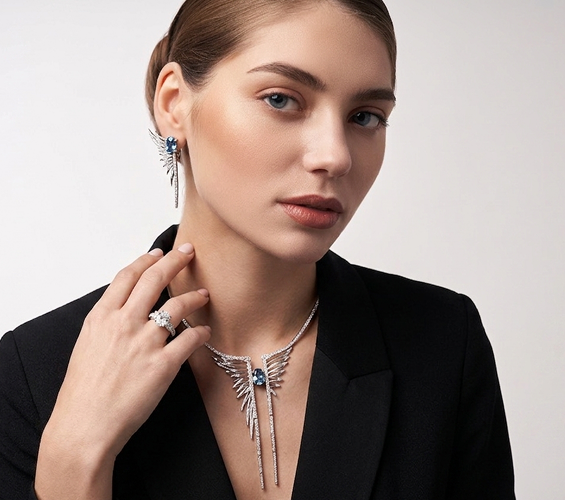
Model imagery provides useful proportion context — but use actual verified dimensions for physical scale.
Look for Scale References Carefully
Images showing jewellery on a person can provide useful context. A pendant shown on a neck may give a better sense of general proportion than an isolated macro photograph. An earring shown on an ear can provide similar context. A ring shown on a hand can help with overall presence. But these remain visual references. Different: hand sizes; ear shapes; neck proportions; camera distance; and perspective can change appearance. Use model imagery for general proportion and verified dimensions for actual scale.
Metal Colour in Photography Is Not Metal Verification
Yellow-coloured jewellery is not automatically solid gold. White-coloured jewellery is not automatically platinum. A rose-coloured piece is not automatically a particular gold fineness. Photography shows appearance. It does not establish composition. Check the written metal and fineness information and applicable hallmark evidence separately.
For the complete framework, read How to Check the Metal Used in Diamond Jewellery
What if an Image and the Product Specification Seem to Disagree?
First identify whether the conflict is real. Suppose a pendant is listed as 12 mm high but appears several centimetres tall on your phone screen. That is not necessarily a contradiction. The image is simply enlarged. Now imagine the product page says: oval centre diamond while the associated report says: round brilliant. That is a factual inconsistency. Or the product description states: four-prong setting while every product view clearly shows six prongs. That deserves clarification.
Separate: visual-scale difference from: factual contradiction. The first may be explained by photography. The second should be resolved.
What if an Important Angle Is Missing?
Do not automatically assume the hidden part is problematic. Instead ask whether that view is material to your decision. For example, if ring setting height matters because you plan to wear a wedding band beside it, a missing side view may be important. If you are purchasing stud earrings and want to understand the backing, a rear image may matter. If the reverse of a simple pendant would not alter your decision, you may not need another photograph. The objective is not to collect the maximum number of images. It is to resolve material uncertainty.
When Should You Ask for Another Product Image?
Ask when a missing view could realistically change your decision. Useful requests include: "Could you show the ring from the side so I can understand the setting profile?"; "Could you show the earring from the rear so I can see the fastening?"; "Is the diamond shown in this video the exact centre diamond associated with the report?"; "Is this image a photograph of the finished item or a rendering of the design?" Those questions are much more useful than simply requesting "more photos".
Product Images Should Agree With Material Product Information
Current UK rules require online sellers to provide a description of the goods before an order is placed, and broader UK consumer rules prohibit misleading practices where material information is omitted or presented in a way that could cause a consumer to make a different transactional decision. The principle for a jewellery shopper is straightforward: images, specifications and documentation should create one coherent understanding of the product. If they do not, investigate why.
.jpg "A Product-Image Verification Checklist")
Use each form of evidence only for what it can reasonably establish — none of them can answer every question alone.
A Product-Image Verification Checklist
| Check | What You Are Trying to Establish |
|---|---|
| Exact or representative? | Whether the shown item is the one you will receive |
| Photograph or rendering? | What level of physical evidence the image provides |
| Front view | Overall design and stone arrangement |
| Side view | Setting/profile/depth |
| Rear view | Fastening or reverse construction where relevant |
| Detail view | Visible workmanship and design features |
| 360° view | Three-dimensional relationships |
| Measurements | Actual physical scale |
| Diamond report | Formal gemmological information where applicable |
| Metal specification | Actual composition rather than colour |
| Missing view | Whether an unresolved visual question matters |
The goal is not to reward the retailer with the largest number of images. It is to determine whether the available evidence answers the questions that matter for that particular piece.
What Makes a Product Image Useful to a Jewellery Buyer?
The most useful image is not necessarily the one with the highest resolution or most dramatic sparkle. It is the one that helps you understand something relevant about the product. A front view can answer: "Do I like this design?" A side view can answer: "How does the setting sit?" A reverse view can answer: "How is this component constructed?" A model view can help with: "What is the general visual scale?" A close-up can help with: "What visible design details are present?" Then use measurements, reports and written specifications for questions those images cannot answer.
Final Rule for Jewellery Product Images
Do not ask photographs to prove more than photographs can prove. Use them to evaluate: design, proportions, visible construction and appearance. Use measurements for: physical scale. Use applicable laboratory documentation for: diamond characteristics. Use metal specifications and hallmarking where relevant for: precious-metal information. And if an important question remains unresolved, ask before committing. Remote jewellery buying becomes much more reliable when each form of evidence is used for the question it is actually capable of answering.
For the complete measurement process, read How to Check Jewellery Dimensions and Weight Online
For the full remote-inspection process, read How to Choose Diamond Jewellery Without Seeing It in Person
For product specifications, use What to Check Before Buying Lab-Grown Diamond Jewellery
Where an Aurelia Royale design is not currently available through an approved direct-purchase flow, Join the Waitlist or submit an enquiry to register your interest.
Explore Aurelia Royale Lab-Grown Diamond Jewellery
Use images for what they can tell you — and specifications for everything else.
Stay Connected
Get Our Latest Updates
Be first to discover new collections, exclusive events, and the quiet privileges reserved for our inner circle.