How to Compare Lab-Grown Diamond Jewellery Online
Units, Worksheets and Step-by-Step Comparison • Published September 10, 2026
Two pieces of lab-grown diamond jewellery can look similar in photographs while being materially different products.
One ring may contain a larger centre diamond but fewer accent stones. Another may have a lower centre-stone weight but greater total diamond weight. Two necklaces may both contain one carat of diamonds while differing in chain length, pendant dimensions, metal construction and how that carat weight is distributed.
Even the phrase "certified diamond jewellery" can describe different situations depending on whether an individual centre diamond has its own report or the complete mounted article has been examined.
That is why a useful online comparison needs to move beyond the product title. Compare each piece using the same units and the same categories, then separate verified facts from visual preference.
Quick Answer: How Should You Compare Two Lab-Grown Diamond Jewellery Products?
First make sure you are comparing genuinely similar products. Then compare: diamond configuration; centre-stone carat weight; total diamond weight; diamond dimensions; finished-jewellery dimensions; diamond grades; report type; metal and fineness; construction; finished-item weight where relevant; size or length; availability; and price basis.
Do not compare unlike numbers. For example: 1.50 ct is a diamond-weight measurement. 9.0 mm is a physical dimension. 4.8 g is finished-jewellery mass. 45 cm is necklace length. Each tells you something different. The aim is not to find the product with the largest number. It is to understand what each product actually contains and which differences matter to you.
Start by Comparing Like With Like
The strongest comparisons keep the basic product category similar. Compare: solitaire ring with solitaire ring; stud earrings with stud earrings; pendant necklace with pendant necklace; tennis bracelet with tennis bracelet.
You can certainly compare a ring with a necklace if you are deciding what type of jewellery to buy, but that is a style decision rather than a direct specification comparison. Like-for-like comparison makes technical differences easier to understand.
Compare the Exact Variation
A product family may contain several variations. For example: yellow gold; white gold; different ring sizes; different chain lengths; different centre-stone weights; or different diamond quality options.
Make sure the specifications you are reading apply to the exact variation being compared. Do not assume the weight or dimensions shown for one version automatically apply to every other version.
Use Consistent Units
This article should use one consistent system: Diamond weight: carats — ct; Diamond and jewellery dimensions: millimetres — mm; Finished jewellery weight: grams — g; Necklace and bracelet length: centimetres — cm. Where a retailer supplies another unit, convert it before comparing. For example: 18 inches is approximately 45.7 cm.
Consistency prevents accidental comparisons such as treating a 5 g jewellery weight as though it were a 5 ct diamond weight.
Carat and Gram Are Not Interchangeable
GIA defines one metric carat as exactly 0.20 grams, and carat refers to gemstone weight rather than jewellery size. A complete ring weighing 5 g therefore does not contain a five-carat diamond. Most of that finished mass can come from the metal and other components. Keep gemstone weight and finished-product weight separate throughout the comparison.
Step 1: Compare the Diamond Configuration
Before comparing grades, determine how the diamonds are arranged. A product may contain: one centre diamond; one centre stone plus accents; several similarly sized diamonds; a halo; a pavé setting; or dozens of diamonds distributed around a bracelet or necklace.
Two products with identical total diamond weights can therefore look very different. Consider: Product A: one 1.00 ct centre diamond. Product B: ten diamonds totalling 1.00 ct. Both genuinely contain one total carat in this hypothetical example. They do not provide the same visual effect.
Step 2: Separate Centre-Stone Weight From Total Diamond Weight
This is one of the most important comparison checks. Imagine two fictional rings. Ring A: Centre diamond: 1.20 ct; Accent diamonds: 0.30 ct total; Total diamond weight: 1.50 ct. Ring B: Centre diamond: 1.00 ct; Accent diamonds: 0.70 ct total; Total diamond weight: 1.70 ct.
If you compare only the largest total number, Ring B appears to have more diamond weight. That is true. But Ring A has the larger centre stone. Which difference matters more depends on the design and buyer preference.
For the full combined-weight explanation, read Total Carat Weight Meaning in Diamond Jewellery.
Step 3: Compare Individual Diamond Carat Properly
If the jewellery contains one significant centre diamond, compare that stone's individual carat weight. But remember: carat measures weight, not physical dimensions. Two equal-carat diamonds can have different visible dimensions because of shape and proportions. That is why centre-stone carat should be read together with millimetre measurements.
For carat itself, read Lab-Grown Diamond Carat Weight Explained.
For carat versus visible physical size, read Diamond Carat Weight vs Size.
Step 4: Compare Diamond Dimensions
Suppose two oval centre diamonds both weigh 1.50 ct. One measures: 9.10 × 6.40 mm and another: 8.85 × 6.55 mm. They weigh the same in this fictional example but have different outlines. The first is longer and narrower. The second is shorter and wider. Neither set of dimensions automatically establishes that one diamond is better. It tells you that their physical proportions differ. This can materially change the appearance of the completed jewellery.
Step 5: Compare Finished-Jewellery Dimensions Separately
Diamond dimensions and complete jewellery dimensions are different. A 6.5 mm centre diamond inside a halo might form part of a 10 mm-wide finished ring head. A 7 mm diamond inside a pendant may produce a finished pendant measuring 12 mm across once the setting is included. Do not use centre-stone dimensions to estimate complete jewellery scale.
For the dedicated measurement guide, read How to Check Jewellery Dimensions and Weight Online
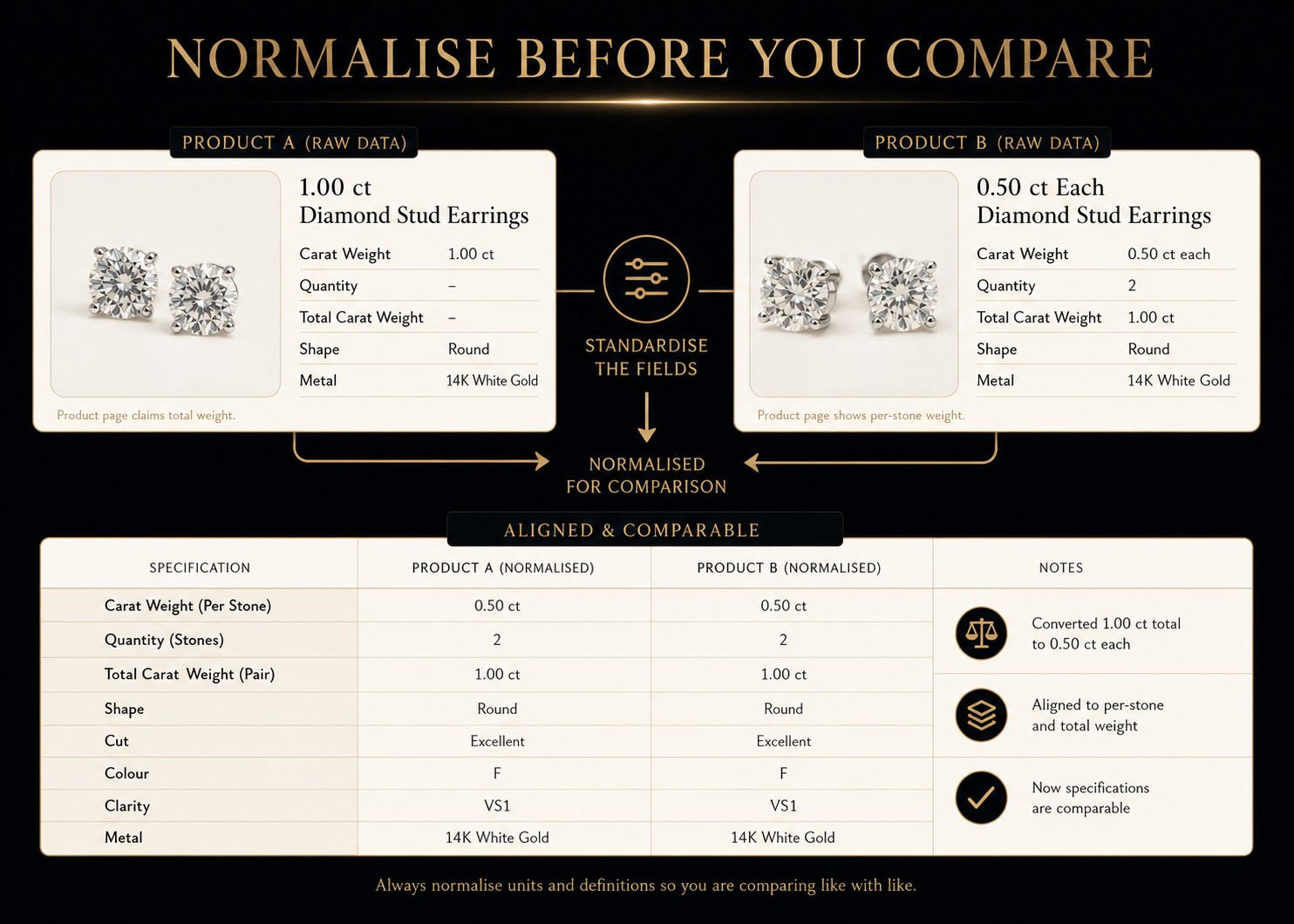
Compare grades within the same reporting framework — a higher total carat does not automatically mean a larger centre stone.
Step 6: Compare Colour and Clarity
Where individual diamond grades are available, compare them directly only when they refer to comparable stones and reporting systems. For example: F / VS1 and: G / VS2 describe different reported colour and clarity results. But do not immediately conclude that F/VS1 must be the better finished jewellery purchase.
One product could have: a larger centre stone; better proportions; a design you prefer; or a substantially different price. The formal grades answer technical questions. They do not decide the entire jewellery comparison.
Step 7: Compare Cut Where Applicable
Cut can have a major influence on the visual performance of a polished diamond. If both products contain significant round brilliant centre stones with applicable cut information, compare that information. For fancy shapes, pay close attention to the actual laboratory framework and visual appearance rather than expecting every shape to use the same conventional overall cut system.
Do not reduce the complete jewellery decision to: higher colour + higher clarity = automatically better. The stone's cutting and proportions matter too.
Step 8: Compare Polish and Symmetry
If reports provide polish and symmetry results, compare those fields separately. If both stones have: Excellent polish and: Excellent symmetry, those categories do not meaningfully separate them. Move to where the products actually differ. A useful comparison focuses on differences, not on repeatedly listing every matching specification.
Step 9: Compare the Report Type
The word certified is not enough. Determine whether: an individual centre diamond has its own report; the complete mounted jewellery article has a jewellery report; or the retailer is simply providing its own documentation.
IGI provides both loose-diamond reporting and finished-jewellery reporting. For mounted jewellery, IGI states that centre-stone shape, measurements and 4Cs assessments are provided as the mounting permits. Where the setting restricts grading, colour and clarity may be given as ranges and cut may be estimated. So: loose stone report and: mounted jewellery report should not automatically be treated as identical evidence.
Step 10: Compare Reports Within Their Actual Scope
Suppose Jewellery A includes an individual IGI report for its centre diamond. Jewellery B includes an IGI finished-jewellery report. Both can provide useful evidence. But they describe different examination situations. The loose centre stone may have been examined independently before setting. The mounted jewellery assessment may be limited by what the setting allows the gemmologist to observe.
For what the different documents mean, use Diamond Certification vs Jewellery Certification
For reading one diamond report, use How to Read a Lab-Grown Diamond Certificate.
Step 11: Verify a Report When It Applies to an Individual Stone
If an individual reported centre diamond is part of the comparison, verify the report through the issuing laboratory where possible. Then make sure the report appears to correspond with the actual stone being offered. Do not stop at: "the report number exists." Compare available identifiers such as: shape; carat; dimensions; grades; and girdle inscription where relevant.
The detailed process belongs in How to Verify an IGI Certificate Number.
Step 12: Do Not Compare Report Numbers as Quality Scores
A report number is an identifier. A larger or newer-looking number does not mean a better diamond. Likewise, the existence of an IGI report is not itself a high-quality grade. Read what the report actually says. IGI's current laboratory-grown diamond reports include description, shape, cutting style, measurements and 4Cs assessment.
Step 13: Compare the Metal
The diamond is only part of finished jewellery. Two otherwise similar products can use different metals. For example: 18ct gold; 14ct gold; platinum; sterling silver; or plated constructions. Metal identity and fineness should therefore be compared separately from diamond specifications. For UK buyers, hallmarking provides independent verification of qualifying precious-metal fineness above applicable thresholds.
For the detailed metal framework, use How to Check the Metal Used in Diamond Jewellery
Step 14: Keep Metal Fineness and Construction Separate
Imagine: Product A: 18ct gold. Product B: sterling silver with 18ct gold plating. Both can have a yellow-gold appearance. They are not equivalent material constructions. Likewise: hollow 18ct gold and: 18ct gold-plated base metal describe fundamentally different products. So when comparing metal, ask two questions: What is the underlying metal and fineness? and: How is the item constructed or finished? Do not let colour alone answer either question.
Step 15: Compare Hallmark Information Correctly
A UK hallmark is useful evidence about qualifying precious-metal fineness. It is not a diamond certificate. Current UK guidance says a complete hallmark contains three compulsory components: the sponsor or maker mark; the metal and fineness mark; and: the Assay Office mark.
Do not award a product extra "diamond quality" because the jewellery is hallmarked. The hallmark and diamond report answer different questions.
Step 16: Compare Finished-Jewellery Weight Where Relevant
Finished-item gram weight can help indicate how substantial an article may feel. Suppose two otherwise similar chains have: Product A: 5.4 g; Product B: 3.2 g. That tells you the first product has greater finished mass. It does not automatically establish that Product A has better workmanship.
Differences could arise from: metal choice; chain dimensions; hollow versus non-hollow construction; product size; or design. Treat finished weight as another product characteristic—not a quality score.
Step 17: Compare Necklace and Bracelet Length
Length strongly affects wearability. If two necklaces contain similar diamonds but one is: 40 cm and another: 45 cm, they will sit differently. Likewise, two tennis bracelets with equal total diamond weight can present differently if one uses a different total length or number of stones. Keep: length in cm separate from: diamond weight in ct.
Step 18: Compare Ring Measurements
For rings, useful differences can include: band width; setting height; head dimensions; and centre-stone dimensions. Two 1.50 ct solitaire rings may look and wear differently because one has: a 1.6 mm band while another has: a 2.4 mm band. Likewise, one may have a higher setting profile. Those measurements belong in the finished-jewellery comparison even when the centre diamonds are very similar.
Step 19: Compare Earring Weight Claims Carefully
Earrings create another frequent unit problem. A product may say: 2.00 ct earrings. Does that mean: 2.00 ct per earring? or: 2.00 ct total per pair? Those are very different products. The listing should make the unit explicit. For a matched two-stone pair described as 2.00 ct total, each diamond might be approximately one carat—but only use that conclusion where the actual product data supports it. Do not invent equal distribution across more complex earring designs.
Step 20: Compare Product Photography Only After Understanding the Numbers
Photography is useful for style and visual proportion. It is not a substitute for measurements. One retailer may photograph a 7 mm stud very close to the lens. Another may show a 10 mm stud at a greater distance. The smaller product can appear larger on screen. Use photographs to judge design. Use verified dimensions for physical scale.
For remote visual evaluation, read How to Choose Diamond Jewellery Without Seeing It in Person.
Step 21: Compare Exact Item vs Representative Imagery
This is especially important when individual centre stones differ. Product A might show the exact finished item. Product B might use a representative rendering. That does not automatically make Product B worse. But it changes what can be compared visually.
If imagery is representative, rely more heavily on the agreed dimensions, diamond specifications and construction information. Do not assume the exact visual characteristics of a unique centre stone from a generic product image.
Step 22: Compare What Is Included
Two jewellery products with similar apparent specifications may come with different documentation or accessories. Possible included items might include an applicable diamond report or retailer documentation. But do not assume that every seller supplies: an appraisal; insurance valuation; gift receipt; warranty card; special packaging; or complimentary resizing.
Compare only what the retailer actually states is included. For Aurelia, no such brand-specific promises should be published unless confirmed by the client.
Step 23: Compare Availability
Two visually similar products may have different availability situations. One may already exist. Another may need to be produced. Another may be enquiry-only. This matters because availability affects: which exact item you are seeing; whether the stone has already been selected; and when the product could realistically be supplied.
Do not describe an enquiry-only product as immediate stock unless that status is confirmed.
Step 24: Compare Ready-Made and Made-to-Order Carefully
A ready-made item may be the exact completed piece shown. A made-to-order item may be produced after the transaction begins. This does not automatically make one better. But it changes what is fixed at the time of comparison. For a made-to-order piece, clarify: metal; diamond specification; dimensions; size; and which characteristics may legitimately vary.
For the detailed distinction, use Ready-Made vs Made-to-Order Diamond Jewellery
Step 25: Compare Price Only After Making the Products Comparable
A lower price can look attractive until you discover that the products are not equivalent. For example: Product A may have a 1.50 ct centre stone. Product B may advertise 1.50 ct total spread across several diamonds. Product A may be 18ct gold. Product B may be plated silver. Product A may include an individually reported centre diamond. Product B may use non-individually reported small stones. Without identifying those differences first, comparing price tells you very little.
The correct sequence is: normalise specifications first → compare price second.
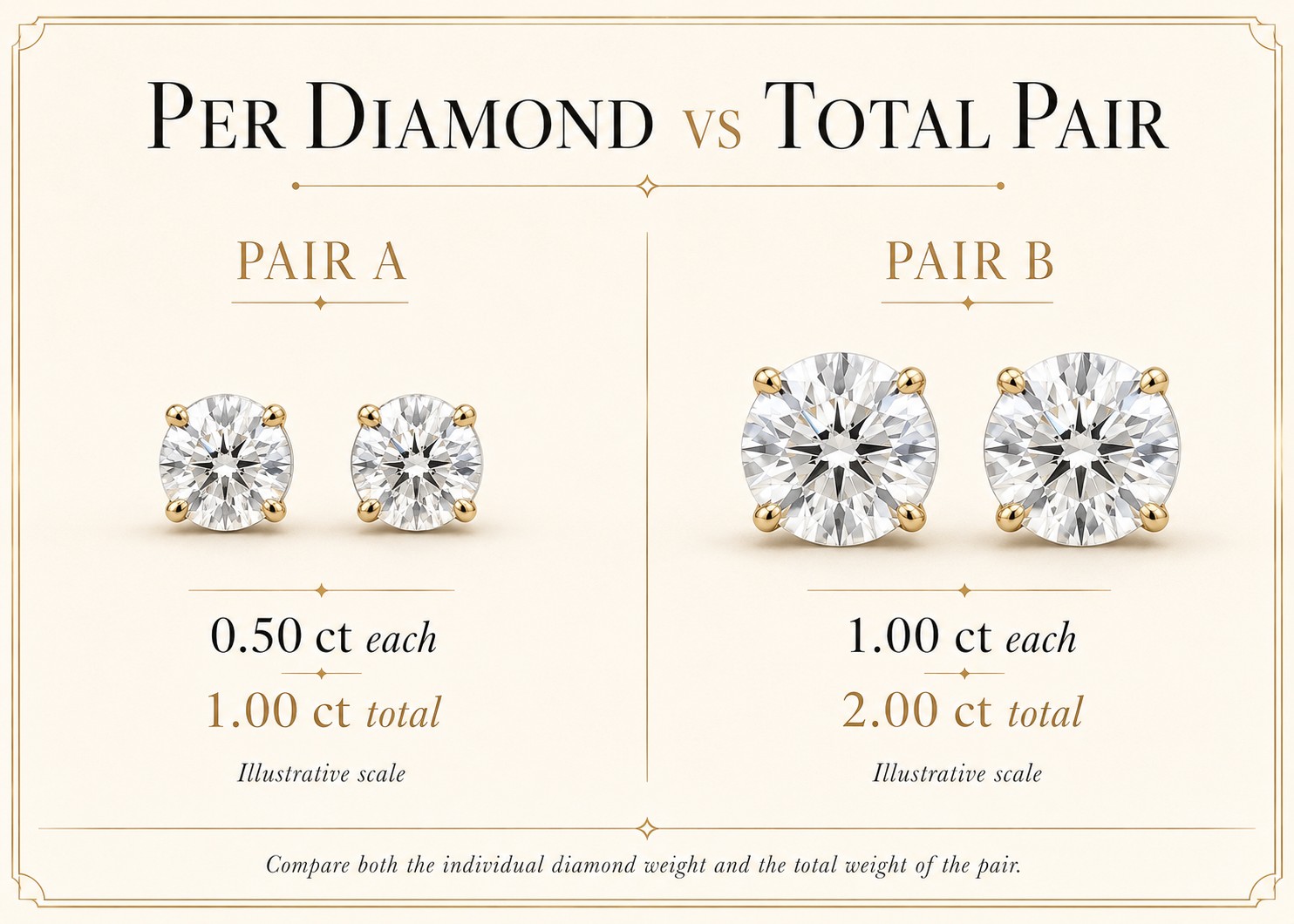
Same total carat does not mean same appearance — the distribution between centre stone and accents matters.
Worked Comparison: Two Fictional Lab-Grown Diamond Pendants
Consider two hypothetical pendant necklaces. These figures are illustrative only. They are not Aurelia product specifications.
| Specification | Pendant A | Pendant B |
|---|---|---|
| Diamond origin | Lab-grown | Lab-grown |
| Centre diamond weight | 0.75 ct | 0.60 ct |
| Accent diamond weight | 0.15 ct | 0.30 ct |
| Total diamond weight | 0.90 ct | 0.90 ct |
| Centre diamond dimensions | 5.8 mm diameter | 5.5 mm diameter |
| Finished pendant width | 8.0 mm | 9.5 mm |
| Chain length | 45 cm | 45 cm |
| Metal | 18ct gold | 18ct gold |
| Finished jewellery weight | 3.2 g | 3.6 g |
| Centre report | Individual report | Individual report |
At first glance, both products contain 0.90 ct total diamond weight. But they are not equivalent. Pendant A puts more of that weight into the centre stone. Pendant B distributes more weight into accent diamonds. Pendant B also has a wider finished pendant. The chain lengths are equal. The metals are equivalent in this fictional example. The finished gram weights differ slightly. There is no universal winner. The answer depends on whether the buyer prefers: a larger centre diamond; or: more surrounding diamond coverage and a wider finished design. That is what a good comparison should reveal.
A Second Example: Why Units Matter
Now imagine this poorly structured comparison: Ring A: 1.50 ct; Ring B: 8.5 mm; Ring C: 4.6 g. Which is largest? The question cannot be answered because the figures measure different things. 1.50 ct = diamond weight. 8.5 mm = physical dimension. 4.6 g = finished jewellery mass. The comparison only becomes meaningful after each product is assigned the same categories.
The Finished-Jewellery Comparison Worksheet
Use this worksheet for two similar products.
| Comparison field | Jewellery A | Jewellery B |
|---|---|---|
| Jewellery type | ||
| Exact item or representative design? | ||
| Diamond origin | ||
| Centre-stone weight (ct) | ||
| Accent diamond weight (ct) | ||
| Total diamond weight (ct) | ||
| Centre-stone dimensions (mm) | ||
| Finished-product dimensions (mm) | ||
| Colour | ||
| Clarity | ||
| Cut / finish information | ||
| Report laboratory | ||
| Report type | ||
| Report verified? | ||
| Underlying metal | ||
| Metal fineness | ||
| Plated? | ||
| Hollow construction? | ||
| Finished jewellery weight (g) | ||
| Necklace/bracelet length (cm) | ||
| Availability | ||
| Ready-made / made-to-order | ||
| Price / quotation | ||
| Important terms |
Do not fill a missing field with an assumption. Mark it: Unconfirmed and decide whether it matters enough to ask about.
Verified, Disclosed and Unconfirmed
This framework makes product comparison much cleaner. Verified means suitable evidence supports the specification. Disclosed means the retailer or manufacturer clearly states it. Unconfirmed means you do not yet have enough information.
For example: A centre-stone carat matching an individual laboratory report may be Verified. A stated chain length may be Disclosed through manufacturer data. An unstated setting height remains Unconfirmed. Not every unconfirmed field needs to be resolved. Only investigate details capable of changing your decision.
Exact, Minimum, Range and Approximate
The second useful framework concerns precision. Exact: 1.03 ct. Minimum: VS2 or better. Range: F–G. Approximate: 1.50 ct total.
Do not compare a minimum specification as though it were an exact grade. For example: VS or better cannot automatically be entered into the worksheet as: VS1. Likewise: F–G cannot simply become: F. Use the specification as it is actually stated.
Omission, Ambiguity and Contradiction
When information is problematic, identify what kind of problem you have. An omission means something is missing. Example: Pendant width not stated. An ambiguity means the wording can be interpreted in more than one way. Example: "2 carat earrings" without stating whether that means per pair or per earring. A contradiction means two sources cannot both be correct. Example: Product page says 1.50 ct oval centre diamond while the associated report states 1.02 ct round brilliant.
Contradictions deserve resolution before purchase.
What If One Product Has More Total Carat but a Smaller Centre Stone?
That is entirely possible. A halo, pavé design or multi-stone piece can have more total diamond weight even though its centre stone is smaller. Decide whether you care more about: centre-stone presence; overall diamond coverage; or the finished design. Do not treat total weight as a centre-stone specification.
What If One Product Has a Higher Colour Grade?
The higher formal grade is a technical difference. Whether that difference is visually meaningful enough to affect your decision is another question. A product with slightly lower colour could still have: a larger centre stone; stronger proportions; a more attractive design; or: a lower price. Compare the finished jewellery, not one grade in isolation.
What If Both Products Have the Same Total Carat?
Determine how the weight is distributed. One could contain: one dominant centre stone. Another could contain: several smaller stones. A third could spread the same total weight across dozens of pavé diamonds. Same total carat does not mean same appearance.
What If Both Products Have the Same 4Cs?
Compare the rest of the product. Look at: diamond dimensions; proportions; metal; finished-jewellery dimensions; setting design; product weight; availability; and price. Two finished jewellery products can use technically similar diamonds and still be very different objects.
What If One Product Has a Certificate and the Other Does Not?
First determine what certificate actually means. A significant individually reported centre diamond may have its own laboratory report. Another product may contain many smaller diamonds where individual reporting is impractical or unnecessary. The existence of a report is useful evidence. It should not automatically make the entire finished product superior. Compare the documentation appropriate to each product.
Can You Compare IGI Jewellery Reports With Loose-Diamond Reports?
Yes, but recognise their different scopes. IGI explains that mounted centre stones may be assessed as mounting permits, and colour or clarity can be expressed as ranges where the setting limits examination. Do not interpret a mounted F–G result as though the laboratory had necessarily assigned one exact loose-stone grade.
Should You Compare Two Jewellery Items Only by Price per Carat?
Usually not. Price per carat can become misleading for finished jewellery because the retail price also reflects: metal; setting; design; manufacturing; diamond distribution; construction; and seller-specific factors. A 1.50 ct total tennis bracelet and a 1.50 ct solitaire ring are not economically or physically equivalent products. Price-per-carat calculations can obscure more than they reveal when used across different jewellery types.
Is the Heavier Jewellery Piece Better?
No. Finished gram weight is only one property. Greater weight may come from: more metal; different metal density; larger dimensions; or different construction. It does not automatically establish superior workmanship.
Is 18ct Gold Better Than 14ct Gold?
They have different gold finenesses and material characteristics. Which is preferable depends on the design, wearer, price and intended use. This comparison page should record the metal accurately rather than create one universal metal hierarchy.
For the technical metal guide, read How to Check the Metal Used in Diamond Jewellery
Can You Compare Plated and Non-Plated Jewellery?
Yes, but recognise that they are different material constructions. For example: 18ct gold and: sterling silver with 18ct gold plating are not comparable simply because both appear yellow. The underlying metal needs to be part of the worksheet.
How Important Are Product Dimensions?
Very. Dimensions often explain differences that carat does not. One pair of earrings can have the same total diamond weight as another but appear larger because the stone distribution or setting dimensions differ. For finished jewellery, real-world physical measurements are often essential to a meaningful comparison.
Compare the Buying Terms Last
Once the products are technically understood, compare the transaction. Look at: price or quotation; availability; whether the item already exists; whether production is required; delivery information; and: returns or cancellation terms.
Do not allow a more generous-looking commercial policy to obscure a fundamentally different product. Likewise, do not choose the technically stronger product without understanding the transaction.
The full purchase journey belongs in How to Buy Certified Lab-Grown Diamond Jewellery Online.
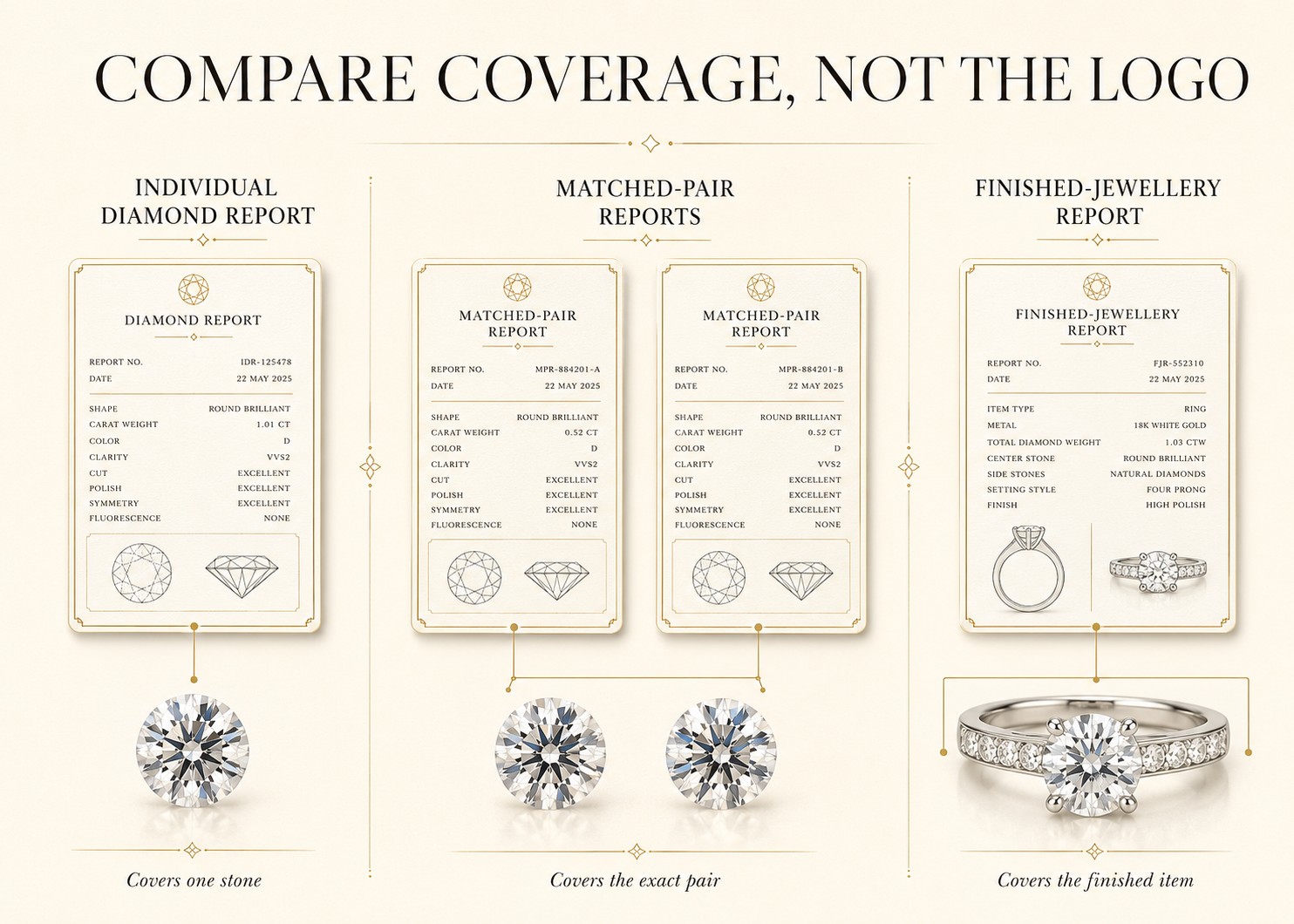
Make the products comparable first — then compare price and terms last.
Frequently Asked Questions
How do I compare lab-grown diamond jewellery online?▼
Compare like-for-like products using diamond configuration, centre and total carat weight, dimensions, grades, reporting, metal, construction, finished weight, length and price.
Is total carat weight the same as centre-stone weight?▼
No. Total carat weight can include multiple diamonds.
Is carat the same as diamond size?▼
No. Carat measures weight.
How much does one diamond carat weigh?▼
One metric carat equals 0.20 grams.
Is finished-jewellery gram weight the same as diamond carat?▼
No. They measure different things.
Can two one-carat diamonds have different dimensions?▼
Yes. Shape and proportions can produce different physical measurements at the same weight.
Should I compare diamond dimensions?▼
Yes, especially for significant centre stones.
Should I compare finished jewellery dimensions too?▼
Yes. The setting can make the complete product much larger than the diamond itself.
Is a higher total carat always better?▼
No. It may simply distribute more weight across multiple smaller stones.
Are two pieces with the same TCW equivalent?▼
No. The weight can be distributed differently.
Should I compare colour?▼
Yes when comparable grades are available, but do not make the complete decision from colour alone.
Should I compare clarity?▼
Yes, but consider whether the difference matters visually and commercially.
Should I compare cut?▼
Yes, particularly for significant centre diamonds where suitable cut information is available.
Does certification make one jewellery product better?▼
Not automatically. Determine which report exists and what it actually covers.
Can IGI grade mounted jewellery?▼
Yes. IGI offers jewellery reports and assesses centre stones as the mounting permits.
Is mounted grading identical to loose-diamond grading?▼
Not necessarily. A setting can limit assessment, leading to ranges or estimates.
Should I verify an individual diamond report?▼
For a significant individually reported stone, verification is useful.
Does a hallmark verify the diamond?▼
No. It relates to precious-metal fineness.
Should I compare metal type?▼
Yes.
Is plated silver the same as solid gold?▼
No.
Does heavier jewellery mean higher quality?▼
No.
Should necklace length be compared in carats?▼
No. Use a linear unit such as centimetres.
What units should I use?▼
Use carats for diamond weight, millimetres for jewellery and gemstone dimensions, grams for finished-item mass, and centimetres for necklace or bracelet length.
What if a specification is missing?▼
Mark it unconfirmed rather than inventing a value.
What if two sources contradict each other?▼
Resolve the discrepancy before proceeding.
Can product photography replace dimensions?▼
No.
What is the best way to compare value?▼
First make the products genuinely comparable. Then decide which differences matter enough to justify the price difference.
Final Answer: How Should You Compare Lab-Grown Diamond Jewellery Online?
Start by comparing products, not headlines. Make sure the jewellery type and variation are genuinely comparable. Then separate: centre-stone carat; accent diamond weight; total diamond weight; diamond dimensions; finished-jewellery dimensions; and: finished-product gram weight. Never use those figures as though they measure the same thing.
After that, compare the diamond quality information. Look at colour, clarity, cut, polish and symmetry where they apply. Check which laboratory report exists and whether it covers an individual loose diamond or mounted jewellery. Then compare the metal. Identify the underlying precious metal, fineness and any plating or hollow construction rather than judging from colour alone.
Next compare the complete physical product: ring dimensions; earring diameter; pendant dimensions; chain or bracelet length; finished weight; and setting design. Only once those differences are clear should you compare price and commercial terms.
The strongest sequence is: make the products comparable → normalise the units → compare diamonds → compare metal → compare finished jewellery → compare price and terms.
For comparing two individual reported stones rather than complete jewellery pieces, use How to Compare Two Certified Lab-Grown Diamonds
For diamond carat itself, read Lab-Grown Diamond Carat Weight Explained.
For carat versus millimetre size, use Diamond Carat Weight vs Size.
For combined stone weight, read Total Carat Weight Meaning in Diamond Jewellery.
For metal identity, fineness, plating and construction, read How to Check the Metal Used in Diamond Jewellery.
For physical jewellery dimensions, use How to Check Jewellery Dimensions and Weight Online
For remote visual assessment, continue with How to Choose Diamond Jewellery Without Seeing It in Person.
When comparing Aurelia Royale designs, use only the specifications verified for the specific products and variations being compared.
Where a design is not currently available through an approved direct-purchase process, Join the Waitlist or submit an enquiry to register your interest.
Explore Aurelia Royale Lab-Grown Diamond Jewellery
Normalise the units, separate the categories, then compare — the only way to make a fair comparison.
Stay Connected
Get Our Latest Updates
Be first to discover new collections, exclusive events, and the quiet privileges reserved for our inner circle.