
How to Compare Different Diamond Necklace Designs
Pendant, Station and Line Necklaces by Coverage, Focal Point and Movement • Published September 10, 2026
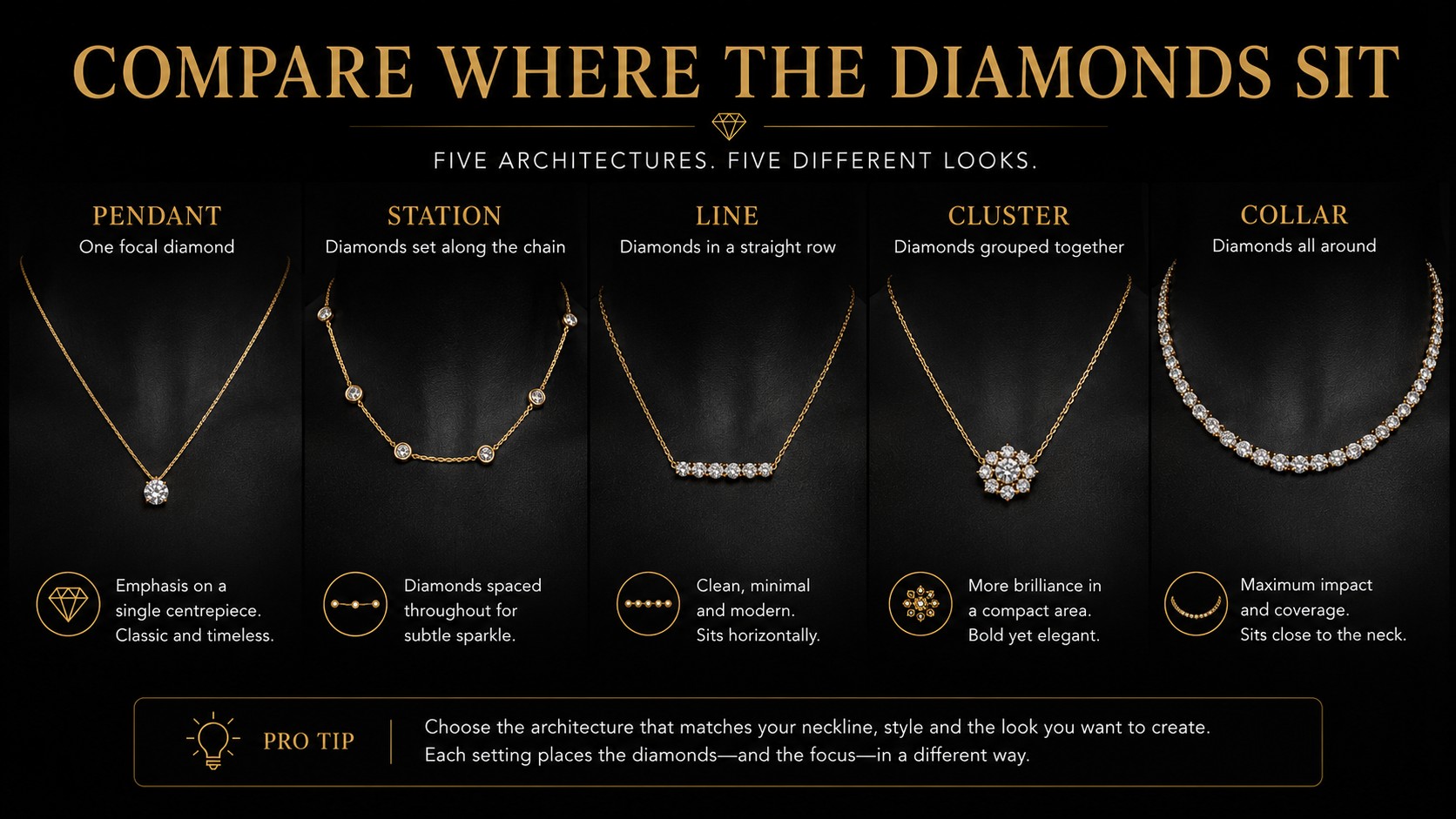
The best necklace design puts the diamonds where you want the eye to go — compare focal placement, coverage and movement before comparing carat weight.
Two diamond necklaces can contain similar amounts of diamond weight and still create completely different effects when worn. A pendant necklace concentrates attention around one focal point. A station necklace distributes diamonds at intervals along a chain. A diamond line necklace spreads the visual emphasis across a much larger section of the neckline.
That difference changes more than appearance. It affects how the necklace moves, where the eye is drawn, how much precious metal remains visible, how strongly necklace length changes the look, how easily the piece layers with other jewellery and how total diamond weight is perceived. The best necklace design is therefore not simply the one containing the most diamonds. It is the design whose focal placement, diamond coverage, movement, length and physical scale suit the effect you actually want.
Pendant vs Station vs Line Necklace: Quick Comparison
| Factor | Pendant Necklace | Station Necklace | Diamond Line Necklace |
|---|---|---|---|
| Diamond placement | Concentrated at one main focal area | Diamonds spaced along chain | Continuous or near-continuous diamond line |
| Primary visual focus | Centre/front focal point | Several distributed points | Broad neckline coverage |
| Metal visibility | Usually high along chain | High between stations | Usually lower across diamond-set section |
| Movement | Chain moves; pendant may move independently | Fluid chain movement | More controlled linked movement |
| Length sensitivity | Very high because pendant position changes | High because station positions shift | High because line must sit correctly across neckline |
| Diamond-weight perception | Concentrated | Distributed with space | Distributed densely |
| Layering behaviour | Often easy to position as focal layer | Useful as a lighter distributed layer | Usually visually dominant |
| Main measurement to check | Chain length + pendant dimensions | Chain length + station spacing | Necklace length + diamond-set width/coverage |
These categories are not quality rankings. They describe three different ways of positioning diamonds around the neck.
What Is a Diamond Pendant Necklace?
A pendant necklace places one principal decorative element on a chain or necklace structure. That focal element may contain one diamond, several diamonds, a motif or a combination of stones and metal. Blue Nile's current necklace guide similarly describes pendant styles as designs where a diamond, gemstone, metal design or other focal element is suspended from a chain. The defining idea is concentration. Instead of spreading diamonds around the neckline, the design directs attention to one area. That makes a pendant particularly sensitive to: chain length, pendant dimensions, and the relationship between pendant size and chain. A beautifully proportioned pendant can look completely different when moved several centimetres higher or lower on the body.
Why Pendant Placement Matters
A pendant creates a focal point. That means its position relative to the: collarbone, neckline, other necklaces, and clothing has a strong effect on the finished look. Tiffany's current necklace-length guidance specifically notes that both neck circumference and pendant size influence how a necklace sits. Its sizing guide recommends testing the intended chain length physically because the pendant's size and shape alter the visual result.
This makes pendant comparison fundamentally different from comparing two loose diamonds. You are evaluating: diamond + pendant body + chain + position on the wearer.
Pendant Size and Diamond Size Are Different
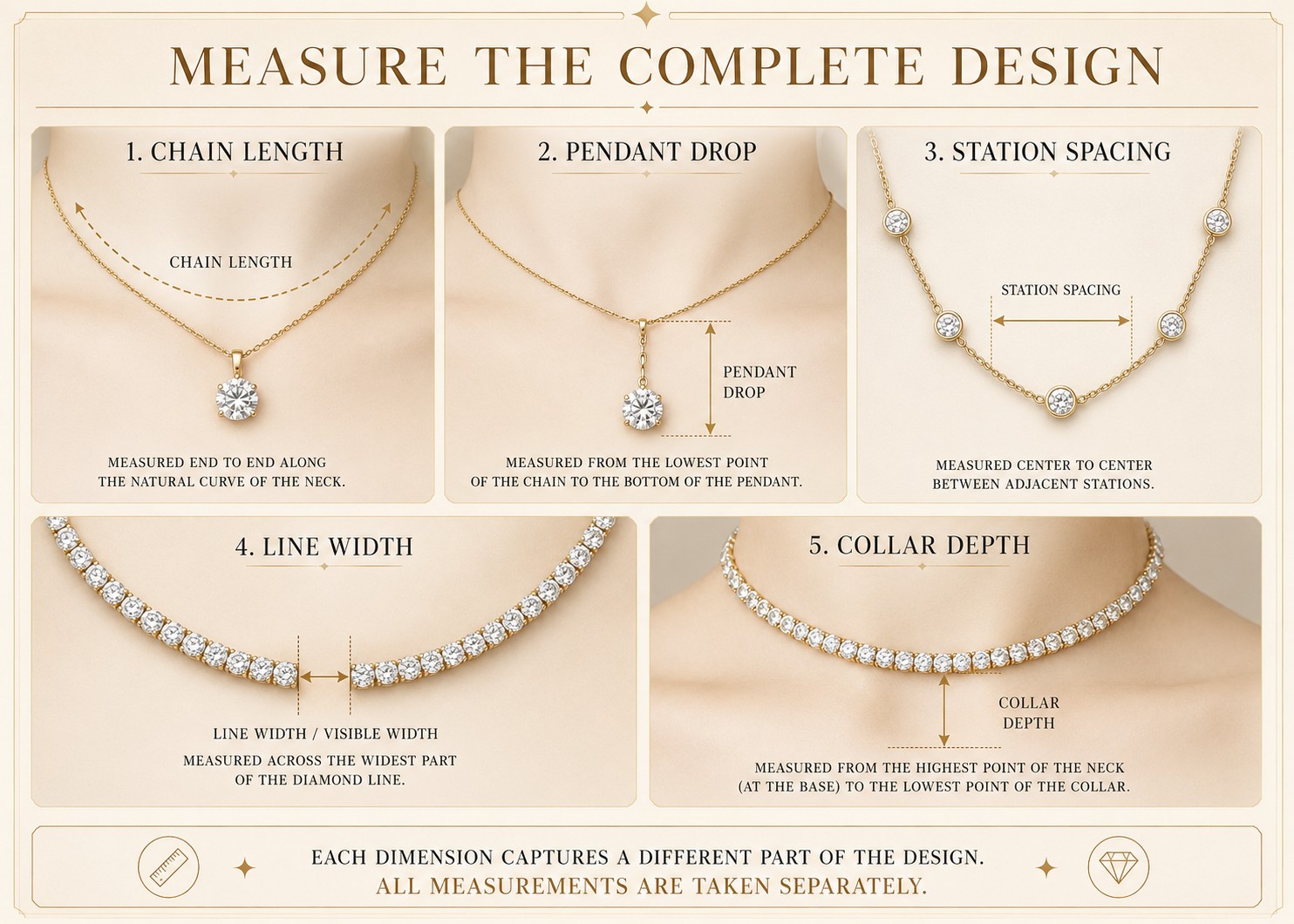
Suppose a pendant contains a 5 mm centre diamond. That does not mean the complete pendant is 5 mm wide. The finished jewellery may also include: prongs, bezel metal, a halo, decorative framing, accent diamonds, or another motif. This creates two separate measurements. The diamond dimensions describe the stone. The pendant dimensions describe the finished visible object. For online buying, the finished pendant measurement is often more useful when trying to understand how noticeable the necklace will look.
For the full measurement process, use the dedicated How to Check Jewellery Dimensions and Weight Online
Solitaire Pendant vs Decorative Pendant
Even within the pendant category, design can change the visual emphasis significantly.
| Comparison | Solitaire Pendant | Decorative / Multi-Stone Pendant |
|---|---|---|
| Main focus | One principal diamond | Complete motif or group of stones |
| Diamond concentration | High | Distributed within pendant |
| Metal visibility | Usually limited around stone | Can be much higher |
| Finished dimensions | Often close to stone dimensions plus setting | Can be significantly larger than centre stone |
| Visual effect | Minimal, diamond-focused | Design-focused |
| Best comparison | Stone + setting + pendant size | Overall motif + total dimensions + diamond distribution |
This matters because the term diamond pendant does not tell you whether most of the visual scale comes from the diamond or from the surrounding design.
What Is a Diamond Station Necklace?
A station necklace places diamonds or other decorative elements at intervals along a chain rather than concentrating everything into one centre pendant. Blue Nile currently defines station necklaces as chains punctuated with gemstones, beads or other elements at specific intervals. Its diamond examples place multiple bezel- or prong-set diamonds along a fine chain. The key concept is spacing. The chain remains visually important because areas of plain chain separate the diamonds. That produces a lighter rhythm than a continuous diamond line.
Why Station Necklaces Look Lighter Than Their Diamond Count Suggests
A station necklace can contain several diamonds while still appearing delicate. That happens because negative space is part of the design. The eye sees: diamond, chain, diamond, chain, rather than one uninterrupted diamond surface. This is why diamond count alone cannot tell you whether a necklace will look substantial. Five well-spaced diamonds on a fine chain can create a much lighter visual effect than a line necklace containing many closely set stones. The correct comparison therefore includes both: diamond quantity and: diamond spacing.
Station Necklace Spacing Comparison
| Design Choice | Closer Stations | Wider Stations |
|---|---|---|
| Diamond continuity | Higher | Lower |
| Chain visibility | Lower | Higher |
| Visual density | Stronger | Lighter |
| Individual diamond separation | Less pronounced | More pronounced |
| Overall effect | More diamond-forward | More delicate |
There is no universally correct spacing. The design depends on whether the wearer wants continuous sparkle or isolated points of light.
Station Necklaces Usually Move Differently From Pendants
A pendant normally creates one heavier focal point. A station necklace spreads several smaller set elements around a flexible chain. That can make the station design feel more fluid because there is no single central element controlling most of the visual weight. But exact movement depends on construction. A station necklace with tiny bezel-set diamonds on a fine chain can move very freely. A heavier station design with larger settings can behave differently.
Blue Nile's station-necklace guidance describes the category as flexible jewellery and notes that the stations are generally fixed at specific positions along the chain, although some designs may contain movable elements. Do not therefore assume every diamond station slides along the chain. Check the specific construction.
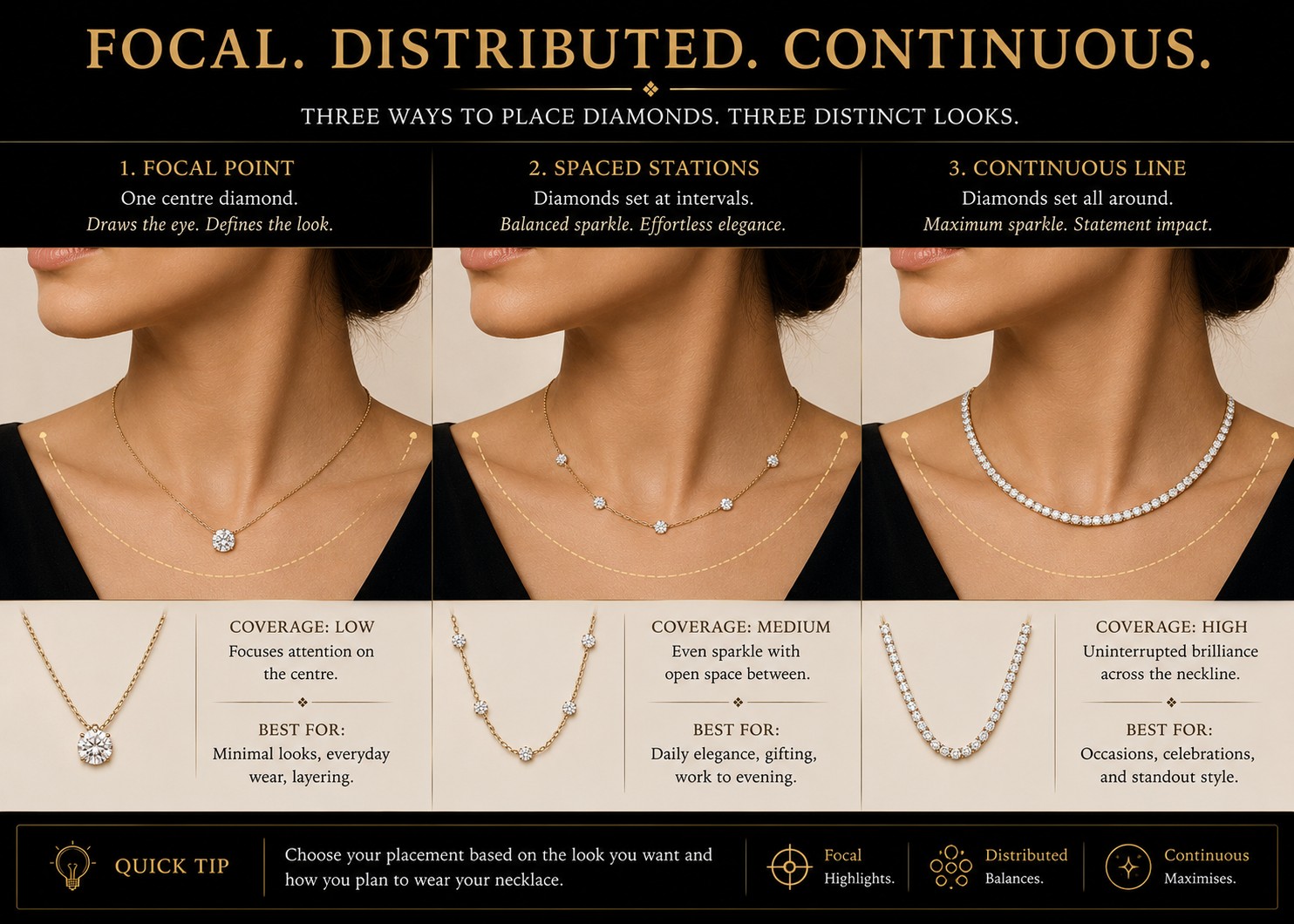
A diamond line necklace distributes stones across a substantial part of the neckline — coverage becomes the visual focus rather than one central pendant.
What Is a Diamond Line Necklace?
For this guide, a diamond line necklace means a design where diamonds form a continuous or near-continuous linked line across a substantial part of the neckline. The individual stones may be: prong-set, bezel-set, channel-set, or incorporated into another linked structure. The important distinction is density. Unlike a station necklace, the design does not rely on long visible sections of plain chain between diamonds. Unlike a pendant, the eye is not directed primarily toward one suspended focal element. Instead, the diamond presence is distributed across the neckline. Tiffany's current necklace styling material treats the diamond line necklace as a distinct necklace form alongside pendants and chains, including it as a stronger continuous element in layered combinations.
Diamond Line Necklaces and Tennis Necklaces
The terms can overlap in ordinary jewellery usage. A tennis-style necklace is one common form of diamond line necklace, typically using a flexible linked sequence of individually set diamonds. However, for this article, line necklace is the broader design concept. The important buyer question is not the terminology alone. It is: How much of the necklace is diamond-set, how closely are the stones positioned, and how does the linked structure sit around the neck?
Line Necklaces Create Broad Coverage Rather Than One Focal Point
With a pendant, the viewer's eye usually arrives at one central point. With a station necklace, attention moves between separated diamonds. With a line necklace, the diamond surface itself becomes the focal area. That changes how total carat weight appears. A line necklace may use many smaller diamonds distributed across the neck. A pendant could use the same fictional TCW concentrated into a much larger centre diamond and smaller accents. Neither distribution is automatically more impressive. They create different effects.
| Necklace Type | Where the Eye Is Drawn |
|---|---|
| Pendant | One principal centre or near-centre element |
| Station | Several spaced points across the chain |
| Line | Broad continuous section across neckline |
This is one of the most important decisions to make before comparing carat weight.
Same Total Carat Weight Can Produce Completely Different Necklaces
Imagine three fictional necklaces, each containing 3.00 ct total diamond weight. These are educational examples only and do not represent Aurelia inventory or pricing.
| Fictional Design | Example Diamond Distribution | Likely Visual Effect |
|---|---|---|
| Pendant | Large centre diamond + smaller accents | Strong central focal point |
| Station | Several diamonds positioned around chain | Distributed sparkle with visible chain |
| Line | Many smaller diamonds set closely together | Continuous diamond coverage |
Every product contains the same fictional TCW. Yet they do not have the same: largest visible diamond, physical coverage, movement, or focal placement. This is why comparing necklaces only by total diamond weight gives an incomplete result.
Pendant vs Station Necklace
| Comparison | Pendant | Station |
|---|---|---|
| Main focal point | Usually one | Several |
| Chain role | Supports pendant | Becomes part of visible design |
| Diamond spacing | Concentrated | Distributed |
| Movement | Pendant may move separately | Multiple stations move with chain |
| Scale question | How large is the pendant? | How far apart are the stations? |
| Layering | Creates a strong focal centre | Creates a lighter distributed layer |
Someone who wants a diamond to become the centre of an outfit may prefer a pendant. Someone who wants subtle sparkle spread around the neckline may prefer a station design.
Station Necklace vs Line Necklace
This comparison is largely about negative space. Station necklaces deliberately expose sections of chain between diamonds. Line necklaces deliberately reduce those gaps.
| Comparison | Station Necklace | Line Necklace |
|---|---|---|
| Diamond spacing | Clear gaps | Continuous or close |
| Chain visibility | High | Lower |
| Visual density | Light to moderate | High |
| Movement | Very fluid chain-like movement | More structured linked movement |
| TCW distribution | Fewer/larger or spaced stones | Often many stones across broad area |
| Overall emphasis | Airy sparkle | Diamond coverage |
A line necklace can therefore appear significantly more diamond-dominant even when each individual stone is quite small.
Pendant vs Line Necklace
These two designs represent opposite approaches to diamond placement. A pendant concentrates. A line necklace distributes.
| Comparison | Pendant | Line Necklace |
|---|---|---|
| Diamond concentration | High at one point | Spread across neckline |
| Largest stone visibility | Often more obvious | Individual stones may be smaller |
| Chain visibility | Usually substantial | Often reduced |
| Movement focus | Pendant + chain relationship | Entire linked diamond line |
| Visual impression | Focused | Expansive |
| Layering role | Often easy centrepiece | Usually more dominant |
The better option depends on whether the buyer values one dominant focal diamond or greater diamond coverage around the neck.
Necklace Length Changes All Three Designs
Length is not simply a comfort measurement. It changes composition. A pendant moved higher or lower changes where its focal point meets the neckline. A station necklace at a different length changes where every diamond station sits. A line necklace at the wrong length may not follow the intended section of the neckline as effectively.
Tiffany's current length guide explicitly states that necklaces vary by chain length and that neck circumference and pendant size influence how a necklace sits. It lists common necklace lengths such as 16, 18, 20 and 24 inches, but those should be treated as product measurements rather than universal fit prescriptions.
Why One Length Does Not Look the Same on Everyone
Two people can wear the same necklace length and have the pendant or diamond line sit differently. Relevant factors include: neck circumference, body proportions, pendant size, neckline, and the construction of the necklace itself. This is why model imagery should provide context rather than being treated as a precise fit prediction. Tiffany's size guidance recommends testing a desired necklace length with string to see where it actually falls on the wearer. The same principle is useful when comparing necklace designs online.
Focal Placement Matters With Clothing Necklines
Pendant necklaces interact strongly with necklines because the pendant can sit: above, inside, or below the visible opening of the clothing. A station necklace is less dependent on one exact centre position because diamonds are distributed around the chain. A line necklace can create a broad band of brilliance that follows the neck or collarbone area. No one design is universally better for a particular neckline. The useful question is: Where do I want the visual focus to sit? That question should be answered before choosing chain length.
Movement: Which Necklace Moves the Most?
Movement depends on actual construction, but the three categories have different typical behaviours. A station necklace usually behaves much like a fine chain and can move freely across the skin or clothing. A pendant necklace also uses a flexible chain, but its central element adds a focal weight that can influence how the chain hangs. A diamond line necklace typically contains many linked settings, creating flexibility but also more structure than a fine open chain.
| Necklace Design | Typical Movement | Main Movement Characteristic |
|---|---|---|
| Pendant | Moderate | Central element can swing or shift |
| Station | High | Chain and spaced stations move fluidly |
| Line | Controlled flexibility | Linked diamond section follows neckline |
This is not a quality ranking. Some people enjoy a necklace that moves freely. Others prefer a piece that remains more visually stable.
Can Pendants Flip or Move?
Yes, some pendant designs can turn, rotate or slide depending on: chain connection, bail construction, pendant weight, and wearer movement. A pendant suspended from a movable bail behaves differently from a centre element fixed directly into the chain. If pendant orientation matters, inspect how the component connects. Product imagery from the front alone may not show this. The dedicated Diamond Pendant Buying Guide should cover bail and pendant construction in greater depth.
Can Station Diamonds Flip?
Station necklaces can also shift as the chain moves. A bezel-set station may behave differently from a prong-set or decorative station. Some designs are engineered to look attractive from more than one orientation. Others have a clear front and back. Blue Nile's current category information notes that most stations are fixed at intervals along the necklace, although certain designs use movable elements. If station orientation matters to you, inspect: the front, back, and side views rather than assuming each station always faces perfectly forward.
A Line Necklace Needs to Sit Smoothly
A continuous diamond line introduces another construction challenge. The individual links or settings need enough articulation to follow the body's contour without creating unintended twisting or abrupt changes in direction. A necklace can contain attractive diamonds and still perform poorly as finished jewellery if: the links do not articulate correctly, the clasp sits badly, or the necklace repeatedly flips. This is a workmanship question rather than a diamond-grading question.
For finished-piece construction, link to What Makes Lab-Grown Diamond Jewellery High Quality?
The clasp should be appropriate to the complete product — a heavier diamond line needs different fastening consideration from a fine station necklace.
Compare Fastening as Part of the Design
Necklace clasps often receive little attention until the piece is worn. But clasp design affects: security, ease of use, balance, and sometimes how the necklace positions itself. A fine pendant or station necklace may use a relatively small clasp appropriate to the chain. A heavier diamond line necklace may require a different fastening structure because more material and diamond weight are being supported. Do not assume one clasp type from the necklace category. Aurelia should state the actual fastening where it materially affects use.
| Design | Main Fastening Question |
|---|---|
| Pendant | Does the clasp suit the chain and pendant weight? |
| Station | Does it secure a fine, fluid chain without dominating it? |
| Line | Does the closure support the heavier linked construction and sit correctly? |
The strongest clasp is not automatically the largest. It should be appropriate to the complete product.
Compare the Chain, Not Just the Diamonds
For pendants and station necklaces especially, the chain is a substantial part of the jewellery. Look at: chain style, thickness, length, connection points, and how it relates visually to the diamonds. A very fine chain can create delicacy. A stronger visible chain can become part of the design. Neither is automatically higher quality. The important issue is whether the chain is structurally and visually suitable for the complete necklace.
How Metal Visibility Changes the Look
Pendant, station and line designs expose different amounts of metal. A solitaire pendant may show a large amount of plain chain around one diamond. A station necklace mixes visible chain with repeated diamond settings. A line necklace can become primarily diamond-facing across the front. This means the same metal can contribute very differently to the finished appearance. Someone who loves the colour of yellow gold may prefer a pendant or station design where more of that metal remains visible. Someone who primarily wants a diamond-forward neckline may prefer a dense line design.
Compare Stone Size and Stone Count Separately
A necklace with many diamonds is not necessarily using larger diamonds. Likewise, a necklace with fewer diamonds is not necessarily lower in total carat weight. A pendant may concentrate much of the diamond weight in one focal stone. A line necklace may distribute similar weight across dozens of smaller stones. A station necklace sits somewhere between those extremes depending on construction. Compare: largest visible stone, stone count, and: total diamond weight as separate specifications.
For the detailed TCW distinction, use Total Carat Weight Meaning in Diamond Jewellery
Which Design Shows the Largest Individual Diamond Most Clearly?
Usually, a solitaire-style pendant places the strongest emphasis on one significant diamond. Because the design isolates that stone from other diamonds, the viewer can focus on its: shape, dimensions, facet pattern, and setting. A line necklace usually does the opposite. The overall sequence matters more than one individual stone. A station necklace can vary. Some use several similarly sized diamonds; others use one slightly larger centre station surrounded by smaller ones. The design determines whether the jewellery is stone-led or pattern-led.
Which Design Gives the Most Diamond Coverage?
If coverage means the proportion of the visible neckline occupied by diamonds, the line necklace usually provides the strongest potential coverage. A pendant provides the least distributed coverage because the diamonds are concentrated. A station necklace provides intermediate coverage through spaced points.
| Design | Typical Coverage Pattern |
|---|---|
| Pendant | One compact focal area |
| Station | Several separated points |
| Line | Broad continuous or near-continuous area |
This distinction can be more useful than asking which necklace has the highest carat number.
Which Necklace Is Easiest to Layer?
All three can be layered, but they play different roles. Tiffany's current layering guidance recommends separating necklaces by length and specifically uses pendants, diamond line necklaces and chains in contrasting combinations. A pendant can act as a central focal layer. A station necklace can introduce small points of diamond without creating a large centre motif. A line necklace often carries more visual weight and may become the dominant piece in the stack.
| Design | Typical Layering Role |
|---|---|
| Pendant | Focal point |
| Station | Light sparkle between layers |
| Line | Strong diamond foundation or statement layer |
Length separation is particularly important because necklaces positioned too close together can overlap or visually compete.
Which Design Is Best for Everyday Wear?
Everyday suitability depends on: profile, length, weight, movement, setting, and the wearer's routine. A small solitaire pendant can be very easy to integrate into daily dressing. A fine station necklace can provide distributed sparkle without one large focal point. A delicate diamond line necklace can also work regularly if its construction and fit suit the wearer. The better question is: How noticeable and mobile do I want the necklace to feel throughout the day?
Which Design Makes the Strongest Occasion Necklace?
A broad diamond line generally has the potential to create the greatest neckline coverage. A larger pendant can instead create one dramatic centre point. A station necklace creates a lighter effect unless its diamonds are substantial or closely spaced. There is therefore more than one way to create visual impact. You can create it through: concentration or through: coverage. That distinction should guide the design choice.
How Necklace Width Changes a Line Design
A line necklace is not automatically one delicate row. Designs can vary in: stone diameter, number of rows, setting width, and overall front-facing depth. A narrow line can appear refined and relatively subtle. A broader multi-row or larger-stone construction can become a major statement piece. Do not use the term line necklace as a substitute for actual physical measurements. Check the visible width.
Pendant Height and Width Matter More Than Product Photography
Macro photography can make a small pendant fill the entire screen. That tells you almost nothing about how large it will look on the body. Use: finished pendant height, finished pendant width, and chain length. If the product includes one significant centre diamond, check its own dimensions separately.
For detailed measurement interpretation, use How to Check Jewellery Dimensions and Weight Online
Compare Front Coverage, Not Just Full Necklace Length
Two necklaces can both be 18 inches long and still look very different. A pendant may use plain chain across almost the entire 18 inches. A station necklace may place diamonds at intervals across part or all of that length. A line necklace may use diamonds across only the front half while the rear section uses plain metal links or chain. Therefore, full necklace length and diamond-set length are not the same specification. That distinction can be particularly valuable when comparing line necklaces.
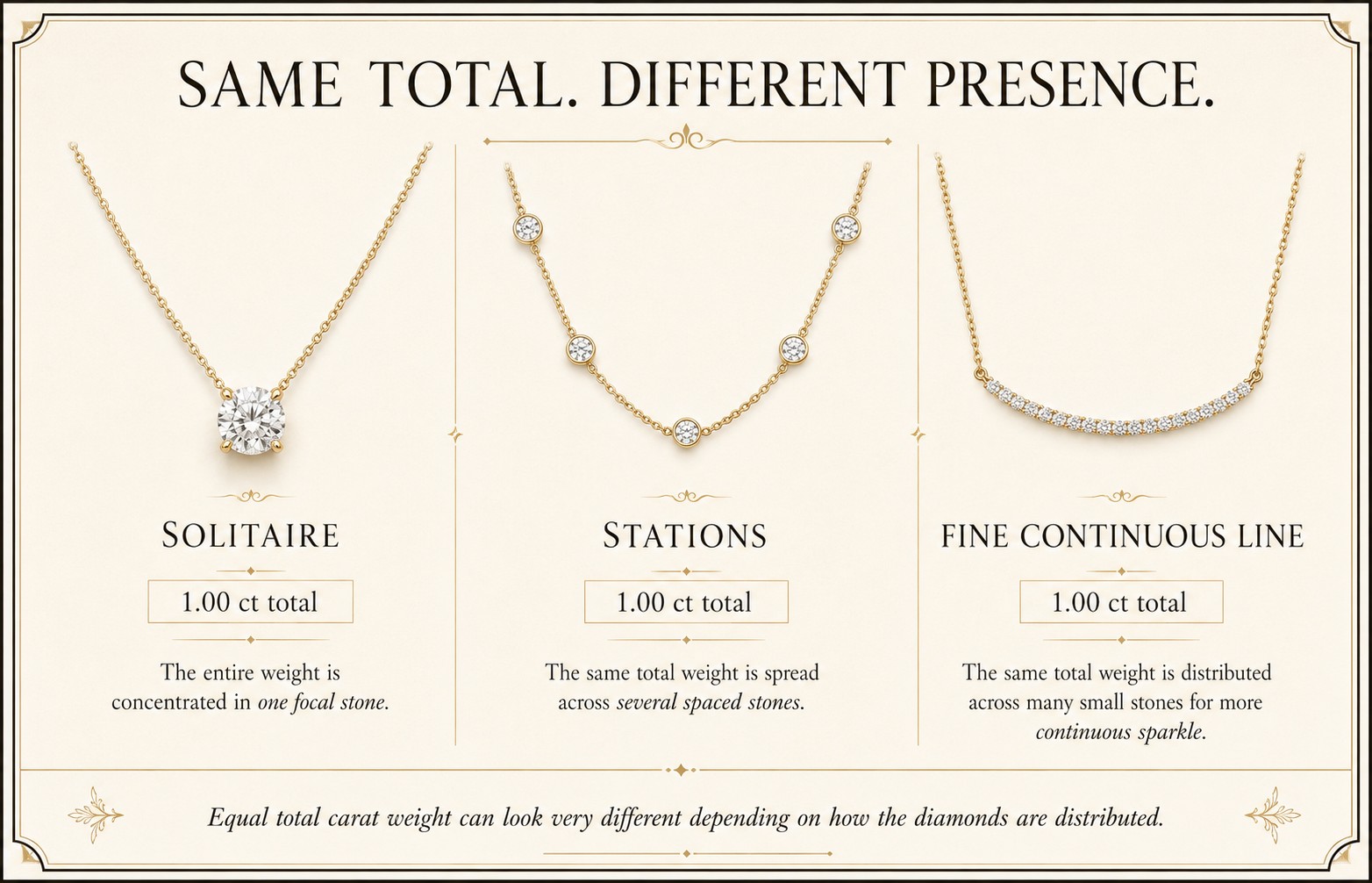
The best design puts diamonds where you want the eye to go — then use specifications to select the right product within that category.
Pendant vs Station vs Line Necklace: Which Should You Choose?
| If You Prioritise... | Consider First | Why |
|---|---|---|
| One dominant focal diamond | Pendant | Concentrates attention in one area |
| Subtle repeated sparkle | Station | Diamonds are distributed with visible space |
| Maximum neckline coverage | Line | Diamonds occupy a broad section |
| Visible precious-metal chain | Pendant / station | More chain remains exposed |
| Diamond-dominant appearance | Line | Less negative space between stones |
| Highly fluid chain movement | Station | Fine chain remains central to construction |
| Easy focal layering | Pendant | Creates a clear centre point |
| Light layering between pieces | Station | Adds dispersed sparkle |
| Strong standalone statement | Line | Broad diamond presence |
A Fictional Side-by-Side Example
Imagine three fictional laboratory-grown diamond necklaces. These specifications are for explanation only and do not represent Aurelia products or prices.
| Specification | Necklace A | Necklace B | Necklace C |
|---|---|---|---|
| Design | Pendant | Station | Line |
| Total diamond weight | 2.00 ct | 2.00 ct | 2.00 ct |
| Diamond distribution | 1 large centre + accents | 7 spaced stones | Many small linked stones |
| Visual focus | Centre | Distributed | Entire front neckline |
| Metal visibility | High | Moderate–high | Lower |
| Movement | Central pendant movement | Fluid | Controlled linked movement |
| Most important scale check | Pendant dimensions | Spacing + chain length | Diamond-set width + total length |
The fact that all three fictional necklaces contain 2.00 ct does not make them visually comparable. One emphasises an individual diamond. One emphasises rhythm. One emphasises coverage. That is why design architecture should be compared before total carat weight.
What to Check Before Comparing Prices
Do not compare the price of a pendant directly with a line necklace and assume the difference comes from diamond quality. First normalise the products. A meaningful comparison should consider: necklace category, largest diamond weight, total diamond weight, number of diamonds, physical dimensions, diamond-set coverage, metal, chain or link construction, length, setting style, and fastening. Only then can you ask whether the price difference reflects specifications you actually value.
For price analysis, use What Determines the Price of Lab-Grown Diamond Jewellery?
What About Diamond Colour and Clarity?
They still matter when they are part of the product specification. But this article should not become another 4Cs guide. The design decision comes first. A D/VVS pendant and a D/VVS line necklace are still fundamentally different products. Once you have chosen the necklace architecture, use the relevant product specification and reporting information to compare actual diamonds.
For the final verification process, use What to Check Before Buying Lab-Grown Diamond Jewellery
What if You Are Buying a Necklace Online?
Online imagery is excellent for identifying: design, stone placement, setting style, and styling. It is less reliable for understanding true physical scale. A pendant may look enormous in a macro shot. A line necklace may look thicker than it is. A model image gives additional context but still reflects that model's body proportions. Use actual measurements.
For remote assessment, use How to Choose Diamond Jewellery Without Seeing It in Person
What if Aurelia Does Not Display a Price?
Do not infer one from another necklace or from an external retailer. Where an Aurelia design does not currently have approved direct-purchase pricing, use: Join Waitlist or: Enquire About This Piece. Submitting an email address should register interest only. It should not imply that: a necklace has been purchased, the jewellery has been reserved, a price has been accepted, or: production has begun.
Frequently Asked Questions
What are the main types of diamond necklaces?▼
For this comparison, the main types are pendant, station and line necklaces. Other necklace categories also exist, but these three represent clearly different ways of distributing diamonds.
What is a diamond pendant necklace?▼
A pendant necklace uses one principal suspended focal element, which may contain one or several diamonds.
What is a diamond station necklace?▼
A station necklace places diamonds or decorative elements at intervals along a chain.
What is a diamond line necklace?▼
In this guide, it means a necklace where diamonds create a continuous or near-continuous line across a substantial part of the neckline.
Is a tennis necklace a line necklace?▼
A tennis-style necklace is one common continuous-line construction, although jewellery terminology varies between retailers.
Which design has the largest focal diamond?▼
Pendant designs are most likely to concentrate substantial diamond weight into one main stone, although actual specifications vary.
Which design gives the most diamond coverage?▼
A line necklace generally has the greatest potential neckline coverage because its stones are positioned continuously or near-continuously.
Which design shows the most chain?▼
Pendant and station necklaces usually leave more visible chain than dense line necklaces.
Which necklace moves the most?▼
Station necklaces can be especially fluid because they retain substantial flexible chain between diamond stations. Actual construction matters.
Does a pendant move?▼
Yes. Movement depends on how the pendant connects to the chain and its shape, mass and construction.
Can station diamonds move along the chain?▼
Many station designs use fixed stations, although movable designs also exist. Check the actual product.
Which necklace is easiest to layer?▼
Pendant and station necklaces can be easy layering pieces when their lengths are appropriately separated. Line necklaces can also be layered but often have stronger visual presence.
Does necklace length matter for a pendant?▼
Yes. Pendant size and necklace length together affect where the design sits.
Does necklace length matter for a line necklace?▼
Yes. The length affects where the diamond-set section follows the neckline.
Is 18 inches the best necklace length?▼
There is no universal best length. Body proportions, neck circumference, pendant size and styling preference affect the result.
Should I use model photographs to choose length?▼
Use them for context, but rely on actual measurements for fit.
Is total carat weight enough to compare necklaces?▼
No. The same total weight can be concentrated into one major diamond or distributed across many stones.
Can two 2 ct necklaces look completely different?▼
Yes.
Should I compare the largest diamond separately from TCW?▼
Yes when the necklace contains one important focal stone.
Is a line necklace automatically more expensive?▼
No. Price depends on the complete diamond, metal and construction specifications.
Is a pendant always cheaper than a line necklace?▼
No.
Is a station necklace always delicate?▼
No. Station designs can vary substantially in stone size, chain weight and spacing.
Is a line necklace only for formal wear?▼
No. Scale and construction matter more than the category name.
Is a pendant best for everyday wear?▼
It can be, but there is no universal rule.
Which design makes the strongest statement?▼
A broad line necklace can create strong overall coverage, while a large pendant can create an equally strong concentrated focal point.
Should I check the clasp?▼
Yes. The clasp should be appropriate to the necklace's weight and construction.
Should I check finished necklace weight?▼
It can provide useful context about physical presence where supplied, but it is not a quality grade.
Should I check the metal separately?▼
Yes. Diamond arrangement does not tell you what metal or fineness the necklace uses.
What should I verify before buying?▼
Check necklace type, length, dimensions, diamond distribution, total carat weight, metal, fastening, imagery and applicable documentation.
Final Answer: Pendant, Station or Line Necklace?
Choose a diamond pendant when you want one clear focal point. The design concentrates visual attention around the centre and allows the chain to remain an important part of the jewellery. Compare pendant dimensions and chain length carefully because both determine where the focal point sits.
Choose a station necklace when you want diamonds distributed around a visible chain. The spaces between stones create a lighter visual rhythm, while the flexible chain can give the necklace more fluid movement.
Choose a diamond line necklace when you want broader diamond coverage. Rather than one centre diamond or several separated stations, the stones form a continuous or near-continuous diamond presence across the neckline.
After selecting the category, compare the actual product. Check: where the diamonds sit, how the total carat weight is distributed, the physical dimensions, necklace length, diamond-set coverage, metal, movement, and: fastening. The strongest necklace choice is not simply the design containing the most diamonds. It is the design that puts the diamonds where you want the eye to go.
For total carat weight, use Total Carat Weight Meaning in Diamond Jewellery
For dimensions and finished weight, read How to Check Jewellery Dimensions and Weight Online
For workmanship, use What Makes Lab-Grown Diamond Jewellery High Quality?
For remote product evaluation, use How to Choose Diamond Jewellery Without Seeing It in Person
For final specifications, use What to Check Before Buying Lab-Grown Diamond Jewellery
Where an Aurelia Royale necklace does not yet have an approved direct-purchase price, Join the Waitlist or submit an enquiry. This should register interest only and should not be presented as an order, reservation or preorder.
Explore Aurelia Royale Lab-Grown Diamond Necklaces
Compare focal placement, coverage and movement — then choose the design that suits you.
Stay Connected
Get Our Latest Updates
Be first to discover new collections, exclusive events, and the quiet privileges reserved for our inner circle.