What Determines the Price of Lab-Grown Diamond Jewellery?
Carat, Metal, Dimensions, Construction and Documentation Explained • Published September 10, 2026
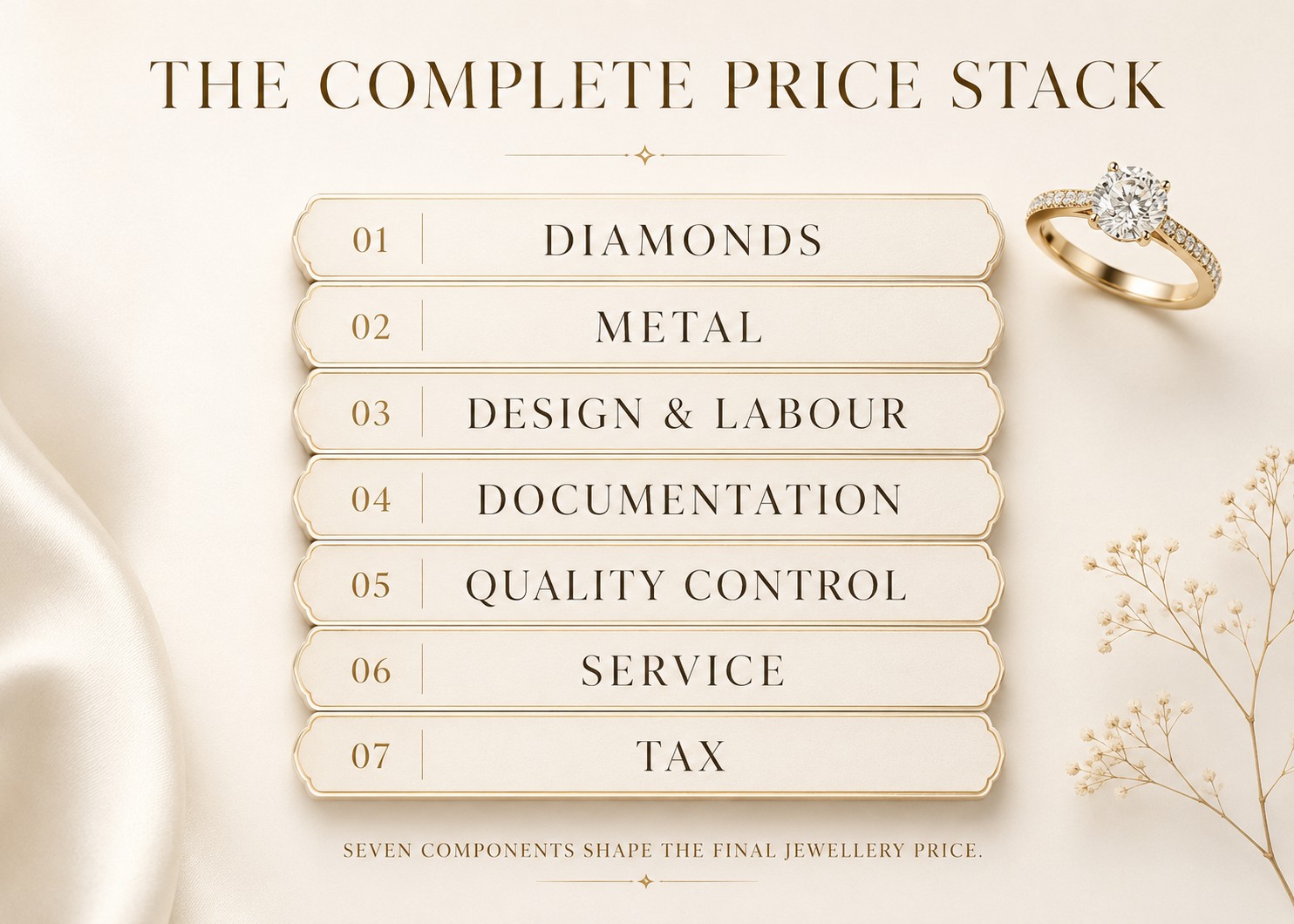
Price differences between similar-looking pieces usually come from diamond characteristics, metal, dimensions, construction and documentation — not from one factor alone.
Two pieces of lab-grown diamond jewellery can look remarkably similar in photographs and still have different prices. That does not necessarily mean one retailer is overpriced or that the cheaper product offers better value. The difference may come from the diamond itself, the amount and distribution of diamond weight, the precious metal, the physical scale of the jewellery, its construction, the complexity of the design, the type of documentation supplied or a combination of several factors.
The most useful way to understand jewellery pricing is therefore not to ask: "Why is this diamond jewellery expensive?" but: "Which characteristics are actually different between these two pieces?" Once those differences are clear, you can decide whether they matter enough to you to justify the price difference.
Quick Answer: What Affects the Price of Lab-Grown Diamond Jewellery?
The main factors are: the diamond or diamonds — including carat, cut, colour, clarity, shape and physical characteristics; the amount of diamond material — including centre-stone weight, accent stones and total diamond weight; the metal — including metal type, fineness, amount used and construction; the jewellery design — including setting complexity, stone count, dimensions and manufacturing requirements; documentation — including whether an individually significant diamond has independent laboratory reporting; and: the commercial product itself — including whether the comparison involves identical specifications, ready-made or made-to-order production and other verified product differences.
No single factor explains every jewellery price. The correct comparison looks at the complete piece.
1. The Diamond Is Only One Part of the Price
It is tempting to look at a jewellery product and assume most of its price can be explained by the centre diamond. That can sometimes be a major component, particularly in a solitaire design. But finished jewellery also contains: metal, setting work, additional diamonds, components, design, manufacturing, finishing, and the retailer's commercial costs.
This is why a one-carat loose diamond and a finished one-carat diamond necklace should not be compared as though they are the same product. Likewise, two jewellery pieces with the same centre-stone carat weight do not necessarily have similar total specifications.
2. Carat Weight Can Affect Price
Carat measures diamond weight. One metric carat equals 200 milligrams. All else being equal, carat weight is an important value factor, although equal-weight diamonds can have very different values because the other quality characteristics differ. GIA's 4Cs guidance explicitly notes that two diamonds of equal carat weight can have different values depending on colour, clarity and cut.
That means: 1.00 ct does not tell you the complete price story. You also need to know what kind of one-carat diamond it is.
Carat Is Not the Same as Visible Size
Two equal-carat diamonds can have different physical measurements. One may carry more of its weight in depth. Another may have a broader face-up outline. Shape also changes how weight is distributed. Therefore, a diamond that looks larger from above is not necessarily heavier. When comparing price for visual size, use both: carat weight and: millimetre dimensions.
For the detailed relationship, read Diamond Carat Weight vs Size
3. Centre-Stone Weight and Total Diamond Weight Are Different Price Factors
A piece of jewellery can contain a large centre diamond plus smaller accent stones. Another can distribute the same total diamond weight across many diamonds. Imagine these fictional examples: Ring A: 1.00 ct centre + 0.20 ct accents = 1.20 ct total. Ring B: 0.70 ct centre + 0.50 ct accents = 1.20 ct total. Both contain the same fictional total diamond weight. They are not equivalent products. Ring A concentrates more of the diamond weight in the centre. Ring B distributes more of it across the design. This difference can affect appearance, manufacturing and price.
For that reason, compare: centre-stone carat and: total carat weight separately.
For the full terminology, read Total Carat Weight Meaning in Diamond Jewellery
4. Cut Can Influence Diamond Value
Cut affects how a polished diamond interacts with light. For standard round brilliant diamonds under GIA's traditional cut framework, the assessment considers factors including brightness, fire, scintillation, weight ratio, girdle thickness, symmetry and polish. GIA describes cut as crucial to a diamond's beauty and value.
This matters for jewellery pricing because two diamonds with similar: carat, colour, and clarity can still differ meaningfully in cutting and proportions. For significant centre stones, do not compare price using carat alone.
5. Colour Can Affect Price
Diamond colour is another quality characteristic that can influence value. Within conventional D-to-Z grading, subtle distinctions can affect valuation even when they are difficult for an untrained observer to distinguish visually. GIA specifically notes that colour differences can materially affect diamond quality and price.
For a buyer, however, a more expensive colour grade is not automatically the better purchase. The relevant question is: Does the higher grade matter enough to you to justify the price difference?
For the grading concepts themselves, read Lab-Grown Diamond Colour Grades Explained
6. Clarity Can Affect Price
Clarity describes internal and external characteristics observed under controlled grading conditions. Higher clarity classifications can affect value because fewer or less significant characteristics are present. But the pricing difference and the visible difference are not the same question. A technically higher clarity grade may command a higher price while producing little visible change for a particular wearer under normal conditions.
This is why a buyer should not automatically pay more simply because one abbreviation ranks above another.
Use Lab-Grown Diamond Clarity Grades Explained when clarity is one of the major differences between products.
7. Shape Can Affect Pricing
A round, oval, emerald, pear and radiant diamond do not necessarily have identical production economics, cutting yields, demand patterns or market pricing even at similar carat and quality levels. That means it is poor methodology to compare: a 1.00 ct round, with: a 1.00 ct emerald cut and conclude the cheaper stone represents better value purely from the price. First make the products comparable by shape and quality. Then examine the difference.
8. Growth Method Is Not a Simple Price Grade
Laboratory-grown diamonds are principally produced through CVD and HPHT processes. But CVD and HPHT are manufacturing methods, not universal quality grades. One method should not automatically be marketed as "premium" and the other as inferior without evidence relating to the individual diamond. Price should still be interpreted through the actual stone characteristics and product specification.
For the deeper distinction, use CVD vs HPHT Lab-Grown Diamonds
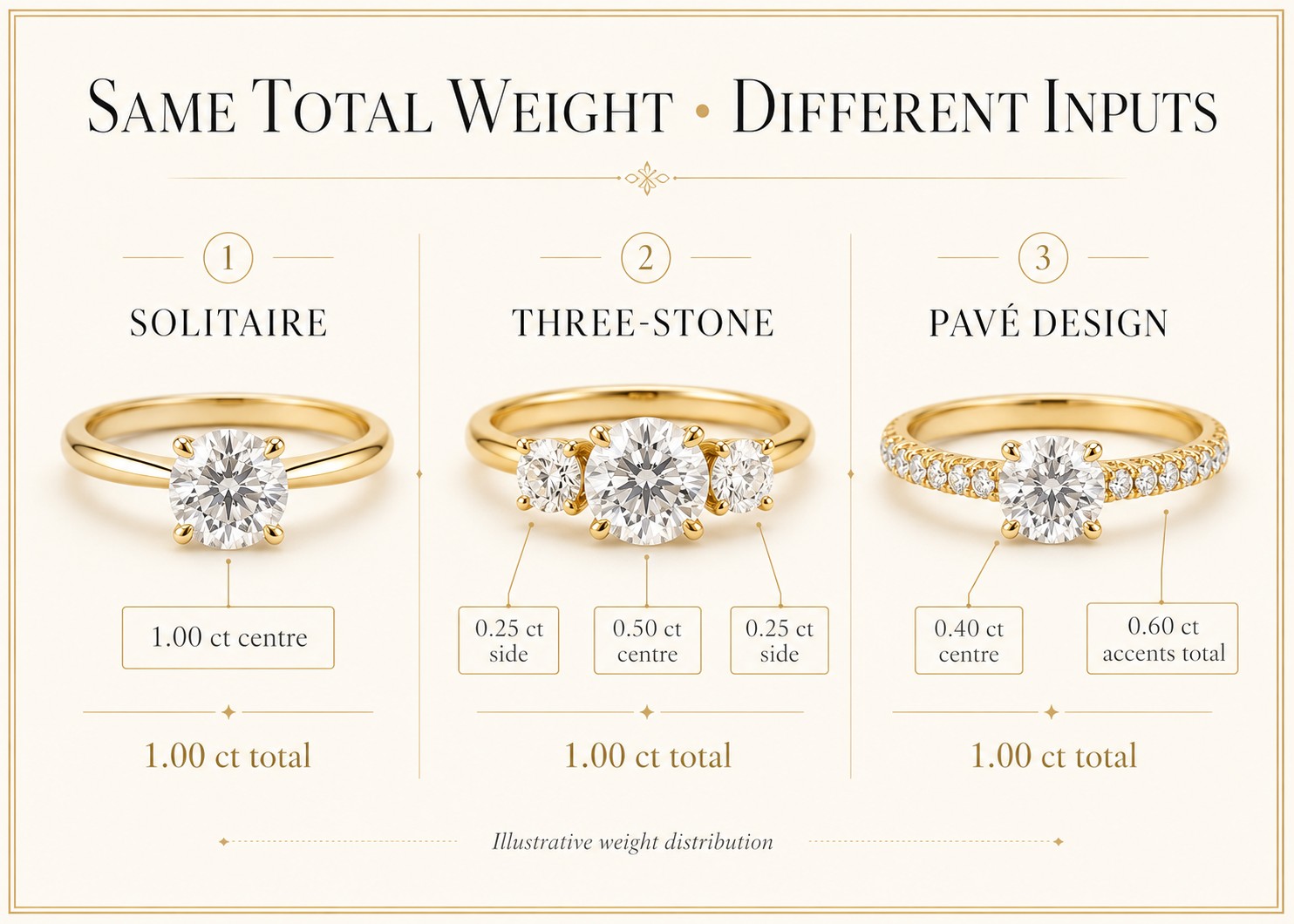
Stone count, matching, metal fineness, physical dimensions and design complexity all contribute to the full price picture.
9. The Number of Diamonds Can Affect the Finished Product
A solitaire with one diamond and a pavé design containing dozens of diamonds are very different jewellery constructions. Even where total diamond weight looks similar, the second piece requires multiple stones to be: selected, matched, positioned, and set. Stone count therefore changes the physical construction of the jewellery. Do not compare two products only by total carat weight if one uses a single stone and the other uses many.
10. Diamond Matching Can Matter in Multi-Stone Jewellery
Pairs and multi-stone designs are judged not only by the characteristics of one isolated diamond. The stones also need to work together visually. For example, stud earrings may use two centre diamonds intended to appear balanced as a pair. A tennis bracelet may contain many stones intended to create a consistent visual sequence. This does not mean every product requires identical individual laboratory reports. It means how diamonds are distributed and matched is part of the finished product, not just the headline carat total.
11. Metal Type and Fineness Affect the Product
Diamond jewellery is not priced from the diamonds alone. The precious metal matters. A piece made from: 18ct gold, 14ct gold, sterling silver, platinum, or a plated construction is not materially identical. For UK hallmarking, the fineness mark identifies the precious-metal content in parts per thousand. For example, a 375 gold fineness mark indicates at least 375 parts gold per 1,000. The British Hallmarking Council also notes that fineness affects the value of a precious-metal article.
So when two pieces look similar but use different metal specifications, their prices should not be compared as if everything else were equal.
12. Metal Colour Alone Does Not Explain Price
Two yellow-coloured pieces may look similar online. One could be gold throughout. Another could use silver or another underlying material with gold plating. Those constructions are different. Similarly, white gold and platinum can produce broadly similar colour families while being different materials. Compare: underlying metal, fineness, plating, and: construction rather than visual colour alone.
For the detailed verification process, read How to Check the Metal Used in Diamond Jewellery
13. The Amount of Metal Can Matter
Even two pieces made from the same alloy can use different quantities of metal. A wide ring may contain more metal than a very fine band. A substantial pendant may use more material than a smaller pendant. A long or heavy bracelet may contain more precious metal than a delicate design. Finished jewellery weight can therefore provide useful context, although it should never be treated as a universal quality score. A heavier item is not automatically better. It is simply a different physical product.
14. Hollow and Non-Hollow Construction Should Not Be Confused
Two items can genuinely use the same precious-metal alloy but differ in construction. A hollow article may contain less material than a visually similar non-hollow design. That difference can affect: weight, wearing feel, production, and potentially price. Hollow does not mean plated. Plated does not mean hollow. These are separate construction concepts.
15. Jewellery Dimensions Affect What You Are Actually Comparing
Suppose two diamond pendants look almost identical on a website. Pendant A is 9 mm wide. Pendant B is 15 mm wide. Even before examining the diamonds, these are materially different physical products. The same applies to: band width, earring diameter, bracelet width, pendant height, chain length, and setting dimensions. Because ecommerce images are often magnified, dimensions should be compared before concluding that two designs are equivalent.
For the full measurement framework, use How to Check Jewellery Dimensions and Weight Online
16. Design Complexity Can Affect Price
Jewellery with a simple structure and jewellery with multiple components do not necessarily require the same production work. Consider the difference between: a simple solitaire, a halo, a multi-row pavé ring, an articulated tennis bracelet, and a complex multi-stone pendant. The number of settings, joints, components and finishing areas can change. That does not mean more complicated always means better. It means design itself can be one of the factors behind a price difference.
17. Setting Style Can Change the Product
Prong, bezel, pavé, channel and other setting approaches involve different constructions. They can also use different amounts of metal and different stone-setting requirements. A bezel-set diamond and a four-prong-set diamond may therefore differ even when the stones themselves have comparable specifications. Do not isolate the diamond from the jewellery architecture holding it.
18. Ready-Made and Made-to-Order Jewellery Can Have Different Commercial Structures
A ready-made piece already exists. Made-to-order jewellery still requires production after an order is accepted. That distinction can affect the retailer's inventory and production model. However, do not create a universal pricing rule such as: made to order is always more expensive or: ready-made jewellery is always cheaper. Neither is reliably true across every business and design.
For the buying-model distinction, read Ready-Made vs Made-to-Order Diamond Jewellery
19. Customisation Can Add Different Requirements
A standard jewellery product and a genuinely customised product should not automatically be expected to have identical pricing. Changes to: design, dimensions, stone configuration, engraving, or other individually agreed features can alter what needs to be produced. But do not assume Aurelia provides all of these customisations. Only publish options the client has actually confirmed.
20. Laboratory Reporting Can Be Part of the Product Specification
Independent laboratory documentation can provide valuable information about a diamond. IGI states that its loose-diamond reports identify natural or laboratory-grown origin and document the diamond's 4Cs. Its current lab-grown reporting also documents relevant gemmological characteristics, with growth process and treatment information available in report comments where applicable.
The important pricing point is not: certificate = automatically expensive. It is: reported and non-individually-reported products may not be identical product propositions. When documentation differs, include that difference in the comparison.
21. Loose-Stone and Mounted-Jewellery Reports Are Not Equivalent
IGI also offers jewellery reports for finished pieces. For mounted centre stones, measurements and 4Cs assessments are provided as mounting permits; where the setting limits examination, colour and clarity can be reported as ranges and cut can be estimated. Therefore, two products both described as "certified" may not have identical report types or scopes. Compare what each report actually covers rather than the presence of a laboratory logo alone.
22. A Report Does Not Set the Retail Price
A laboratory report documents gemmological characteristics. It does not dictate what a retailer must charge. Two sellers could theoretically offer diamonds with similar grading characteristics at different prices because their: jewellery, commercial models, operating costs, service, inventory, and margins are different. Do not treat a grading report as a retail price certificate.
23. Branding Can Affect Retail Price Without Changing Diamond Grades
Finished jewellery is also a retail product. Brand positioning, store model, design identity, marketing, service structure and operating costs can contribute to pricing. That does not automatically make the higher-priced product poor value. Nor does a lower price automatically mean a bargain. The buyer needs to distinguish: technical specification from: retail proposition. This is one reason two products with apparently similar diamonds may still have different final prices.
24. Customer Service Can Be Part of the Retail Proposition
Some retailers may include more support within the commercial price than others. However, do not assume a more expensive product automatically includes: free resizing, lifetime repair, insurance, free servicing, extended returns, or any other specific benefit. Those services need to be explicitly confirmed. For Aurelia, no such promises should be incorporated into price explanations unless the client has approved them.
25. Availability Can Affect What You Are Comparing
A product that already exists and a product available only through future production are not necessarily identical purchasing propositions. But again, avoid unsupported rules such as: in-stock means cheaper or: made-to-order costs more. Instead identify the actual difference in availability.
For waitlist, preorder and production terminology, use How to Understand Jewellery Availability and Production Time
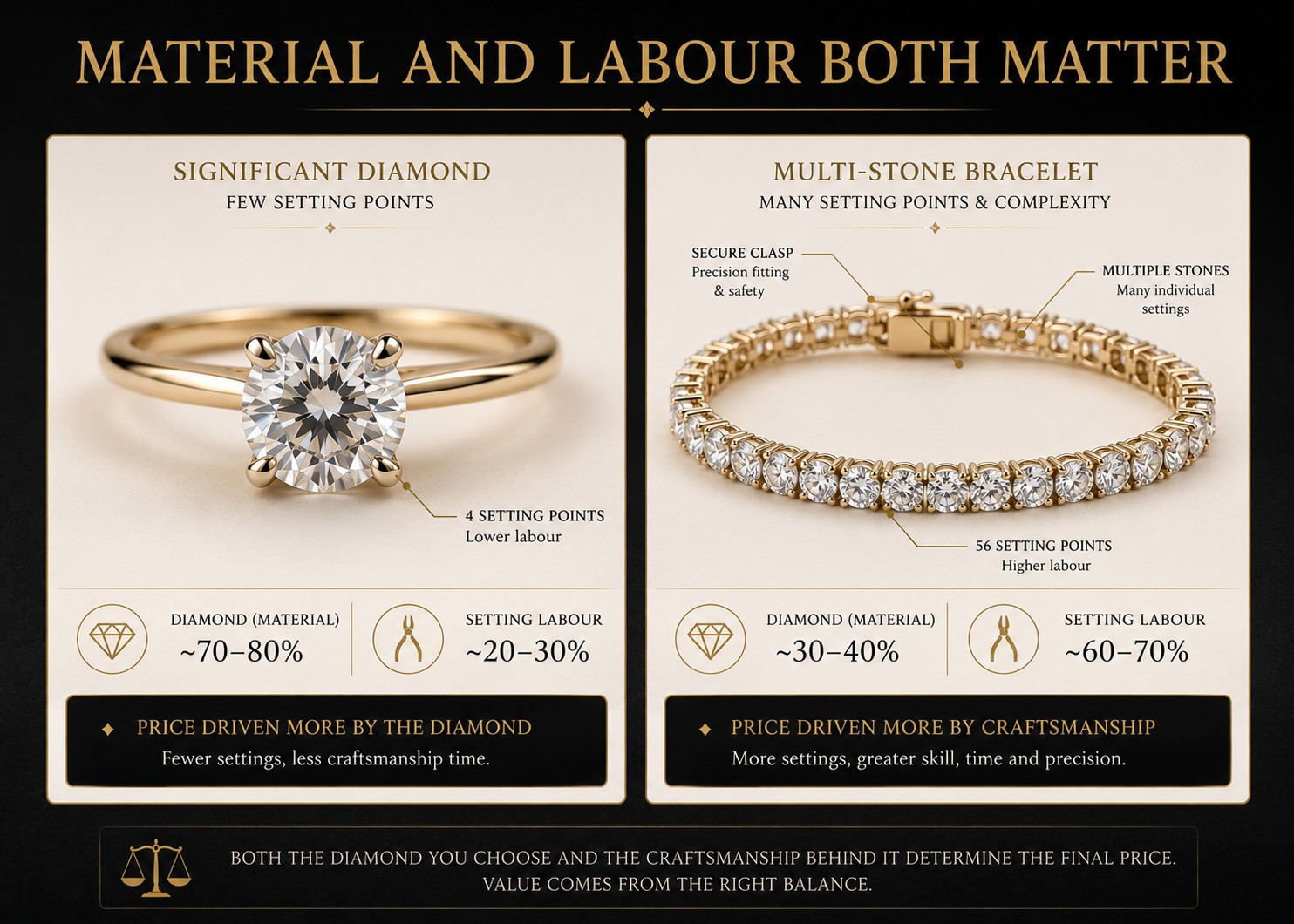
Until the specifications are normalised across all fields, the price comparison is incomplete — ask 'what changed?' rather than 'which one is cheaper?'
Why Similar-Looking Jewellery Can Have Different Prices
Imagine two rings photographed from the same angle. Both appear to have: one oval centre diamond, a slim yellow-metal band, and small accent diamonds. At first glance, they look comparable. But one might contain: a larger centre diamond, more total accent weight, a different gold fineness, a wider band, an individually reported centre stone, or different jewellery dimensions. Until those fields are normalised, the price comparison is incomplete. This is why the most useful question is: "What changed?" rather than: "Which one is cheaper?"
A Fictional Worked Example
The following figures are entirely illustrative. They are not Aurelia Royale prices, market benchmarks or recommendations.
| Specification | Fictional Ring A | Fictional Ring B |
|---|---|---|
| Price | £1,250 | £1,650 |
| Centre diamond | 1.00 ct | 1.20 ct |
| Accent diamonds | 0.20 ct | 0.30 ct |
| Total diamond weight | 1.20 ct | 1.50 ct |
| Centre dimensions | 8.0 × 5.8 mm | 8.7 × 6.2 mm |
| Colour | G | F |
| Clarity | VS2 | VS1 |
| Metal | 14ct gold | 18ct gold |
| Band width | 1.7 mm | 2.1 mm |
| Centre report | Individual report | Individual report |
Ring B costs £400 more in this fictional example. But the explanation is not simply: "Ring B is better." Several things changed simultaneously: the centre stone became heavier, the total diamond weight increased, the centre stone became physically larger, colour and clarity changed, metal fineness changed, and the band became wider. The buyer's next question should be: Which of those differences actually matters to me? That is a budget decision rather than a price-factor question.
For that step, use How to Set a Budget for Lab-Grown Diamond Jewellery
A Better Way to Compare Price
Before deciding whether one product is expensive, make the comparison like-for-like. Compare: the same jewellery category, similar design type, centre-stone carat separately from TCW, physical dimensions, colour, clarity, cut information, metal and fineness, finished-jewellery dimensions, report scope, and applicable commercial terms. Only then compare price. This approach prevents apparently cheap products from winning comparisons simply because important specifications were different or missing.
For the complete side-by-side method, use How to Compare Lab-Grown Diamond Jewellery Online
Price Difference vs Value Difference
Price and value are related but not identical. Suppose one product costs £300 more because it has a higher clarity grade. That explains part of the price difference. Whether that improvement creates £300 of additional value to you depends on your preferences. Another buyer might gladly pay more for: larger visible size, different metal, or a preferred design while choosing a lower clarity. This is why a price-factor guide cannot tell everyone which product to buy. It can tell you what changed. You decide whether the change matters.
Does a Bigger Diamond Always Cost More?
If every other factor were genuinely identical, higher carat weight can contribute to higher diamond value. But real products rarely differ in only one variable. A larger diamond can simultaneously have: different colour, different clarity, different cut, different dimensions, or another shape. Therefore, do not use carat alone to predict the final retail price.
Does Higher Clarity Always Cost More?
Clarity can influence value, but actual pricing depends on the complete diamond and market. Do not turn a general relationship into a fixed percentage. There is no responsible universal statement such as: VVS always costs X% more than VS. The difference depends on the exact stones and market conditions.
Does Higher Colour Always Cost More?
Colour can affect value, but again there is no safe universal percentage uplift across all laboratory-grown diamonds and jewellery. Compare the actual products. Avoid publishing static formulas unless they are based on current verified inventory or market datasets.
Are Round Diamonds Always More Expensive?
Do not publish this as an absolute rule. Shape can influence market pricing, cutting economics and demand, but the actual result depends on the diamonds being compared. A higher-quality fancy shape could easily cost more than a lower-quality round. Make shape one comparison field rather than a universal pricing rule.
Does CVD Cost More Than HPHT?
There is no responsible universal rule that CVD must always cost more or less than HPHT. Growth method is only one characteristic of a laboratory-grown diamond. Compare the individual stones rather than assuming one manufacturing method guarantees a price tier.
Does Certification Make Jewellery More Expensive?
Independent reporting can be one component of the product proposition. But there is no universal surcharge you should apply simply because a report exists. A report documents characteristics. It does not set the retail price.
Does More Gold Mean a Higher Price?
The amount and fineness of precious metal can influence material value, but the final retail price depends on the entire product. Finished gram weight can provide context, but it should not be used alone to calculate whether a jewellery price is "fair". The product also contains design, diamonds, manufacturing and other components.
Why Are Two 1-Carat Rings Different Prices?
Because 1 carat tells you only one characteristic of one part of the product. The rings may differ in: cut, colour, clarity, shape, measurements, accent diamonds, metal, fineness, band dimensions, construction, reporting, or design. A fair comparison has to examine those differences.
Why Are Lab-Grown Diamond Jewellery Prices Different Between Retailers?
Retailers can differ in: product specification, design, inventory model, service, business costs, brand positioning, and commercial margin. Therefore, even genuinely similar products need not have identical prices. The useful comparison remains: product → evidence → terms → final price.
Should You Buy the Cheapest Lab-Grown Diamond Jewellery?
Not solely because it is cheapest. First confirm that the specifications you care about are genuinely comparable. A lower price might be an excellent result. Or it might reflect: less diamond weight, different metal, smaller dimensions, different grades, different construction, or a completely different product proposition. You cannot know until the specifications are normalised.
Does a Higher Price Mean Better Quality?
Not automatically. A higher price can result from characteristics that matter to you. It can also result from commercial factors unrelated to diamond grade. Therefore: higher price ≠ automatic proof of better jewellery and: lower price ≠ automatic proof of better value. Compare the underlying differences.
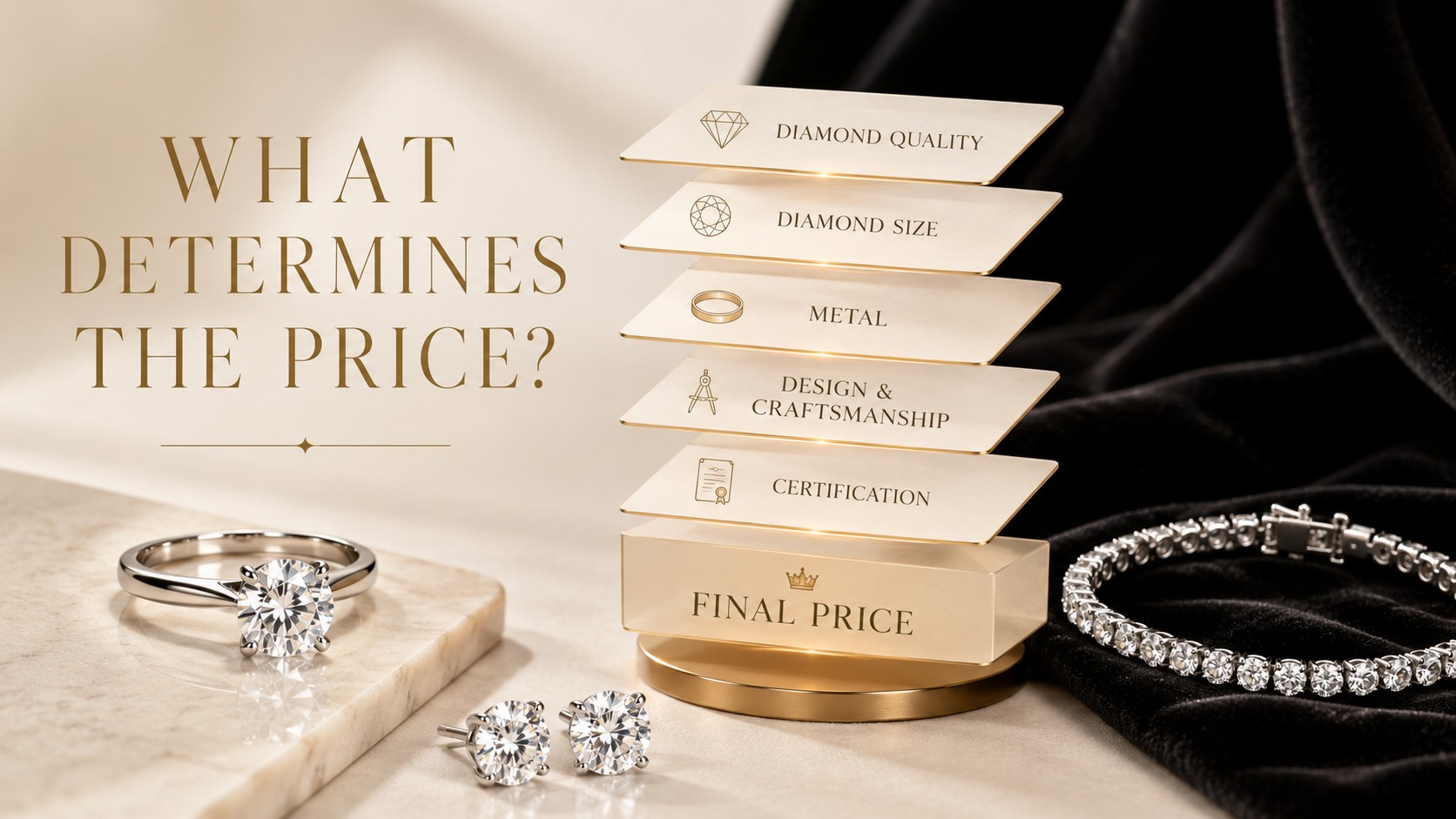
The strongest pricing framework: diamond → diamond distribution → metal → construction → dimensions → documentation → commercial proposition.
Frequently Asked Questions
What determines the price of lab-grown diamond jewellery?▼
The price can reflect the diamond characteristics, total diamond weight, metal, amount of material, jewellery dimensions, design, construction, documentation and the retailer's overall commercial proposition.
Does carat affect lab-grown diamond price?▼
Carat is an important value factor, but it should be considered with cut, colour and clarity. GIA notes that equal-carat diamonds can have different values because the other 4Cs differ.
Does cut affect price?▼
Cut can influence diamond value and appearance, particularly for shapes where an overall cut assessment applies.
Does colour affect price?▼
Yes, colour can influence diamond value, although the actual monetary difference depends on the diamonds and market rather than a universal percentage.
Does clarity affect price?▼
Yes. Clarity is a value characteristic, but the price impact varies.
Is a larger diamond always more expensive?▼
Not necessarily when other characteristics differ.
Is carat the same as visible size?▼
No. Carat measures weight.
Why can equal-carat diamonds have different prices?▼
Because their cut, colour, clarity, shape, proportions and other characteristics can differ.
Does total carat weight affect jewellery price?▼
It can, but TCW should be considered with stone distribution, number of stones and product construction.
Is TCW the same as centre-stone carat?▼
No.
Why does metal affect jewellery price?▼
Different precious metals and finenesses represent different material compositions. UK hallmarking uses fineness marks to identify precious-metal content.
Is 18ct gold the same as 14ct gold?▼
No. They have different gold finenesses.
Is gold-plated silver the same as gold jewellery?▼
No.
Is platinum the same as white gold?▼
No.
Does finished jewellery weight affect price?▼
The amount of material can contribute to the product's cost, but gram weight is not a complete quality or price formula.
Does a complex setting cost more?▼
It can require different production and stone-setting work, but there is no universal fixed price multiplier.
Does having more diamonds always mean a higher price?▼
Not automatically. Stone size, total weight, quality and construction all matter.
Do matched earrings cost differently from one diamond?▼
A pair is a different product requiring two stones intended to work together. Compare the full pair specification rather than one stone alone.
Does IGI reporting affect value?▼
An IGI report independently documents relevant diamond characteristics and origin; it should be treated as documentation rather than as a retail-price guarantee.
Is a jewellery report the same as a loose-diamond report?▼
No. IGI notes that mounted jewellery can be assessed "as mounting permits", sometimes using ranges or estimated information where the setting limits examination.
Does an IGI report guarantee a specific retail price?▼
No.
Is CVD always cheaper than HPHT?▼
No universal pricing rule should be assumed.
Is HPHT always cheaper than CVD?▼
No.
Does made-to-order jewellery always cost more?▼
No.
Does ready-made jewellery always cost less?▼
No.
Does bespoke jewellery always cost more?▼
Do not assume a universal rule. Compare the actual work and specification involved.
Why can two visually similar rings have different prices?▼
They may differ in centre diamond, total diamond weight, grades, dimensions, metal, construction or documentation.
Does the cheapest jewellery offer the best value?▼
Not necessarily.
Does the most expensive jewellery have the best quality?▼
Not necessarily.
How do I know whether a price difference is worth paying?▼
Identify exactly what changes between the two products and decide whether those differences match your priorities.
How should I set my budget?▼
Use How to Set a Budget for Lab-Grown Diamond Jewellery to establish a spending limit and prioritise where you want that budget to go.
How should I compare two finished products?▼
Use How to Compare Lab-Grown Diamond Jewellery Online.
What if Aurelia does not currently publish a product price?▼
Do not estimate it. Join the waitlist or submit an enquiry and evaluate the confirmed price once Aurelia provides it.
Final Answer: Why Does Lab-Grown Diamond Jewellery Pricing Vary?
Start with the diamond, but do not stop there. Carat, cut, colour, clarity, shape and dimensions can all differentiate individual diamonds. Then look at how the jewellery uses those diamonds. Separate centre-stone weight from total diamond weight and consider the number and distribution of accent stones.
Next, examine the metal. Check the underlying precious metal, fineness, amount used and relevant construction rather than judging by colour alone. Then compare the finished jewellery. Physical dimensions, setting style, number of components and design complexity can make two superficially similar pieces fundamentally different products.
Finally, understand what documentation and commercial proposition apply. An individually reported centre stone is not the same situation as an unreported accent-stone product, while a grading report itself does not dictate retail price.
The most useful pricing framework is therefore: Diamond → diamond distribution → metal → construction → dimensions → documentation → commercial proposition. If two products have different prices, move through those categories and identify what actually changed. Then ask a separate question: Is that difference worth paying for according to my priorities?
For that decision, continue with How to Set a Budget for Lab-Grown Diamond Jewellery
For a structured side-by-side comparison, use How to Compare Lab-Grown Diamond Jewellery Online
For carat versus physical dimensions, read Diamond Carat Weight vs Size
For combined diamond weight, use Total Carat Weight Meaning in Diamond Jewellery
For precious-metal differences, continue with How to Check the Metal Used in Diamond Jewellery
For jewellery dimensions, use How to Check Jewellery Dimensions and Weight Online
Where an Aurelia Royale piece does not yet have an approved published price, do not infer a price from another product or external retailer. Join the Waitlist or submit an enquiry and evaluate the confirmed offer when it is available.
Explore Aurelia Royale Lab-Grown Diamond Jewellery
Compare diamonds, metal, dimensions and construction — not just price.
Stay Connected
Get Our Latest Updates
Be first to discover new collections, exclusive events, and the quiet privileges reserved for our inner circle.