
What Makes Lab-Grown Diamond Jewellery High Quality?
Diamond, Metal, Setting, Finishing, Clasps and Workmanship Explained • Published September 10, 2026
High quality requires both good materials and good execution — diamond quality alone does not determine jewellery quality.
A high-quality lab-grown diamond does not automatically create high-quality jewellery. The diamond is only one part of the finished piece.
A ring can contain an attractive, independently reported diamond and still have poorly executed prongs. Earrings can contain good diamonds but uncomfortable posts or poorly aligned settings. A bracelet can use the stated precious metal yet still have weak joints or an unsuitable clasp.
To judge the quality of finished diamond jewellery, look at the complete construction: diamond quality, metal specification, stone security, setting workmanship, alignment, finishing, proportions, moving components and suitability for the way the jewellery will be worn.
GIA's jewellery-manufacturing quality benchmarks make the same broader point: jewellery quality depends not only on the gemstone but also on design engineering, setting, assembly and finishing.
The most useful question is therefore not simply: "Is this a high-quality diamond?" It is: "Has this diamond been incorporated into a well-designed, properly constructed and well-finished piece of jewellery?"
Quick Answer: What Makes Lab-Grown Diamond Jewellery High Quality?
High-quality lab-grown diamond jewellery combines an appropriate diamond specification with well-executed jewellery construction. Look for a stone that matches the disclosed specifications, the correct precious metal and fineness, secure and appropriately shaped settings, consistent alignment, smooth finishing, functional clasps or hinges where relevant and dimensions suitable for the intended wear.
For prong-set jewellery, the prongs should contact and secure the stone appropriately rather than merely appearing to surround it. GIA's workmanship benchmarks show that good prongs are evenly shaped and positioned, while poor seating, short prongs and incomplete contact can increase the risk of stone loss.
A hallmark can help verify precious-metal fineness, but it does not tell you whether the jewellery has been well made. Likewise, a diamond grading report can describe the diamond without grading the craftsmanship of the finished setting. High quality therefore requires both: good materials and: good execution.
1. Start by Separating Diamond Quality From Jewellery Quality
This is the most important distinction. A diamond can be evaluated using characteristics such as: carat, colour, clarity, cut, measurements, polish, symmetry, and relevant laboratory documentation. Finished jewellery requires a different assessment.
You also need to consider: how securely the diamond is set, whether the setting suits the stone, whether components align correctly, how the metal has been finished, whether moving parts operate properly, and whether the overall design is suitable for normal wear.
A grading report may tell you a centre diamond is 1.20 ct, F colour and VS1 clarity. It cannot tell you whether a poorly shaped prong is likely to snag on clothing. That is workmanship.
2. Lab-Grown Origin Does Not Determine Jewellery Workmanship
A laboratory-grown diamond can be incorporated into very fine jewellery. It can also be incorporated into poorly made jewellery. The same is true of a natural diamond. Diamond origin and jewellery workmanship are separate questions.
For the broader question of whether laboratory-grown diamonds are suitable for fine jewellery, use Are Lab-Grown Diamonds Suitable for Fine Jewellery?
3. A High-Quality Diamond Still Needs the Right Setting
Diamonds are extremely hard, but hardness is not the same as resistance to every type of damage. GIA notes that diamonds can chip or break when struck in vulnerable directions, and shapes with exposed points or corners can require appropriate protection.
This means setting design matters. A pear-shaped diamond, for example, may require suitable protection around its pointed end. A ring intended for frequent wear needs different practical consideration from a pendant that experiences fewer impacts. The setting should support the stone rather than simply make it look attractive.
4. What Does a Good Prong Setting Look Like?
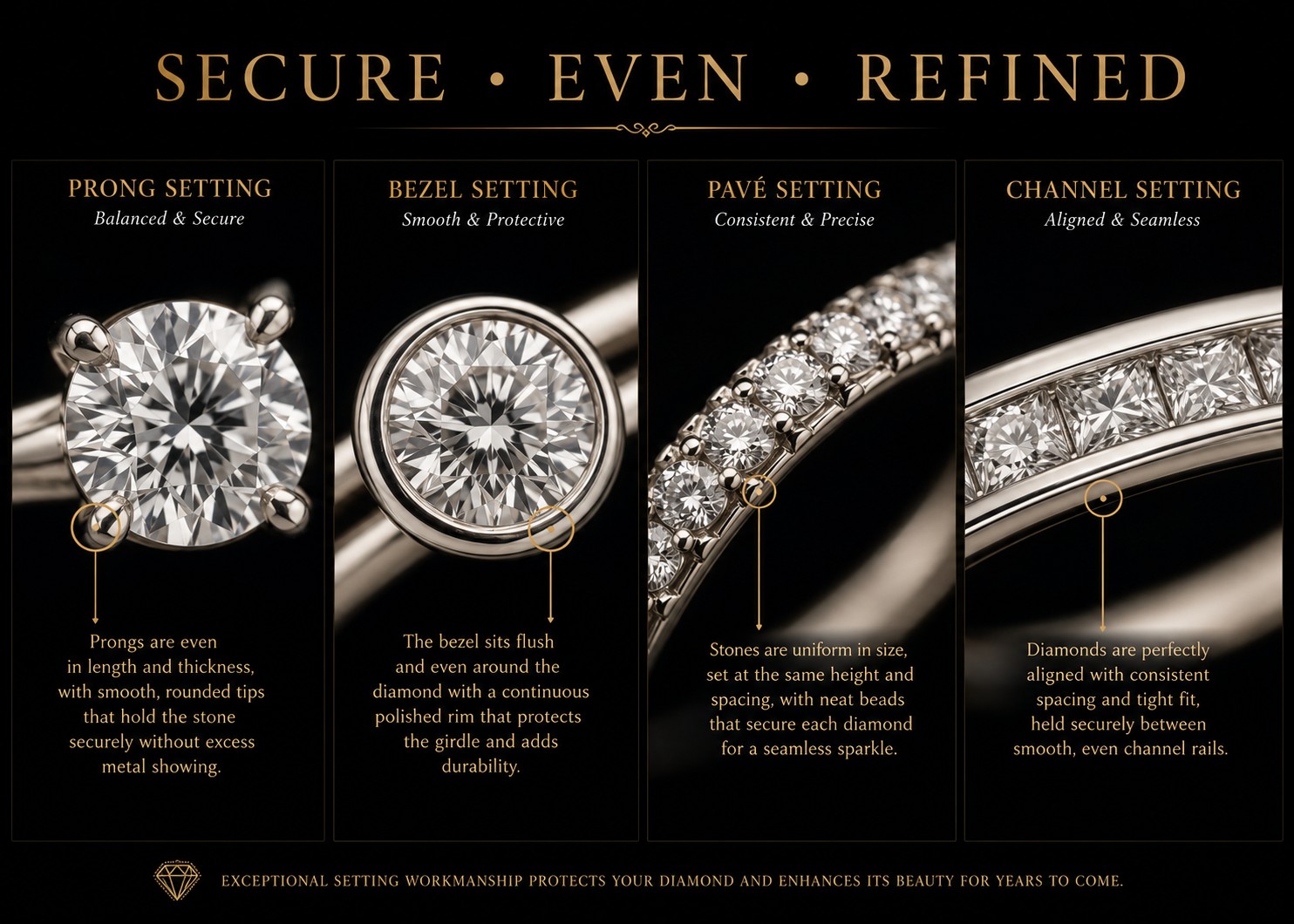
Prongs are small, but their execution is one of the clearest indicators of setting workmanship. In a well-executed prong setting, the prongs should be: appropriately positioned, consistent in shape, properly seated against the stone, and finished so that unnecessary sharpness or snagging is minimised.
GIA's quality-assurance material describes well-finished prongs as evenly rounded and consistent in size and shape. It also explains that proper prong tension is necessary to hold a gemstone securely. The aim is not simply symmetry for appearance. The prongs actually need to retain the stone.
Secure vs Weak Prong Construction
| More reassuring workmanship | Potential warning sign |
|---|---|
| Prongs make appropriate contact with the stone | Visible gap between prong and stone |
| Prongs are reasonably consistent in shape | One prong is noticeably shorter or thinner |
| Stone sits evenly in the setting | Stone appears tilted without design reason |
| Prongs are positioned logically around the stone | Prongs look displaced or badly asymmetric |
| Tips are properly finished | Rough, sharp or heavily protruding prongs |
| Stone feels secure | Stone visibly or audibly moves |
GIA has documented poor workmanship examples where stone seats were incorrectly cut, prongs were short and multiple prongs failed to make full contact with the centre stone—conditions associated with increased stone-loss risk.
5. A Prong Can Look Present Without Actually Holding the Stone Properly
This distinction is important when buying online. Seeing four or six prongs in a photograph does not prove the diamond is secure. Security depends on: the stone seat, the position of the prong, actual contact with the stone, metal condition, and appropriate tension.
GIA notes that a loose gemstone can damage both the gemstone and setting, and a loose diamond can eventually wear against the metal holding it. That is why visible design and physical security should not be treated as identical.
6. What Makes a Good Bezel Setting?
A bezel secures a gemstone using a rim of metal around some or all of its perimeter. A well-executed bezel should visually follow the stone in a controlled, intentional way. Look for: reasonably even metal coverage, smooth finishing, a centred stone, and no obvious unintended gaps between the stone and the metal.
A poorly executed bezel might show: uneven metal height, obvious gaps, rough edges, or a stone that appears incorrectly positioned within the setting. A bezel is not automatically higher quality than prongs. It is simply a different construction. Execution still matters.
7. What Makes Pavé Workmanship High Quality?
Pavé can involve many small diamonds set closely together. This means workmanship has to remain consistent across a much larger number of setting points. Look for: reasonably even stone spacing, consistent rows, similar stone heights, controlled bead or prong placement, and an intentional overall pattern.
Potential concerns include: stones visibly sitting at different angles, irregular spacing, broken visual lines, uneven setting beads, or obvious areas where stones appear insufficiently retained. A pavé design can look extremely refined when properly executed. But having more diamonds does not automatically mean the jewellery is higher quality.
8. What Makes a Good Channel Setting?
Channel-set diamonds are secured between metal walls rather than individual visible prongs. The quality of the setting depends on consistent stone seating and proper channel construction. Look for: stones that form a controlled line, reasonably consistent spacing, appropriate alignment, and no obviously loose or tilted stones.
A poorly executed channel can show: uneven stone heights, unintended gaps, misalignment, or inconsistent metal edges. Again, the setting style itself is not the quality grade. The execution determines quality.
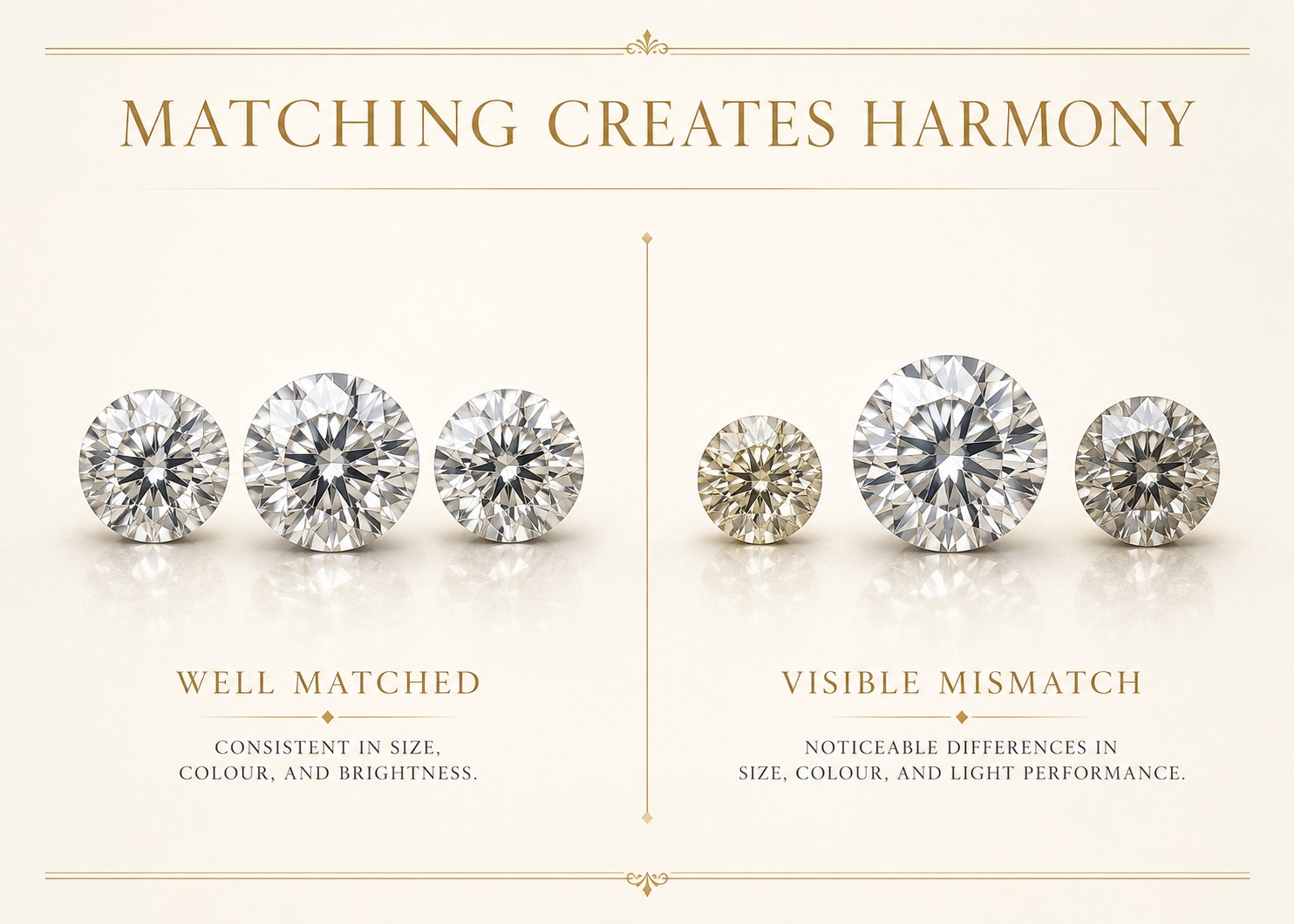
Well-made jewellery generally looks intentional from multiple angles — visible inconsistency suggests poor assembly or setting.
9. Alignment Is a Major Workmanship Signal
Well-made jewellery generally looks intentional from multiple angles. On a symmetrical design, check whether the jewellery actually appears symmetrical. For example: Is the centre stone correctly centred? Are halo stones distributed evenly? Do earrings appear matched as a pair? Does a pendant hang in the intended orientation? Are bracelet links aligned consistently? Are decorative elements positioned where the design suggests they should be?
Small handmade variations can exist without indicating poor workmanship. The concern is not microscopic mathematical perfection. It is visible inconsistency that suggests poor assembly or setting.
10. Check the Jewellery From the Side, Not Just the Front
Front-facing product photography shows the design. Side views often reveal construction quality more clearly. For a ring, a side view can reveal: setting height, basket structure, prong shape, gallery construction, stone seating, and how the setting joins the shank.
For earrings, side and rear views can reveal: post alignment, setting depth, hinges, and fastening design. For pendants, side and rear views can reveal how the stone setting, bail and pendant body connect. This is why judging workmanship from one hero image is difficult.
11. Smooth Finishing Matters
Jewellery finishing affects appearance, comfort and perceived refinement. Well-finished jewellery should generally avoid unintended: sharp burrs, rough edges, deep tool marks, irregular surfaces, or unfinished-looking areas that are visible or contact the wearer.
GIA's Quality Assurance Benchmarks include dedicated processes for prefinishing, polishing and buffing because finishing is part of jewellery workmanship rather than merely cosmetic presentation. Highly polished jewellery does not have to be mirror-finished everywhere. Some designs intentionally use: satin, brushed, textured, or matte surfaces. Quality means the finish appears intentional and consistent with the design.
12. Look at the Areas Most Photography Hides
The front of jewellery is usually the most carefully presented part. Quality assessment should also consider less visible areas. For a ring, look at: the inside of the shank, underside of the setting, gallery, and joins. For a pendant, look at: the reverse, bail, and chain attachment. For earrings, inspect: the post, hinge, back, or latch. For bracelets, examine: link connections, underside, and clasp. These areas can reveal whether the entire piece has been finished carefully rather than only the visible face.
13. Joins and Connections Should Look Deliberate
Many jewellery pieces contain several components joined together. A ring head may join a shank. A pendant may connect to a bail. A bracelet contains repeated links. An earring may contain a hinge and post. Look for connections that appear: properly aligned, structurally appropriate, and cleanly finished.
Potential warning signs include: visible unintended gaps, components sitting at incorrect angles, excess material around joints, or obvious roughness around connection points. GIA's jewellery-manufacturing benchmarks treat assembly, settings, soldering and finishing as distinct workmanship areas because poor execution at a connection can compromise an otherwise attractive design.
14. Porosity and Surface Pits Can Indicate Manufacturing Problems
Small surface pits can occur for multiple reasons, so one tiny mark should not automatically condemn a piece. However, extensive unintended porosity can be a workmanship concern. GIA's jewellery-forensics work uses features such as porosity, solder evidence and other manufacturing traces when evaluating how jewellery was made and whether workmanship may affect longevity. The key word is unintended. Decorative texture is different from casting or finishing defects.
15. Clasps Are Part of Jewellery Quality
A beautiful diamond bracelet with an unreliable clasp is not a well-resolved piece of jewellery. For clasps and closures, look for: positive engagement, logical alignment, smooth operation, and appropriate security for the jewellery type.
A clasp should not: require excessive force, sit obviously misaligned, open unintentionally during normal handling, or feel as though the components cannot engage correctly. The same principle applies to: earring backs, hinged hoops, lobster clasps, box clasps, and other mechanisms. The closing system is part of the product—not an accessory to the product.
16. Moving Parts Should Move Intentionally
Some jewellery is designed to articulate. Tennis bracelets flex. Drop earrings move. Pendant components may pivot. A high-quality piece should move according to its intended design without unnecessary binding or instability. Too little movement can make articulated jewellery uncomfortable. Too much unintended movement can suggest excessive play in the construction. Judge movement according to what the design is meant to do.
17. Chain Quality Is More Than Chain Length
For necklaces, do not assess the pendant and ignore the chain. Look at: link consistency, connections, clasp, jump rings, bail compatibility, and how the chain supports the pendant. A heavier pendant on an extremely delicate chain may create a different durability equation from a lighter design. That does not mean delicate chains are poor quality. The point is that the components should make sense together.
18. Earring Quality Includes Matching and Fastening
For a pair of earrings, quality is partly about consistency between the two pieces. Check whether: the diamonds appear appropriately matched, the earrings sit at similar angles, posts align correctly, fastenings operate similarly, and dimensions are reasonably consistent. A high-quality pair should look like a pair. This is especially relevant for symmetrical studs and hoops.
19. Ring Quality Includes the Shank, Not Just the Centre Stone
For a diamond ring, inspect more than the head of the ring. The shank affects: fit, comfort, durability, and balance. Look at whether: width appears consistent where intended, the profile makes sense for the design, the inside feels properly finished, and any sizing or join area does not look obviously irregular. A spectacular centre diamond cannot compensate for poorly executed ring construction.
20. Metal Specification Is Part of Quality
You cannot judge precious-metal composition from appearance alone. Yellow jewellery is not automatically gold throughout. White jewellery is not automatically platinum. A rose-coloured finish does not tell you the fineness. For UK qualifying precious-metal jewellery, hallmarking provides independent verification of metal fineness. A complete UK hallmark includes a sponsor or maker mark, a metal-and-fineness mark and an Assay Office mark.
Check the actual metal specification separately from workmanship. For the detailed guide, use How to Check the Metal Used in Diamond Jewellery
21. Hallmarking Does Not Grade Workmanship
This distinction is essential. A UK hallmark can verify that a qualifying precious-metal article meets the stated legal fineness. It does not tell you whether: the diamond is securely set, the clasp is well engineered, the prongs are correctly finished, the piece is comfortable, or the polish is excellent.
The British Hallmarking Council describes hallmarking primarily as protection against misrepresentation of precious-metal content. So: hallmark = metal evidence, not: hallmark = complete jewellery quality grade.
22. A Diamond Report Does Not Grade All Jewellery Workmanship Either
Independent diamond reporting is useful for verifying gemmological characteristics. But it should not be treated as a universal workmanship certificate. IGI does offer Jewellery Reports for mounted pieces and records mounted gemstones and relevant precious-metal information within the scope of examination. However, mounted-stone assessment can be limited by the setting, and the report remains a gemmological/documentation product rather than a blanket promise about future mechanical durability. A report and workmanship inspection answer different questions.
23. "Certified" Does Not Automatically Mean High-Quality Jewellery
A jewellery product can contain an independently reported diamond while still needing evaluation as a finished piece. Likewise, a well-made jewellery piece may contain smaller stones that do not each carry individual reports. Do not use the presence or absence of one certificate as the entire quality assessment. Instead evaluate: diamond evidence + metal evidence + construction + finishing + suitability.
For certification terminology, read What Does Certified Lab-Grown Diamond Jewellery Actually Mean?
24. Heavy Jewellery Is Not Automatically Higher Quality
Finished gram weight can tell you something about how much material a piece contains. It is not a universal quality score. A carefully engineered lightweight design can be excellent jewellery. A heavy design can still have poor finishing or insecure stones. Judge weight in context. Ask whether the amount and distribution of material make sense for the design.
25. Handmade Does Not Automatically Mean Better
Likewise, manufacturing method does not create a simple quality ranking. Hand finishing, casting, machining, die striking and other jewellery-production techniques can all produce high-quality results when executed appropriately. GIA's workmanship resources focus on the quality of the result and the suitability of the manufacturing method, rather than treating one manufacturing technique as automatically superior. Do not pay for the word handmade without understanding what it actually describes.
26. A Complex Design Is Not Automatically Better Quality
More diamonds, more prongs and more decorative details can make jewellery more complex. That does not automatically make it better. Complexity creates more places where consistency matters. A simple solitaire with excellent proportion, secure prongs and clean finishing can represent higher workmanship quality than an elaborate design with: uneven pavé, poor alignment, rough finishing, or insecure components. Judge execution—not the number of features.
27. High Quality Does Not Mean Indestructible
Even excellent jewellery can wear over time. Prongs can be damaged. Clasps can wear. Chains can be pulled. Diamonds can chip if struck in vulnerable directions. GIA notes both that diamonds are not immune to breakage and that loose diamonds can damage their own settings over time. Quality reduces avoidable weaknesses. It does not eliminate physics.
28. Jewellery Quality Should Match the Intended Use
A jewellery design can be well made yet poorly suited to a particular lifestyle. A very high setting may be appropriate for one wearer but inconvenient for someone frequently using their hands. Long drop earrings may be beautifully manufactured but unsuitable for someone seeking small everyday studs. A delicate necklace may be ideal for occasional wear but not the first choice for high-contact activity. Quality therefore involves both: construction quality and: fitness for the intended use.
29. Look for Proportion, Not Just Material Quantity
Well-resolved jewellery usually appears visually balanced. That does not mean everything has to be symmetrical. Intentional asymmetry can be excellent design. Proportion means the relationships between: diamond size, setting size, metal thickness, chain, clasp, earring post, or other components make visual and structural sense. A setting that overwhelms the centre diamond may not achieve the same design objective as one that balances protection with visibility. The intended aesthetic matters.
30. Quality Photography Helps—but Cannot Prove Quality
Detailed product imagery can help you inspect: alignment, setting style, prong shape, surface finish, joints, and proportions. But photography cannot test: prong tension, metal composition, hidden solder integrity, or internal structural weakness. Use imagery as one part of the evidence.
For remote visual assessment, read How to Choose Diamond Jewellery Without Seeing It in Person
A Practical High-Quality Jewellery Checklist
Use this as a visual and specification check rather than a substitute for professional inspection.
| Area | What to Look For |
|---|---|
| Diamond | Appropriate specifications and documentation where relevant |
| Stone security | Stone seated correctly without visible movement |
| Prongs | Consistent, appropriately positioned and contacting the stone |
| Bezel/channel/pavé | Controlled, intentional and reasonably consistent setting |
| Alignment | Stones and components positioned as the design requires |
| Metal | Clearly identified underlying metal and fineness |
| Hallmark | Applicable UK hallmark where legally required |
| Finish | Smooth, intentional surfaces without obvious rough workmanship |
| Joins | Components connected cleanly and correctly |
| Clasp/fastening | Engages correctly and operates smoothly |
| Moving parts | Articulate as intended without excessive play |
| Dimensions | Suitable for the intended appearance and use |
| Comfort | No unintended sharpness or impractical geometry |
| Documentation | Matches the product and has an understood scope |
No single row determines quality. Look at the complete piece.
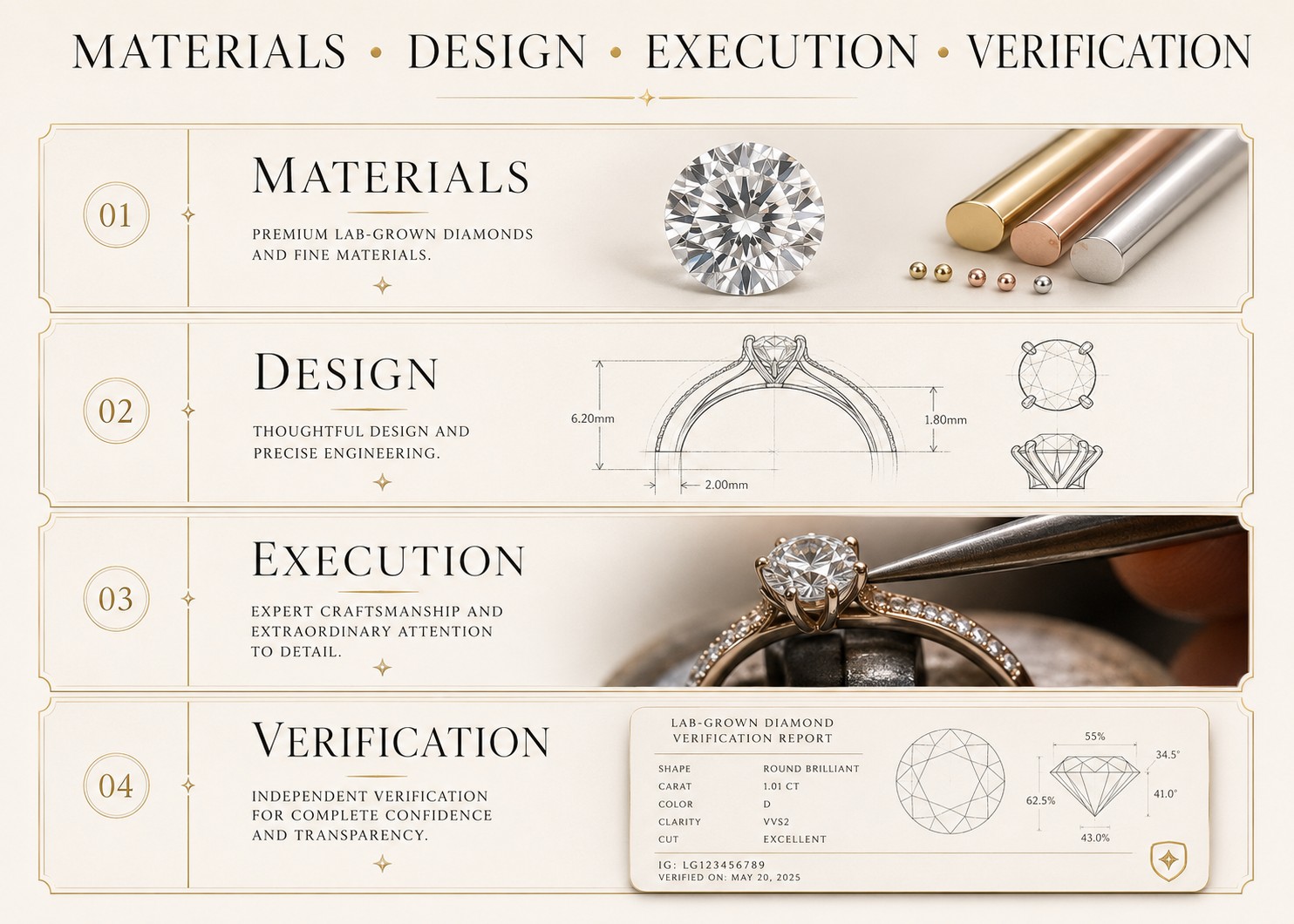
Quality cannot be inferred from carat weight or diamond grade alone — workmanship must be evaluated across the entire piece.
Secure vs Weak Construction: Concrete Examples
Example 1: Solitaire Ring. More reassuring: the centre diamond sits level, the prongs are reasonably even and make proper contact, tips are smoothly finished and the setting connects cleanly with the shank. Potential concern: one prong is short, another appears lifted away from the diamond, the stone visibly moves and the ring head appears misaligned.
Example 2: Pavé Ring. More reassuring: small diamonds follow consistent rows with controlled spacing and reasonably uniform setting work. Potential concern: stones visibly sit at different angles, spacing changes randomly and several setting beads appear incomplete.
Example 3: Pendant. More reassuring: the stone is centred, the bail aligns properly with the pendant, the reverse is finished appropriately and the chain connection looks intentional. Potential concern: the bail is visibly crooked, the pendant does not hang correctly or the connection shows an obvious unintended gap.
Example 4: Stud Earrings. More reassuring: both earrings appear matched, posts are similarly positioned and fastening components operate consistently. Potential concern: one setting tilts differently, one post is noticeably misaligned or the two earrings appear structurally inconsistent.
Example 5: Tennis Bracelet. More reassuring: stones and links form a consistent sequence, articulation is smooth and the clasp closes positively. Potential concern: links bind unexpectedly, stones appear loose or badly tilted, or the clasp does not engage reliably.
These examples show why quality cannot be inferred from carat weight or diamond grade alone.
What Quality-Control Process Should a Jewellery Brand Use?
A meaningful finished-jewellery quality check can involve examining: stone security, alignment, setting workmanship, surface finishing, clasp operation, dimensions, metal identification, and agreement between the finished piece and its documented specification.
But that does not mean we should claim Aurelia performs every one of those checks. Aurelia's website should only publish a statement such as: "Every piece passes a multi-stage quality-control inspection" if the client can confirm: what is inspected, who performs the inspection, and whether the process applies consistently across the relevant products. Until that evidence exists, the safer consumer-facing wording is simply to explain what buyers should look for in well-made jewellery.
What Should Aurelia Avoid Claiming Without Evidence?
Do not publish unsupported claims such as: hand-finished by master jewellers, individually inspected at every production stage, triple-checked before dispatch, lifetime stone-security guarantee, 100% flawless craftsmanship, made in our own workshop, or: every diamond setting is inspected under magnification unless the client has actually confirmed those processes and can maintain them. Quality language is strongest when it describes verifiable facts rather than luxury-sounding generalities.
Can You Judge Jewellery Quality Online?
You can evaluate some aspects well online. Product images can reveal: design, alignment, setting style, visible finishing, and proportions. Dimensions reveal physical scale. Metal specifications and hallmark information help identify material. Diamond reports can document gemmological characteristics.
But some mechanical issues require physical examination. You cannot reliably measure prong tension from a photograph. You cannot test a clasp's long-term wear resistance through a video. You cannot inspect every hidden join remotely. A good online assessment therefore separates: what can be seen from: what can be verified and: what remains uncertain.
Does Higher Price Mean Higher Quality?
Not automatically. Price can reflect: diamond size, diamond grades, precious metal, design, brand positioning, construction, reporting, and other commercial factors. A higher-priced piece may genuinely contain more expensive components. That does not prove superior workmanship. Likewise, a lower-priced piece should not automatically be assumed poorly made.
For the price side of the question, read What Determines the Price of Lab-Grown Diamond Jewellery?
Does a Higher Diamond Grade Mean Better Jewellery?
It means the diamond has a different gemmological characteristic. That is not the same as finished-jewellery quality. A VVS diamond poorly set into a weak mounting does not become high-quality jewellery because of its clarity grade. Likewise, jewellery can be beautifully constructed around a diamond whose specification was deliberately selected for practical value rather than maximum paper grades. The two quality layers should always remain separate.
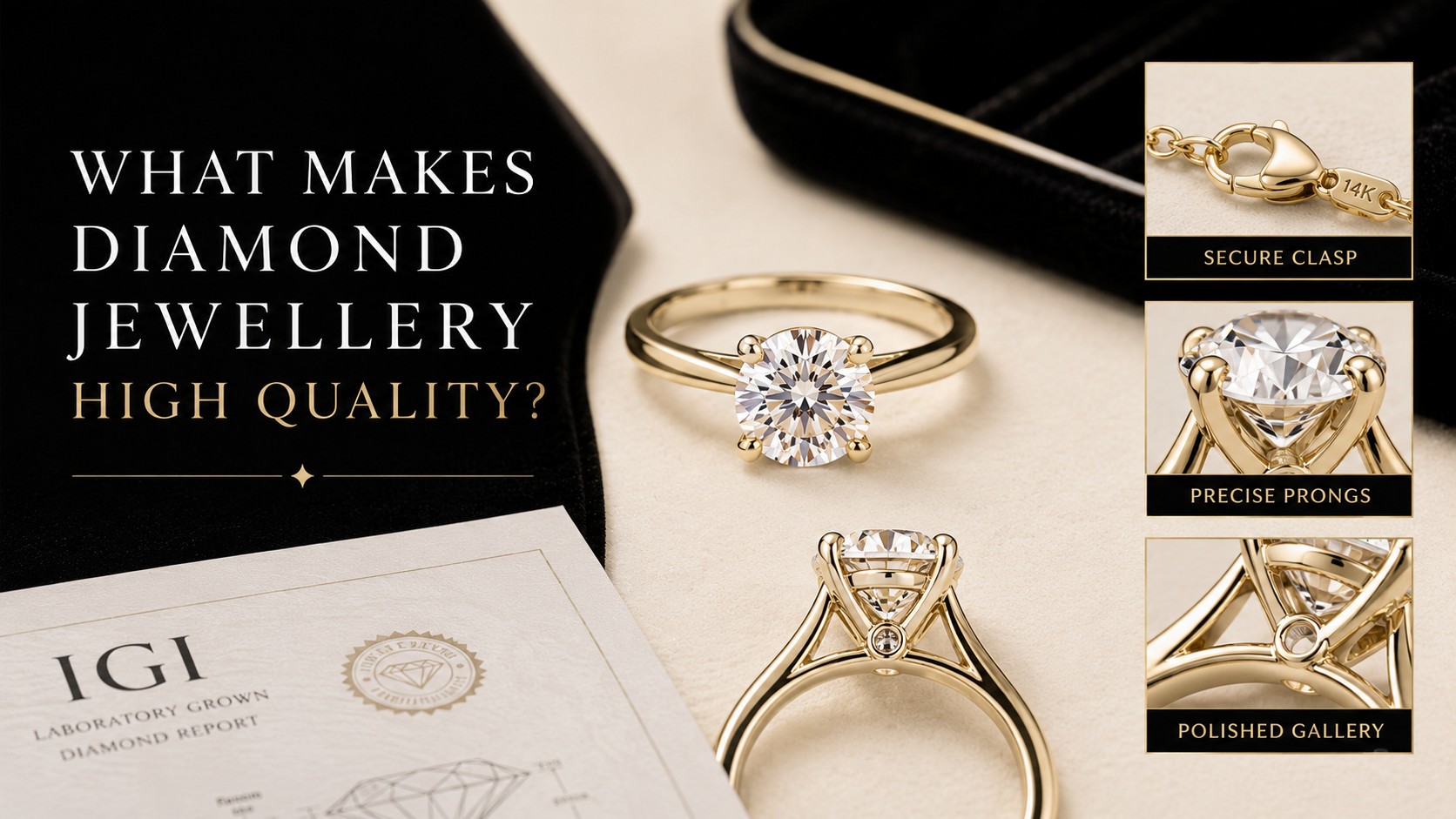
Judge the diamond, metal and workmanship separately — then decide whether they form a well-resolved finished piece.
Frequently Asked Questions
What makes lab-grown diamond jewellery high quality?▼
High quality combines appropriate diamond specifications with good metal, secure stone setting, careful alignment, controlled finishing, functional components and workmanship suited to the intended wear.
Are lab-grown diamonds suitable for high-quality jewellery?▼
Yes. Diamond origin does not prevent laboratory-grown diamonds from being used in fine jewellery. The finished quality still depends on the individual diamond and the jewellery construction.
Is diamond quality the same as jewellery quality?▼
No. Diamond grading and jewellery workmanship are separate assessments.
What makes a diamond setting secure?▼
The stone should be correctly seated and retained by an appropriately executed setting. In prong settings, the prongs need to contact and hold the gemstone securely.
What are signs of poor prong workmanship?▼
Examples can include short or inconsistent prongs, incomplete stone contact, visible misalignment or a loose stone. GIA has documented these as workmanship concerns.
Should all prongs look exactly identical?▼
They should be appropriately consistent for the design, but jewellery does not need microscopic machine-like uniformity to be well made.
Can a diamond become loose even in good jewellery?▼
Yes. Jewellery can wear or be damaged over time. Regular inspection can identify loose settings before stone loss occurs.
Can diamonds chip?▼
Yes. Diamond is extremely hard but not indestructible, and vulnerable edges or points can chip under sufficient impact.
Does a hallmark prove jewellery is high quality?▼
It verifies applicable precious-metal fineness. It does not grade the setting, finishing or diamond.
Does an IGI or GIA report prove the jewellery is well made?▼
A diamond report primarily documents gemmological information about the examined diamond. A finished-jewellery report has a different scope. Neither should automatically be interpreted as a lifetime workmanship guarantee.
Is heavier jewellery better quality?▼
Not automatically.
Is handmade jewellery always higher quality?▼
No. Execution matters more than the label.
Is made-to-order jewellery automatically higher quality?▼
No.
Is a more complicated setting automatically better?▼
No. More complexity simply means more components and setting work need to be executed consistently.
What should I check on a ring?▼
Check stone security, prongs or setting, alignment, shank, finish, dimensions, metal and fit.
What should I check on earrings?▼
Check matched appearance, stone setting, posts or hinges, fastenings, dimensions and finishing.
What should I check on a bracelet?▼
Check stone security, link consistency, articulation, clasp operation, dimensions and metal.
What should I check on a necklace?▼
Check pendant construction, stone setting, bail, chain, connections, clasp and length.
Can product photos prove workmanship quality?▼
They can reveal visible workmanship but cannot prove hidden structural or mechanical integrity.
Does high quality mean jewellery will never need maintenance?▼
No. Even well-made jewellery can require inspection, cleaning or repair as it wears.
Does Aurelia perform a specific quality-control process?▼
No process should be claimed publicly until Aurelia confirms exactly what inspections it performs and which products the process covers.
What is the simplest jewellery quality rule?▼
Judge the diamond, metal and workmanship separately, then decide whether they form a well-resolved finished piece.
Final Answer: How Can You Tell if Lab-Grown Diamond Jewellery Is High Quality?
Begin with the diamond. Check that its disclosed origin and relevant specifications are appropriate to the product and supported where necessary. Then move beyond the diamond. Confirm the underlying metal and fineness. Inspect the setting. For prong-set jewellery, look for appropriately positioned prongs that make secure contact with the stone rather than simply appearing decorative. For pavé, channel or bezel work, look for controlled alignment, consistent setting and secure-looking stone placement.
Then inspect the complete construction. Look at joins, backs, hinges, clasps, posts, chains and moving parts—not only the front-facing design. Check the finishing. Visible surfaces and wearer-contact areas should appear intentionally finished rather than rough, sharp or incomplete. Finally, judge whether the jewellery is suitable for its intended use.
High-quality jewellery is not simply: high diamond grades or: high metal weight or: a high price. It is the combination of: appropriate materials + good design + secure construction + careful finishing + suitable wearability.
For whether laboratory-grown diamonds are suitable for fine jewellery, read Are Lab-Grown Diamonds Suitable for Fine Jewellery?
For individual diamond differences, use What Makes One Lab-Grown Diamond Different from Another?
For metal and hallmarking, read How to Check the Metal Used in Diamond Jewellery
For dimensions and finished-jewellery weight, use How to Check Jewellery Dimensions and Weight Online
For remote workmanship assessment, read How to Choose Diamond Jewellery Without Seeing It in Person
For product specifications before buying, use What to Check Before Buying Lab-Grown Diamond Jewellery
For understanding price differences, read What Determines the Price of Lab-Grown Diamond Jewellery?
Where Aurelia Royale has not supplied a verified quality-control process, the site should describe the product's confirmed specifications rather than inventing inspection, workshop or craftsmanship claims.
Explore Aurelia Royale Lab-Grown Diamond Jewellery
Judge the diamond, metal and workmanship together — not one factor in isolation.
Stay Connected
Get Our Latest Updates
Be first to discover new collections, exclusive events, and the quiet privileges reserved for our inner circle.