
Coloured Centre Stones vs Colourless Diamond Designs
Journal • Published July 16, 2026
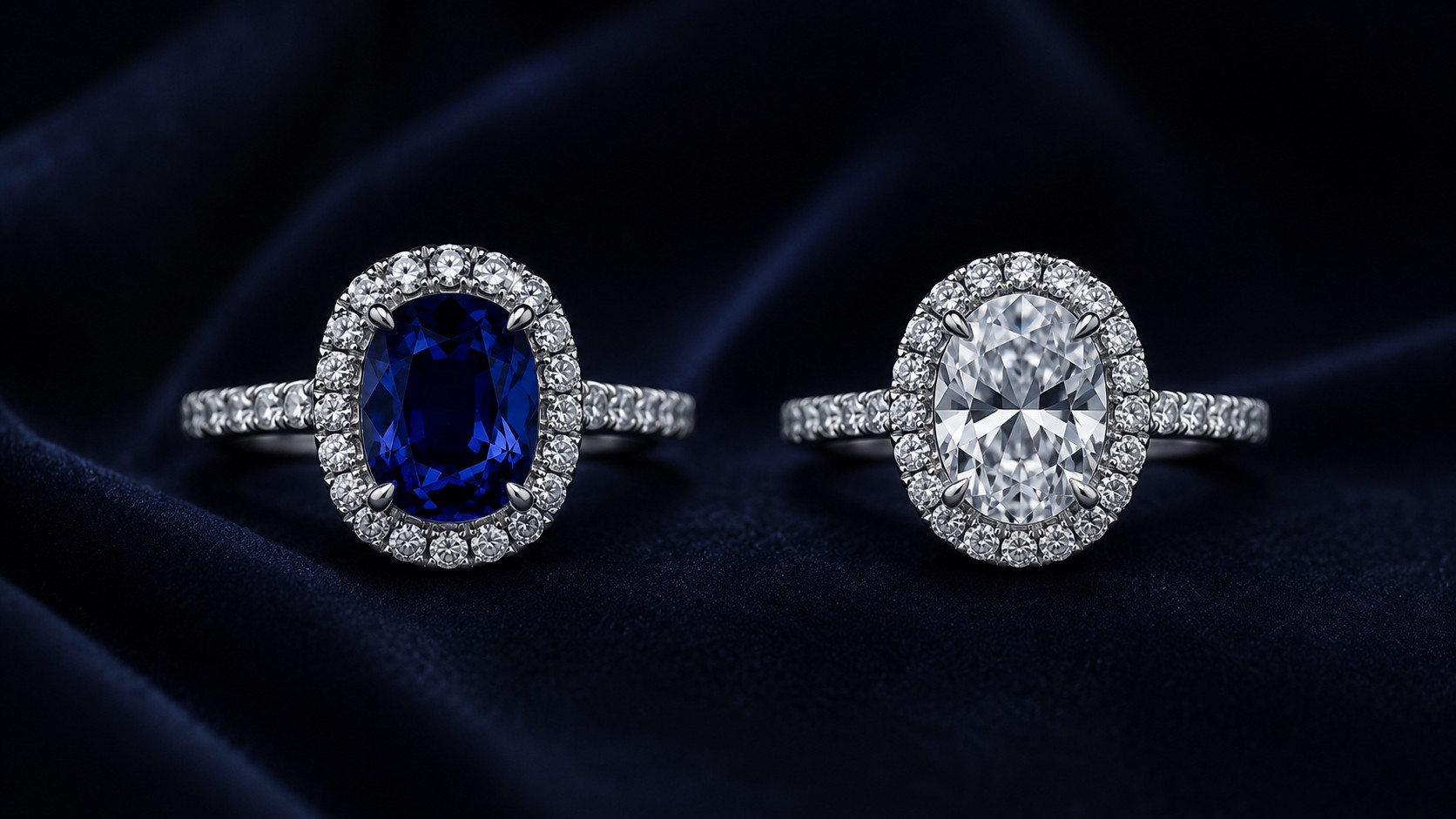
Coloured centre stones lead with hue and contrast while colourless diamonds lead with brightness.
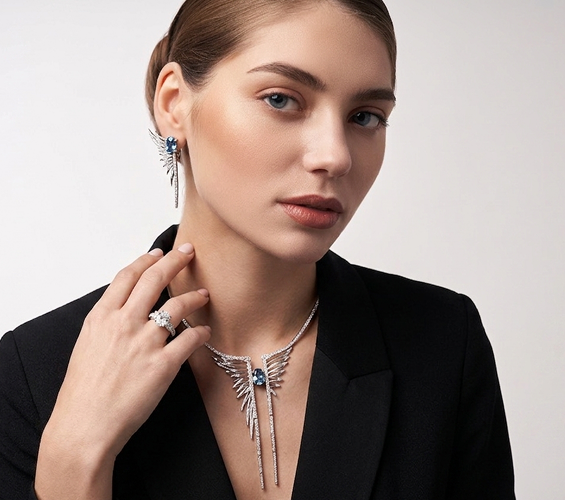
A coloured centre stone and a colourless diamond can occupy the same position in a piece of jewellery while creating very different visual experiences.
The coloured stone leads with hue and contrast. The colourless diamond leads with brightness, fire and scintillation. Neither is automatically more beautiful, versatile or valuable. The right choice depends on the exact stone, complete design, how you plan to wear it and whether the product information is complete.
Quick comparison
| Design factor | Coloured centre stone | Colourless diamond centre |
|---|---|---|
| First impression | Colour-led focal point | Light-led focal point |
| Visual variation | Hue, tone, saturation and zoning can vary | Facet pattern, brightness, fire and scintillation vary |
| Contrast | Often distinct from diamond accents | Usually a continuous diamond-led look |
| Metal interaction | Metal can strengthen or soften perceived colour | Metal can influence perceived warmth and outline |
| Matching | Exact colour matches may be difficult | Diamond grades and dimensions support structured comparison |
| Care | Depends strongly on gem identity and treatment | Depends on diamond, setting and metal |
| Best for | Buyers wanting expressive colour | Buyers wanting a neutral, luminous design |
The essential distinction: colour-led or light-led
Understand hue, saturation, and tone values for coloured options. Contrast these with the light brilliance and scintillation metrics of colorless cuts. For the 4Cs, see the 4Cs of lab-grown diamonds.
1. Decide what should attract the eye first
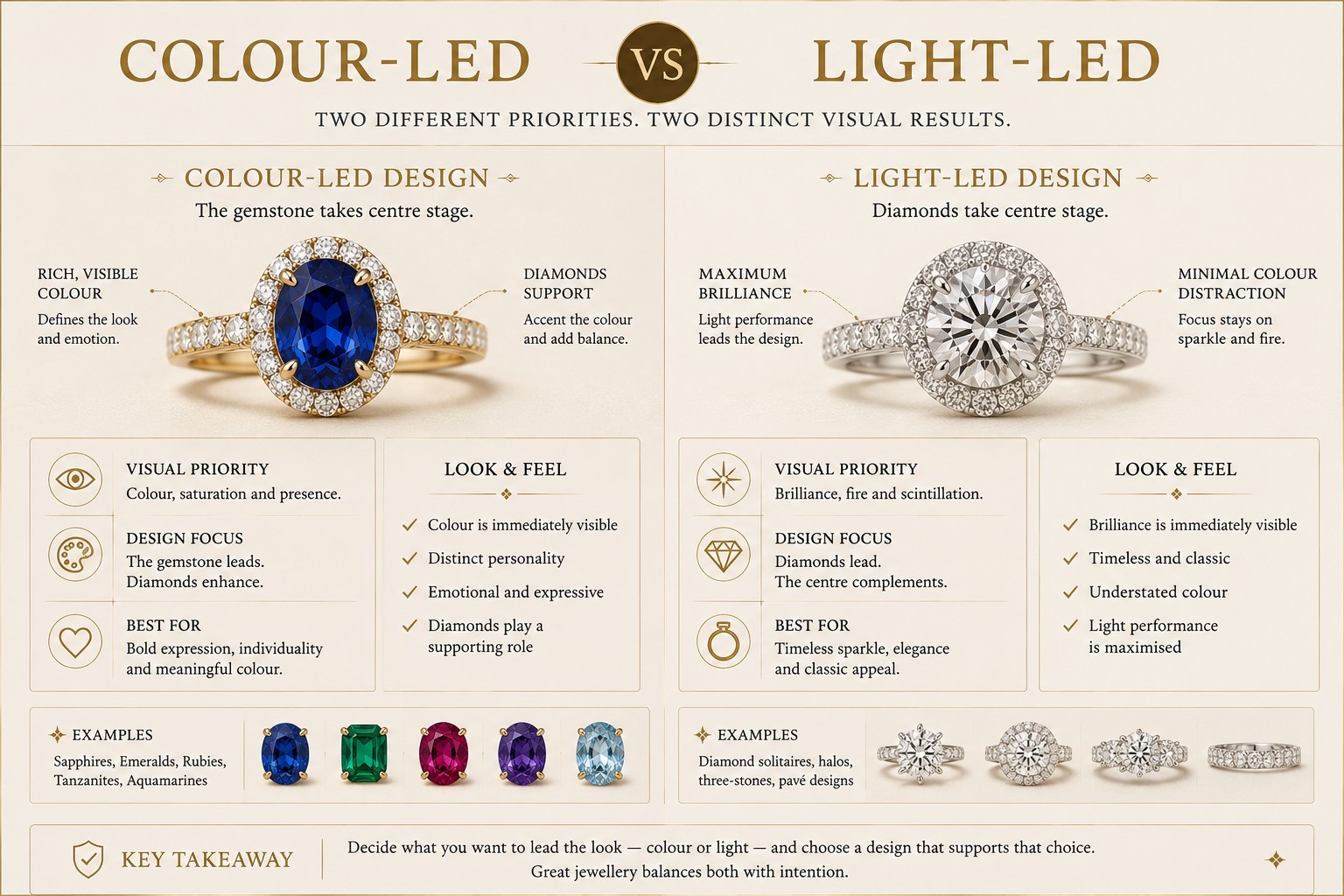
Comparing solitaire styles against surrounding accent frames defines visual emphasis.
Determine if the styling aims for colorless light interaction or bold chromatic focus. Evaluate visual outlines at normal viewing distance.
2. Compare colour under more than one light
Observe how daylight, warm indoors, and showroom lighting alter gem body hues. Verify actual stock colors in movement video captures.
3. Do not compare carat weight as visible size
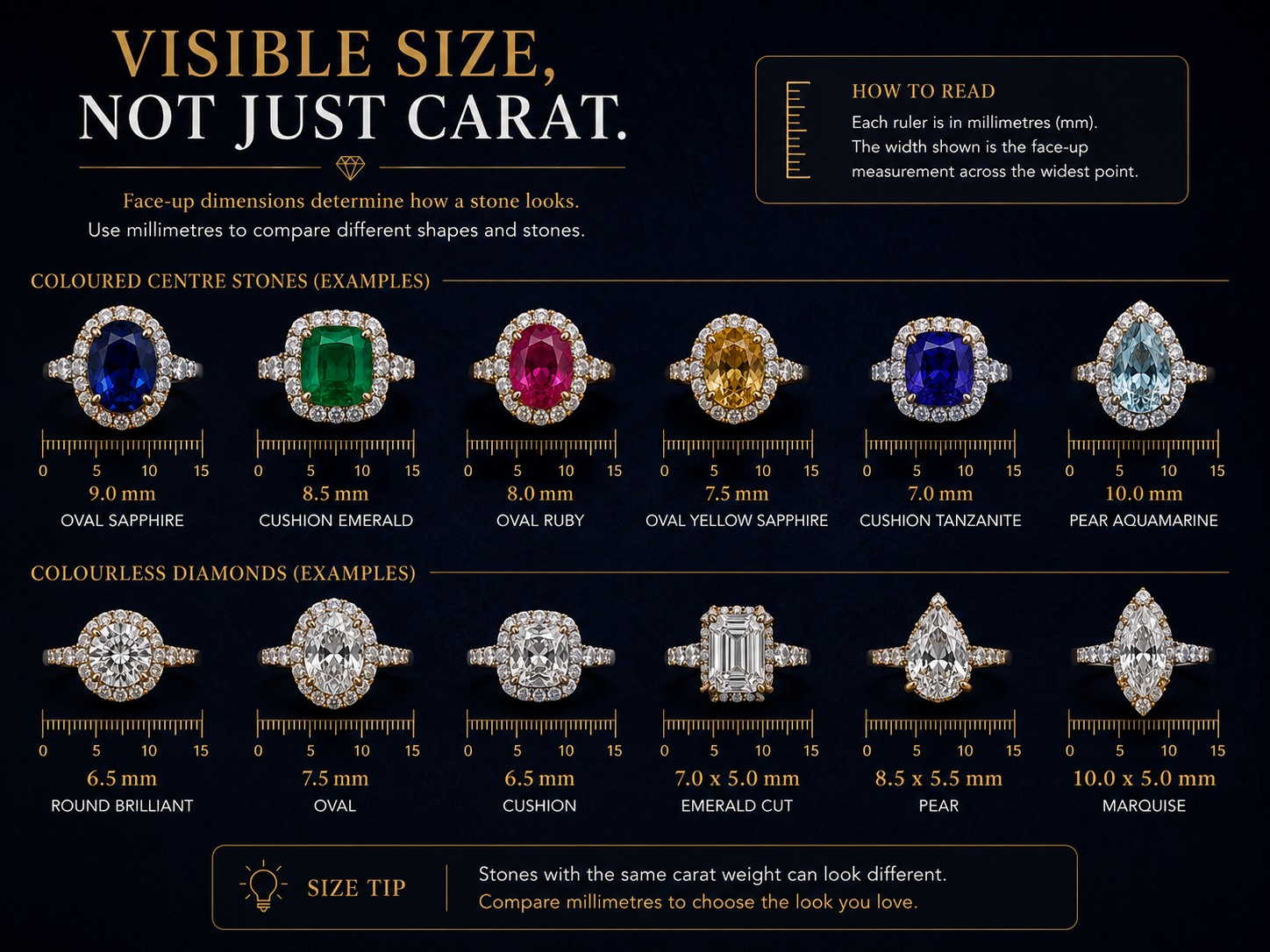
Density variations mean equal carats look different: check length and width dimensions.
Varying densities alter gem volumes: always record millimetre widths, setting projection depths, and heights. Consult carat weight versus visible diamond size.
4. Understand what diamond accents contribute
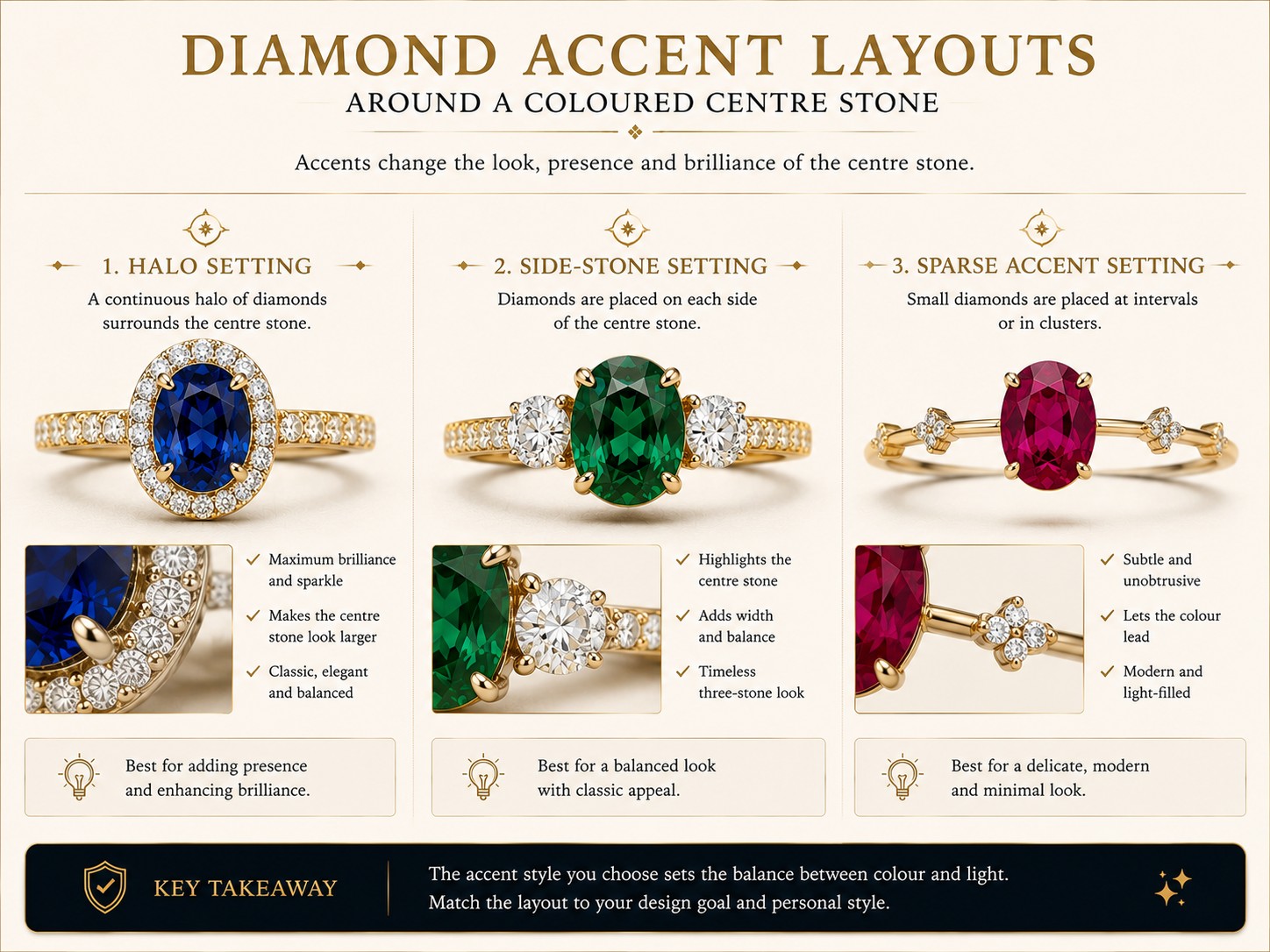
Accents frame coloured centers with brightness; separate carat totals specify exact distributions.
| Accent layout | Effect on a coloured centre |
|---|---|
| Halo | Expands the bright outer outline |
| Side stones | Draws the eye horizontally |
| Pavé surround | Adds fine surface shimmer |
| Drop or line | Creates movement and length |
| Sparse accents | Preserves more visual emphasis on colour |
Verify center weight separate from accent counts. For totals, see total carat weight in diamond jewellery.
5. Let metal colour participate deliberately
White-coloured metal creates cooler boundaries; rose/yellow alloys generate warm contrast. For checklists, see how to check the metal used in diamond jewellery.
6. Compare outline and cut—not just material
Select face outlines (oval, round, emerald cuts) and facet alignments. Coloured stones favor color retention cuts over pure light returns.
7. Consider wardrobe versatility realistically
Ensure colors work with regular outfit shades. Base versatility on real frequency of wear rather than trade labels.
8. Treat durability and care as separate from appearance
Hardness is separate from cleavage and heat sensitivities: check exact gem identity first. Read care protocols at how to care for coloured stones and diamonds.
9. Compare price only after matching specifications
- Exact gemstone identities and origins.
- Treatments and their disclosure.
- Centre-stone dimensions and weight.
- Diamond origin, grades and report scope.
- Accent count and total carat weight.
- Metal, fineness and weight.
- Setting construction and workmanship.
- Documentation, returns, warranty and aftercare.
10. Check documentation appropriate to each stone
Verify report coverage limits. For certificate types, see what certified lab-grown diamond jewellery means.
11. Use this decision framework
A coloured centre stone may suit you if:
- colour is the reason you noticed the piece;
- you appreciate natural or expected visual variation;
- you are comfortable checking identity, treatments and care;
- you want clear contrast with diamond accents; and
- the hue works with how you actually dress.
A colourless diamond design may suit you if:
- brightness and movement attract you more than body colour;
- you prefer a neutral focal point;
- comparing established diamond specifications is useful to you;
- you want a continuous diamond-led composition; and
- the exact cut and silhouette perform well in person.
A mixed design may be the answer if:
Product-page checklist
- the exact centre-stone identity;
- natural or laboratory-created origin;
- treatments;
- centre dimensions and carat weight;
- diamond specifications and their scope;
- separate accent total carat weight;
- metal and fineness;
- complete jewellery dimensions;
- accurate images and video;
- report coverage;
- care instructions; and
- returns, warranty and production time.
The Aurelia Royale standard
Aurelia Royale structures listings to describe gemstone parameters, diamond grades, and metals itemized by layer. Browse options at Aurelia Royale jewellery or contact Aurelia Royale to request specific specifications.
Final verdict
Is a coloured centre stone better than a colourless diamond?▼
Neither is universally better. A coloured stone creates a colour-led focal point; a colourless diamond creates a light-led one. Compare the exact stones and complete designs.
Does a coloured gemstone look larger than a diamond?▼
It may, but carat is weight rather than visible size. Compare millimetre dimensions, cut, depth and setting outline.
Are coloured centre stones less durable than diamonds?▼
Durability depends on the particular material, treatments, inclusions and setting. Do not infer it from colour alone.
Do colourless diamonds have no colour at all?▼
D-to-Z grading measures degrees of colourlessness. Subtle colour distinctions may be difficult for an untrained observer to see, and fancy-colour diamonds use a different system.
Why add lab-grown diamond accents to a coloured stone?▼
Accents can add brightness, contrast, movement and a larger outer outline while leaving colour as the focal point.
Which metal is best for a coloured centre stone?▼
There is no universal best metal colour. Compare how white, yellow and rose-coloured metals interact with the exact stone and complete design.
Is a colourless diamond design more versatile?▼
Its neutral appearance may coordinate easily, but scale, shape and personal wardrobe matter. A regularly worn coloured piece can be equally versatile for its owner.
Can coloured stones be certified like diamonds?▼
Laboratories may issue identification reports for coloured stones, but their content differs from diamond grading reports. Check the report type and scope.
Should I compare coloured stones by the diamond 4Cs?▼
Not mechanically. Colour, cut, clarity and weight matter in different ways across gem materials, and diamond-specific cut grades do not apply universally.
Are coloured centre stones always natural?▼
No. They may be natural, laboratory-created, composite or imitation, and may be treated. The listing should state the correct category.
Which design photographs best online?▼
Both can photograph well, but accurate colour, controlled exposure, multiple lighting contexts, movement and on-body scale are essential for a fair comparison.
How do I make the final choice?▼
Compare both at normal viewing distance, confirm every specification and choose whether you want colour or light to lead the design.
Find Your Perfect Center
Aurelia Royale showcases both premium colored stones and colorless lab-grown diamonds in signature settings. Consult our design experts.
Stay Connected
Get Our Latest Updates
Be first to discover new collections, exclusive events, and the quiet privileges reserved for our inner circle.