
Are Lab-Grown Diamonds Worth Buying?
Advantages, Disadvantages & Who They Suit • Published July 15, 2026
.jpg "Are Lab-Grown Diamonds Worth Buying?")
Lab-grown diamonds can provide genuine diamond properties and greater purchasing flexibility for the same budget.
Lab-grown diamonds can be worth buying if you want a genuine diamond, strong visual impact and greater flexibility over size, quality and jewellery design without paying the same initial price typically associated with a comparable natural diamond.
Their advantages are substantial, but they are not universal. Lab-grown diamonds should not be presented as automatically flawless, environmentally harmless or financially appreciating. They may also be less suitable for someone who places particular importance on natural geological origin, rarity or the secondary market associated with natural diamonds.
The most useful way to answer whether a lab-grown diamond is "worth it" is therefore to look at what you expect from the jewellery.
If your priority is owning and wearing an attractive diamond, lab-grown can provide considerable value. If your priority is natural provenance, geological rarity or future resale, you need to weigh the decision differently.
Quick Answer: Are Lab-Grown Diamonds Worth It?
What Does "Worth Buying" Actually Mean for a Diamond?
A diamond can have more than one kind of value.
There is wearing value: how beautiful, durable and enjoyable the piece is. There is purchase value: what specifications and design your budget allows you to choose. There is emotional value, which may come from an engagement, anniversary, gift or other personal meaning. And there is potential resale value, which concerns what another buyer might pay for the item later.
Lab-grown diamonds can perform very strongly in the first three categories while behaving differently from natural diamonds in the fourth.
That distinction matters because describing a lab-grown diamond as "good value" does not mean its retail price will be preserved indefinitely. It means the buyer may be able to obtain the appearance, diamond specifications and finished jewellery design they want for a lower initial expenditure than with a comparable natural diamond.
Advantage 1: Lab-Grown Diamonds Are Genuine Diamonds
One of the biggest advantages of lab-grown diamonds is straightforward: they are diamonds, not diamond simulants.
A laboratory-grown diamond consists of crystallised carbon and possesses essentially the same chemical, physical and optical properties as a natural diamond. GIA makes the important distinction that natural and laboratory-grown diamonds are not literally identical in every respect because their growth environments create detectable structural differences, but both are diamond material.
This separates lab-grown diamonds from materials such as cubic zirconia and moissanite. Those gemstones may be used as diamond alternatives, but they have different compositions and physical properties.
A well-cut lab-grown diamond can therefore display the brightness, fire and scintillation associated with diamond. Its laboratory origin does not inherently reduce those optical properties.
This is particularly significant for buyers who want an actual diamond but do not specifically require that the diamond formed naturally within the Earth.
For a deeper explanation of diamond identity and origin, read What Are Lab-Grown Diamonds? and Are Lab-Grown Diamonds Real?
Advantage 2: More Purchasing Flexibility for the Same Budget
Price is one of the main reasons buyers consider lab-grown diamonds.
Lab-grown diamonds are generally sold at lower initial prices than natural diamonds with comparable specifications. The exact difference is not fixed and can change with carat weight, quality, shape, supplier, production economics and market conditions, so one universal percentage should not be applied to every diamond.
What matters from a buyer's perspective is what that price difference makes possible.
Instead of simply spending less, someone might keep the same overall jewellery budget and allocate more of it towards a larger centre stone, a more elaborate setting, a heavier precious-metal construction or additional diamonds within the design.
This is why affordability and design flexibility are closely connected.
It does not mean the largest possible diamond is automatically the best purchase. Cut, proportions, setting security, metal construction and overall balance remain important. A larger stone with weak proportions or an unsuitable setting can be a poorer choice than a smaller, better-balanced design.
For the detailed pricing question, read Are Lab-Grown Diamonds Cheaper Than Natural Diamonds?
Lab-Grown Does Not Automatically Mean High Quality
Origin and quality are different questions.
"Lab-grown" explains where the diamond originated. It does not tell you that the diamond has exceptional cut, colour, clarity or proportions.
Individual lab-grown diamonds can vary considerably. They may have different colour characteristics, inclusions, measurements, proportions, polish, symmetry and light performance.
This is why the individual stone still needs to be evaluated rather than assuming laboratory production creates a perfect diamond.
The 4Cs — cut, colour, clarity and carat weight — remain useful quality characteristics, although laboratories may document lab-grown diamonds differently depending on their current reporting system.
Cut is particularly important because a diamond's proportions and facet relationships affect how it interacts with light. Carat should also be considered with millimetre measurements because weight and visible size are not the same thing.
Read What Are the 4Cs of a Lab-Grown Diamond? for the complete framework.
.jpg "Quality Still Matters: Evaluating Individual Lab-Grown Diamonds")
Laboratory origin does not guarantee quality — individual cut, colour, clarity and proportions still need to be assessed.
Advantage 3: Greater Freedom Over Diamond Size
For buyers who care strongly about visible diamond size, lab-grown diamonds can provide another practical advantage.
Because the stone itself may account for less of the total budget than a comparable natural diamond, buyers can potentially consider higher carat weights without increasing their overall jewellery budget to the same extent.
However, carat weight should never be used alone to predict how large a diamond will look.
Two diamonds with the same weight may have different face-up dimensions because their proportions and shapes distribute that weight differently. Oval, pear, emerald, cushion and round diamonds can also present weight differently when viewed from above.
A buyer looking for visual presence should therefore compare carat weight and physical dimensions together, not simply search for the highest carat number available.
Advantage 4: More Freedom in Jewellery Design
The lower initial cost of the diamond can also make more complex jewellery concepts accessible.
A design might use several diamonds rather than one, increase the size of side stones or incorporate diamonds around a greater proportion of a ring, necklace, bracelet or pair of earrings.
This makes lab-grown diamonds particularly relevant to styles where the total amount of diamond material contributes strongly to the appearance of the piece.
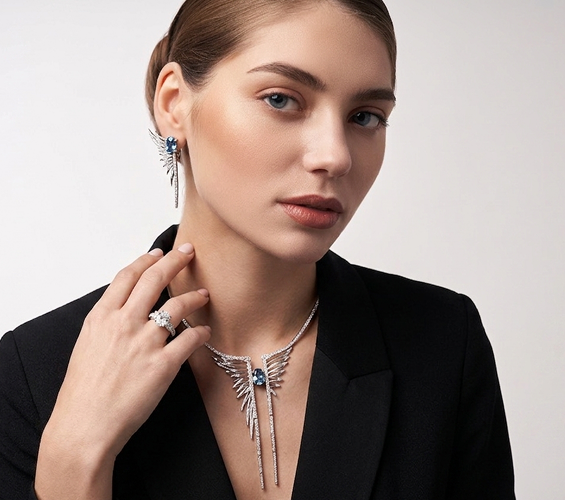
Tennis-style jewellery, multi-stone rings, diamond-set hoops, graduated necklaces, halo settings and matching jewellery combinations can all involve multiple stones. Lab-grown diamonds can give designers and buyers more freedom to explore these configurations without the stone cost increasing in exactly the same way as an equivalent natural-diamond design.
The finished jewellery still needs to be judged as a complete object. Metal weight, setting security, clasp design, prong construction, comfort and craftsmanship can be just as important to long-term satisfaction as the diamonds themselves.
.jpg "Design Freedom with Lab-Grown Diamonds")
Lower stone costs can make multi-diamond designs and more elaborate settings more accessible.
Advantage 5: Lab-Grown Diamonds Are Suitable for Fine Jewellery and Regular Wear
Laboratory-grown diamonds share diamond's high resistance to scratching.
Diamond sits at 10 on the Mohs hardness scale, which makes it an excellent material for jewellery intended to be worn regularly. GIA lists diamond at Mohs hardness 10 and notes that laboratory-grown diamond possesses essentially the same physical properties as its natural counterpart.
That does not mean a diamond is indestructible.
Hardness describes resistance to scratching; it should not be confused with resistance to every form of impact. A diamond can still chip or become damaged under certain conditions, and the jewellery setting surrounding the stone can bend, loosen or wear over time.
A well-made lab-grown diamond ring, necklace, bracelet or pair of earrings can therefore be suitable for long-term use, but durability depends on both the gemstone and the construction of the finished jewellery.
For more specialised guidance, see Are Lab-Grown Diamonds Suitable for Regular Wear? and Aurelia Royale's jewellery-care guides.
Advantage 6: You Can Obtain Independent Diamond Documentation
Another practical benefit is the availability of independent gemmological assessment.
Laboratories can identify a diamond as laboratory-grown and document characteristics of the stone. IGI, for example, provides laboratory-grown diamond reports containing identification and quality information, including 4Cs assessments where applicable.
However, buyers should avoid assuming that every lab-grown diamond will automatically arrive with an individual certificate or that every laboratory uses an identical report format.
Small accent diamonds in finished jewellery may not each have individual reports, while important centre stones may be individually documented. The correct question is therefore not simply, "Is it certified?" but "What documentation applies to this particular diamond or jewellery item, who issued it and what does it actually confirm?"
A grading report is also not the same thing as a financial appraisal.
For more information, read How Are Lab-Grown Diamonds Graded?, How to Read a Lab-Grown Diamond Certificate and What Does Certified Lab-Grown Diamond Jewellery Actually Mean?
Advantage 7: Laboratory Origin Can Be Clearly Identified and Disclosed
Lab-grown diamonds have a modern manufacturing origin through either Chemical Vapour Deposition (CVD) or High Pressure High Temperature (HPHT) processes.
The growth method should not automatically be interpreted as a ranking of quality. Both processes can produce jewellery-quality diamonds, and the individual finished stone remains more important than simply choosing between the initials CVD and HPHT.
Professional identification is also important because a polished natural diamond and a polished laboratory-grown diamond can be extremely difficult to separate by ordinary observation. GIA explains that advanced testing is required for reliable identification because laboratory-grown and natural diamonds share very similar chemical and optical properties.
Clear origin disclosure therefore protects the buyer.
In the United States, FTC guidance requires marketers to make clear when a diamond is laboratory-grown rather than mined and to avoid descriptions that could mislead consumers about the nature or origin of the product.
For the growth processes themselves, see CVD vs HPHT Lab-Grown Diamonds.
Advantage 8: The Diamond Does Not Need to Be Extracted from a Mine
Another reason some buyers choose lab-grown diamonds is that the diamond itself is produced above ground rather than extracted through diamond mining.
That distinction is factual and useful.
It should not, however, be expanded into an unsupported claim that every laboratory-grown diamond is automatically "eco-friendly," "carbon neutral," "sustainable" or environmentally superior in every measurable way.
Growing diamonds requires infrastructure and energy. Cutting, polishing, jewellery manufacturing, precious-metal sourcing, packaging and transportation also form part of the finished product's environmental footprint.
Production conditions can differ significantly between manufacturers.
The more responsible conclusion is therefore that lab-grown diamonds avoid the mining required to extract the diamond itself, while broader environmental claims require evidence about the particular production and supply chain.
This distinction helps buyers avoid replacing one oversimplified marketing claim with another.
What Are the Disadvantages of Lab-Grown Diamonds?
The advantages of lab-grown diamonds are meaningful, but so are their limitations.
A balanced purchasing decision should consider them before choosing the stone.
Resale Value Can Be Lower and Less Predictable
The most important financial limitation is resale.
Lab-grown diamonds should not be purchased on the assumption that their retail purchase price will be maintained or that they will appreciate financially.
Production technology and capacity can increase over time, influencing market supply and new-diamond pricing. A future second-hand buyer is also not paying for every component included in the original retail transaction, such as retailer operations, manufacturing, design, taxes or services.
This can create a significant difference between the original retail price and a later resale offer.
Natural diamonds are also not guaranteed financial investments, and their resale value can likewise fall well below retail purchase price. The point is not that one type of diamond provides a guaranteed return and the other does not. Neither future value should be promised.
Instead, anyone for whom resale matters should investigate the likely secondary-market options before purchasing and distinguish between cash resale, retailer trade-in programmes, replacement valuations and insurance valuations.
Read Do Lab-Grown Diamonds Have Resale Value? for the dedicated discussion.
.jpg "Resale and Ownership Expectations")
Lab-grown diamonds offer strong wearing value — resale should not be assumed to mirror retail price.
Their Market Price Can Change
The same production economics that help make lab-grown diamonds accessible can also affect their future new-retail prices.
As technology becomes more efficient and production capacity changes, comparable stones may become available at different prices later.
That can be beneficial to future buyers but matters to anyone expecting the purchase price of an existing stone to remain stable.
For jewellery bought primarily to wear and enjoy, this may be relatively unimportant. For someone treating the purchase as a store of financial value, it becomes much more significant.
Lab-Grown Diamonds Do Not Have Natural Geological Rarity
For some buyers, the appeal of a natural diamond is inseparable from its origin.
Natural diamonds formed through geological processes deep within the Earth, while lab-grown diamonds are produced through controlled technological processes.
The visual result may be extremely similar, but the stories are different.
Neither preference is inherently incorrect. Someone may value the modern manufacturing story and accessibility of lab-grown diamonds, while someone else may specifically want natural geological origin and rarity.
This is why the decision cannot be reduced to specifications alone.
Are Lab-Grown Diamonds More Ethical?
This question needs careful wording.
Choosing a lab-grown diamond means the diamond itself did not come from a diamond mine. That removes mining from the origin of that particular stone.
But "ethical" can refer to many different issues, including labour practices, energy sourcing, manufacturing conditions, cutting and polishing, precious-metal sourcing and broader supply-chain governance.
Laboratory production does not automatically answer every one of those questions.
If ethical sourcing is an important reason for choosing lab-grown, look for specific, verifiable information about the producer and supply chain rather than relying only on broad marketing terminology.
Are Lab-Grown Diamonds Better for the Environment?
Not automatically.
The environmental impact of laboratory-grown diamond production can depend heavily on the energy source, facility efficiency, location and manufacturing method. Finished jewellery also involves metal production, cutting, setting, transportation and packaging.
For this reason, "lab-grown" should be treated as an origin description rather than an environmental certification.
A company making specific carbon, renewable-energy or sustainability claims should be able to support those claims with evidence.
Who Are Lab-Grown Diamonds Best For?
Lab-grown diamonds can be particularly compelling for someone whose highest priorities are diamond appearance, size, jewellery design and initial purchase value.
They can also suit a buyer who wants genuine diamond material but does not attach additional value to natural geological origin.
For an engagement ring, this could mean allocating more of the budget towards the centre stone or setting. For earrings, it might make a larger matched pair possible. For bracelets or necklaces, it can make diamond-rich designs more accessible because many stones may be required across the piece.
The important point is that the advantage changes with the jewellery.
A buyer should start with the desired finished piece, then decide whether lab-grown diamond characteristics align with that objective.
When Might a Natural Diamond Suit You Better?
A natural diamond may better match your priorities if geological origin itself is important to you, if rarity carries significant emotional meaning, or if you specifically prefer the established natural-diamond market.
Someone with strong resale considerations may also wish to compare the two markets carefully rather than making the decision solely on initial purchase price.
This does not mean natural diamonds are universally "better," just as lower pricing does not make lab-grown diamonds universally "better."
They solve different buyer priorities.
For a complete origin-versus-origin comparison, read Lab-Grown vs Natural Diamonds rather than relying on this article alone.
How to Decide Whether a Lab-Grown Diamond Is Worth Buying
The most useful decision begins by separating what matters visually from what matters emotionally or financially.
Start with the jewellery you actually want. Consider the desired design, visible diamond size, cut performance, colour appearance, clarity, metal and overall construction. Then compare what a lab-grown diamond and a natural diamond allow within the same realistic budget.
Next, decide whether geological origin matters to you independently of appearance.
Finally, consider your ownership expectations. If you intend to wear and enjoy the jewellery for many years and do not expect the stone to behave like a financial investment, lab-grown diamonds can offer a very strong proposition. If future resale or natural rarity is central to the purchase, that trade-off deserves greater weight.
That approach is much more useful than asking whether all lab-grown diamonds are either "good" or "bad."
What Should You Check Before Buying One?
Regardless of origin, a jewellery purchase should still be evaluated carefully.
Check that laboratory-grown origin is stated clearly, understand the diamond's relevant quality information, confirm carat weight and dimensions, distinguish centre-stone weight from total carat weight, review the precious metal and setting construction and understand what documentation actually accompanies the piece.
If a significant individual diamond has a laboratory report, check the issuing laboratory and verify the information using the laboratory's official service where possible.
Also read the seller's availability, returns, delivery and after-sales terms rather than making assumptions from generic industry practice.
Aurelia Royale's What to Check Before Buying Lab-Grown Diamond Jewellery guide covers these purchase checks in more detail.
Advantages vs Disadvantages: The Real Trade-Off
The strongest advantage of a lab-grown diamond is not simply that it is "cheap."
It is that a buyer can obtain genuine diamond material with different budget economics.
That may translate into a larger stone, better cut, more diamonds within the jewellery, a more substantial setting or simply lower overall expenditure.
Its biggest disadvantages relate less to everyday appearance and more to the factors surrounding the stone: changing market prices, weaker resale expectations, absence of natural geological origin and environmental claims that require more evidence than the term "lab-grown" alone provides.
Once those distinctions are understood, the decision becomes much clearer.
Final Verdict: Are Lab-Grown Diamonds Worth Buying?
Yes, lab-grown diamonds can be worth buying for someone who prioritises beauty, genuine diamond properties, durability, design freedom and purchasing flexibility.
They are particularly compelling when the jewellery is being bought primarily to wear, enjoy and keep, rather than as an asset expected to preserve its retail price.
They are not automatically the right choice for everyone.
Someone who strongly values natural geological origin, scarcity or the characteristics of the natural-diamond secondary market may reasonably prefer a natural diamond.
The important point is to make that decision using accurate expectations.
Lab-grown diamonds are real diamonds. They can be exceptionally beautiful. They can provide substantial flexibility within a jewellery budget. But individual quality still matters, environmental claims still need evidence, documentation should be understood correctly and resale should never be guaranteed.
Choose the diamond that best matches what you genuinely value rather than the one supported by the loudest marketing claim.
What is the biggest advantage of a lab-grown diamond?▼
For many buyers, the main advantage is the combination of genuine diamond properties and a generally lower initial price than a comparable natural diamond. This can create greater freedom over carat weight, quality and jewellery design.
Are lab-grown diamonds real diamonds?▼
Yes. Laboratory-grown diamonds consist of diamond material and have essentially the same chemical, physical and optical properties as natural diamonds. They are different from simulants such as cubic zirconia and moissanite.
Are lab-grown diamonds worth the money?▼
They can be if your priorities are wearing enjoyment, appearance, durability and obtaining more flexibility from your jewellery budget. They may be less suitable if your main objective is natural rarity or future financial resale.
What are the main benefits of lab-grown diamonds?▼
Their main benefits include genuine diamond material, diamond hardness and optics, generally more accessible pricing, greater size and design flexibility and suitability for fine jewellery. Their laboratory origin also means the diamond itself does not require mining.
What are the disadvantages of lab-grown diamonds?▼
The principal considerations are weaker and less predictable resale value, changing market pricing, lack of natural geological rarity and the fact that lab-grown origin does not automatically prove sustainability.
Do lab-grown diamonds look different from natural diamonds?▼
They can look extremely similar. GIA notes that reliable separation of natural and laboratory-grown diamonds can require specialised gemmological testing rather than ordinary visual observation.
Are lab-grown diamonds as durable as natural diamonds?▼
They share diamond's characteristic hardness and are highly resistant to scratching. However, neither natural nor laboratory-grown diamonds are indestructible, and the security of the jewellery setting also matters.
Do lab-grown diamonds lose their sparkle?▼
A diamond does not simply lose its optical properties because it is laboratory-grown. Surface oils, cosmetics, soap and dirt can reduce apparent brilliance until the jewellery is cleaned. Cut quality also has a major influence on light performance.
Are lab-grown diamonds good for engagement rings?▼
They can be. Their hardness and diamond properties make them suitable for engagement jewellery, provided the individual diamond is well chosen and the ring is properly constructed for regular wear.
Can lab-grown diamonds have inclusions?▼
Yes. Laboratory-grown diamonds can contain internal and external characteristics. Laboratory-grown origin does not mean a diamond will automatically be flawless.
Are lab-grown diamonds certified?▼
Some are accompanied by independent laboratory reports or quality assessments, particularly significant individual stones. Not every small diamond in finished jewellery necessarily receives an individual report, so buyers should check the exact documentation supplied with the product.
Are lab-grown diamonds more sustainable than mined diamonds?▼
The diamond itself is grown rather than extracted from a mine, but that alone does not establish the complete environmental impact of the jewellery. Energy sources, manufacturing efficiency, metal sourcing, cutting, transport and other factors matter.
Do lab-grown diamonds have resale value?▼
A secondary market may exist, but future resale prices should never be guaranteed. Offers can differ significantly from the original retail purchase price.
Is a lab-grown diamond a good investment?▼
Diamond jewellery should not be purchased on the assumption of guaranteed financial appreciation. Lab-grown diamonds are generally better evaluated as jewellery to own and enjoy rather than as an investment product.
Is CVD better than HPHT?▼
Neither growth method automatically produces the better diamond. Both can create high-quality laboratory-grown diamonds. The individual stone's quality, appearance and documentation are more useful buying considerations.
Should I choose lab-grown or natural diamonds?▼
Choose lab-grown if its appearance, budget flexibility and manufacturing origin suit your priorities. Choose natural if geological origin and natural rarity are particularly important to you. Compare the actual diamonds rather than assuming that one origin is universally superior.
Understanding both the advantages and the limitations of lab-grown diamonds makes it much easier to decide whether they suit the jewellery you are looking for.
Explore Aurelia Royale's lab-grown diamond designs and, where a piece is not currently available for direct purchase, Join the Waitlist or submit an enquiry to register your interest.
Explore Lab-Grown Diamond Jewellery with Aurelia Royale
Discover designs that balance genuine diamond quality with flexible budget economics.
Stay Connected
Get Our Latest Updates
Be first to discover new collections, exclusive events, and the quiet privileges reserved for our inner circle.