How to Choose a Lab-Grown Diamond Jewellery Set
Contents, Coordination, Carat Allocation and Component Dimensions Explained • Published September 10, 2026
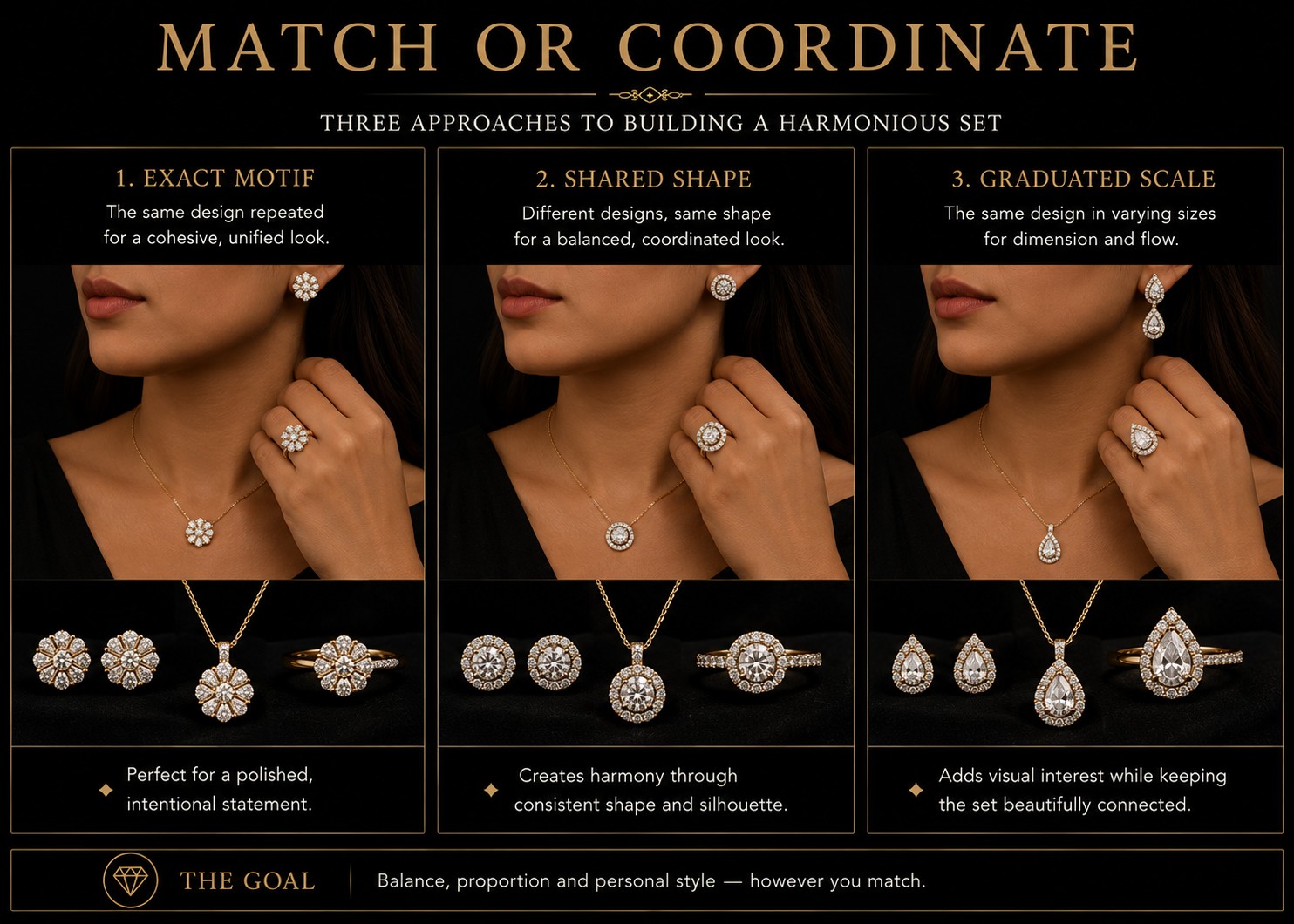
Evaluate in this order: set contents → coordination → carat allocation → component dimensions → metal → fastening and construction → documentation → separate wearability → availability and terms.
Choosing a lab-grown diamond jewellery set is not simply a matter of finding two or three pieces that contain similar diamonds. A coordinated set needs to work at two levels. First, the pieces should look intentional when they are worn together. That can come from a shared diamond shape, motif, metal colour, setting style, proportion or another repeated design element. Second, each component should still make sense as jewellery on its own.
A necklace-and-earring set may look perfectly coordinated in one photograph, for example, but that does not tell you whether the necklace length suits you, whether the earrings are comfortable, whether the stated carat weight applies to the whole set or only one component, or even whether the chain shown with the pendant is actually included.
The strongest way to choose a lab-grown diamond jewellery set is therefore to evaluate it in this order: set contents → coordination → carat allocation → component dimensions → metal → fastening and construction → documentation → separate wearability → availability and terms.
Quick Answer: What Should You Check Before Buying a Diamond Jewellery Set?
Start by identifying exactly what the set includes. A product described visually as a necklace-and-earring set should clearly state whether you receive the necklace or pendant, the chain, both earrings and any other component shown. Then examine how the pieces coordinate. Matching jewellery does not mean every component needs to be identical in size. A necklace pendant may appropriately be larger than the related earrings while still repeating the same shape, setting, motif or diamond arrangement.
Next, separate the diamond information by component. If the complete set is described as 3.00 ct total weight, determine how much of that weight belongs to the necklace, how much belongs to the earrings and whether the earring figure refers to each earring or the pair. After that, compare the real physical dimensions. Finally, check the metal, clasp, earring fastening, pendant-chain connection, documentation, availability and any policies that apply specifically to the complete set.
The Jewellery-Set Buying Framework
| Stage | Main Question |
|---|---|
| Set contents | Exactly which pieces are included? |
| Coordination | What makes the components visually belong together? |
| Carat allocation | How is the total diamond weight divided? |
| Dimensions | How large is each component physically? |
| Metal | Do all components use the stated metal and fineness? |
| Construction | How does each component fasten and function? |
| Documentation | What does any laboratory report actually cover? |
| Separate wearability | Would I wear each piece by itself? |
| Availability | Is the complete set available together? |
| Policies | Are returns, exchanges or warranties different for the set? |
First, Confirm What Is Actually Included in the Set
The phrase jewellery set can describe several different product configurations. One set might contain a pendant necklace and matching earrings. Another might contain a necklace, bracelet and earrings. Another could contain only a pendant and earring pair, with the chain sold separately. A photograph cannot prove which situation applies. The product specification must do that.
| Product Description | What You Need to Confirm |
|---|---|
| Necklace + earrings | Does "necklace" include the chain? |
| Pendant + earrings | Is the chain included or sold separately? |
| Necklace + bracelet | Are both full finished pieces included? |
| Necklace + earrings + bracelet | Are all three components part of one set price/status? |
| Pendant + chain + earrings | Are the pendant and chain removable/separate? |
| Matching collection | Is this actually one set, or are pieces purchased separately? |
The distinction between a coordinated collection and a single jewellery set matters. Several products can be designed to match without automatically being sold together.
Pendant Only, Pendant With Chain and Complete Necklace Are Different
A necklace-and-earring set needs especially clear wording. If the central neck piece is a pendant, establish whether the chain comes with it. There are three possible situations. A pendant-only component includes the pendant but not necessarily the chain. A pendant with chain forms a complete wearable necklace. A complete necklace may have its central motif fixed into the chain rather than functioning as a removable pendant at all.
| Set Component | Pendant Included? | Chain Included? | Complete Wearable Necklace? |
|---|---|---|---|
| Pendant only | Yes | No / must be confirmed | No |
| Pendant with chain | Yes | Yes | Yes |
| Fixed-motif necklace | No separate removable pendant required | Yes | Yes |
A Matching Set Does Not Need Every Piece to Be Identical
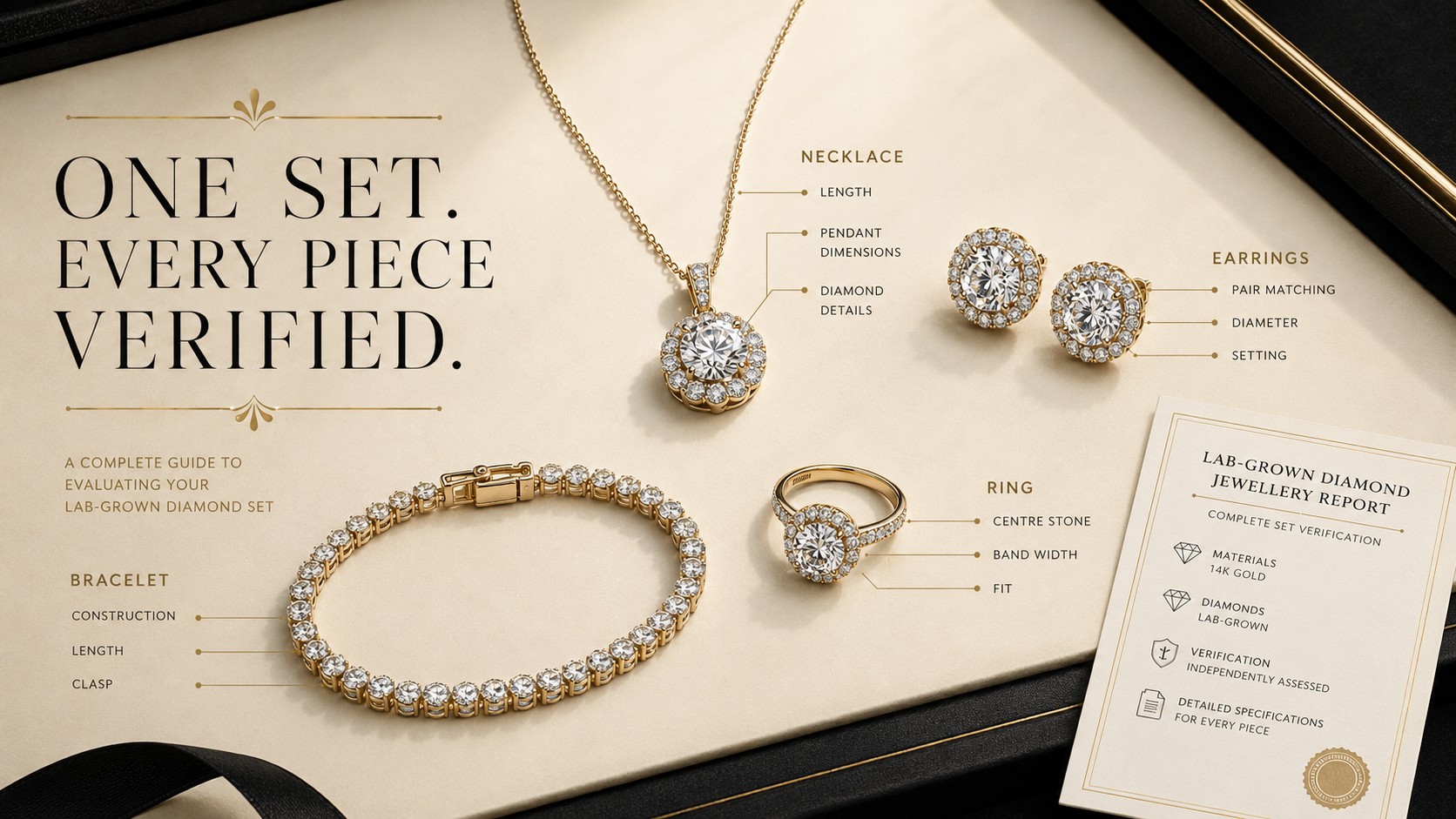
Coordination is not the same as duplication. A well-designed necklace-and-earring set may use the same diamond shape or motif while intentionally changing scale. For example, the necklace pendant might be larger because it needs to remain visually clear at the centre of the neckline, while the earrings might use a smaller version of the same motif for comfort and proportion. That can create stronger coordination than simply making every component the exact same dimensions.
| Coordination Element | Example |
|---|---|
| Diamond shape | Oval diamonds repeated across necklace and earrings |
| Motif | Same butterfly, floral or geometric form |
| Setting style | Matching bezel, halo or prong treatment |
| Metal colour | Same confirmed metal/finish |
| Diamond arrangement | Similar centre-and-accent pattern |
| Proportion | Same design language at different scales |
| Surface finish | Consistent polished or decorative treatment |
Start With Design Coordination, Not Diamond Grade
When buyers compare matching jewellery, it is easy to start with questions such as colour, clarity and carat. Those specifications still matter. But they are not what makes a set coordinated. Imagine a necklace and earrings containing diamonds with exactly the same colour and clarity grades but using unrelated shapes, settings and proportions. They may have similar diamond specifications without looking like a set. Now imagine a pendant and earrings with slightly different stone sizes but the same motif, setting style, metal and proportions. Those pieces can look far more intentionally coordinated. This is why design language comes before detailed diamond grading when choosing a set.
Decide How Closely You Want the Pieces to Match
| Strongly Matched Set | Loosely Coordinated Set |
|---|---|
| Repeated motif | Related design language |
| Same diamond shape | Shapes may vary |
| Similar setting | Different but compatible settings |
| Closely related proportions | More independent proportions |
| Immediately reads as a set | Pieces feel related but less formal |
| Strongest when worn together | Often easier to mix separately |
Think about how frequently you expect to wear the pieces as one complete set. If most use will be separate, subtle coordination can sometimes offer more flexibility.
The Pieces Should Also Work Separately
This is one of the most useful tests when buying a coordinated jewellery set. Ask: Would I choose the earrings if they were sold alone? Then ask: Would I wear the necklace without the earrings? If the answer to both is yes, the set is likely giving you more practical value than a combination that only works in one exact styling arrangement. A well-coordinated set should create three useful options: necklace alone, earrings alone, and: necklace + earrings together. If a bracelet is included, the number of possible combinations increases further.
The headline total alone does not tell you what each component looks like — always separate carat weight by component.
Understand the Total Carat Weight of the Entire Set
Multi-piece jewellery creates one of the easiest places to misunderstand total carat weight. Suppose a set is described as 3.00 ct total diamond weight. That could mean: the necklace contains 2.00 ct and the earrings together contain 1.00 ct, or: the necklace contains 1.50 ct and the earrings contain 0.75 ct each, or: another allocation entirely. The headline total alone does not tell you what each component looks like.
| Specification | What It Means |
|---|---|
| Set TCW | Combined weight of all diamonds across all included components |
| Necklace TCW | Combined diamonds in necklace only |
| Earring-pair TCW | Combined diamonds across both earrings |
| Per-earring TCW | Diamonds in one earring only |
| Centre-stone weight | One specific focal diamond |
| Accent weight | Combined secondary diamonds |
Carat Allocation Can Change the Character of the Set
Two jewellery sets can have exactly the same overall TCW while looking completely different. Imagine two fictional necklace-and-earring sets, both containing 3.00 ct of diamonds.
| Specification | Set A | Set B |
|---|---|---|
| Complete set TCW | 3.00 ct | 3.00 ct |
| Necklace allocation | 2.20 ct | 1.50 ct |
| Earring-pair allocation | 0.80 ct | 1.50 ct |
| Visual emphasis | Necklace-dominant | More balanced |
| Likely wearing effect | Strong centrepiece necklace | Earrings carry greater presence |
Neither allocation is automatically better. Set A suits someone who wants the necklace to dominate. Set B suits someone who wants the necklace and earrings to have more comparable visual weight. This is a much more useful comparison than simply asking which set has the larger combined carat number.
Earring Weight Needs Extra Clarification
When earrings form part of a set, the diamond-weight wording becomes even more important. A statement such as: Earrings: 1.00 ct could mean 1.00 ct across the complete pair. It could also be interpreted as 1.00 ct per earring if the wording is not clear. The specification should remove that ambiguity. For a simple matched pair, it should be possible to understand whether the stated carat figure is: per stone, per earring, or: pair total.
Do Not Use Carat Weight as a Substitute for Physical Size
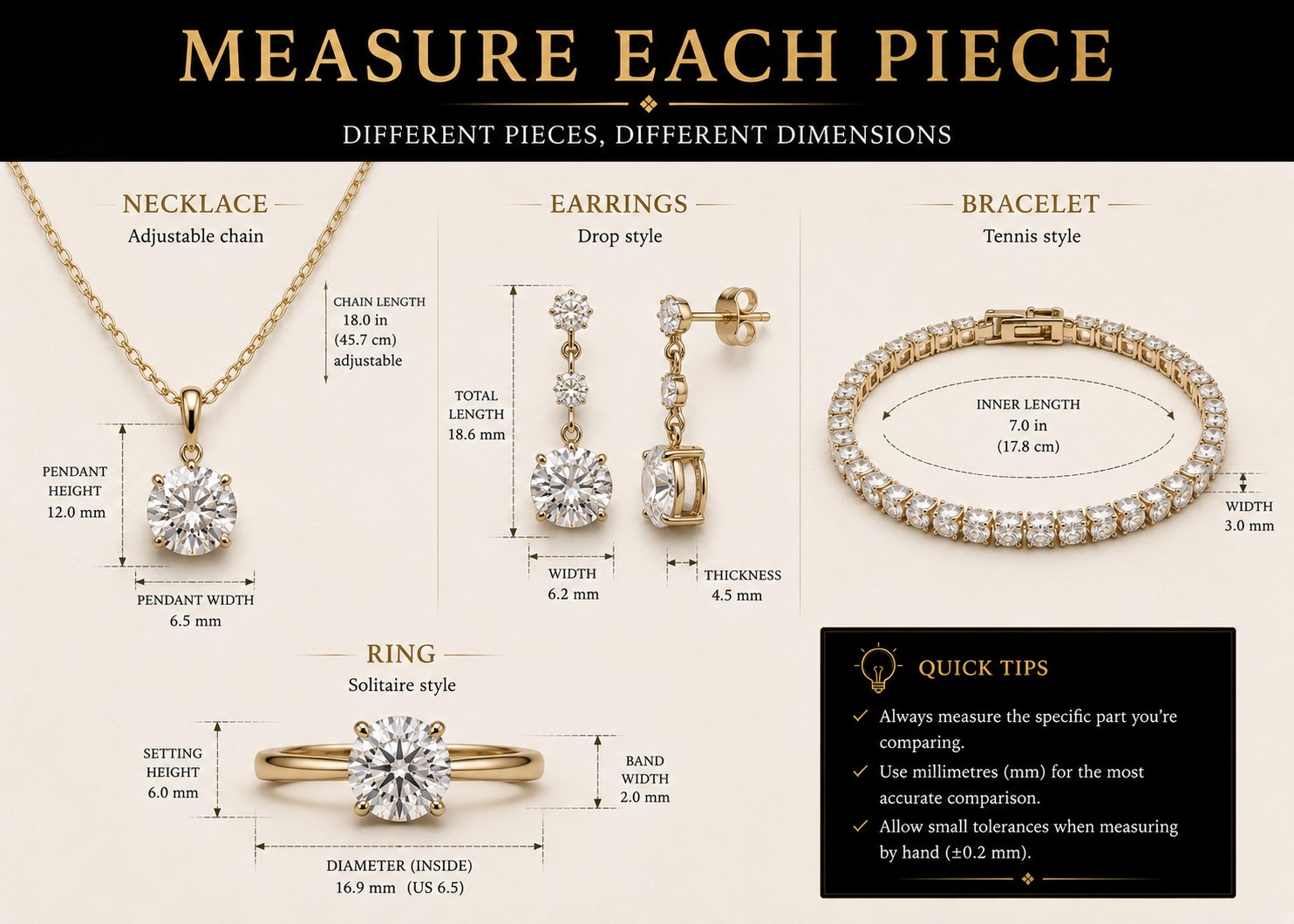
Carat is diamond weight. It does not directly tell you how large the finished necklace, pendant or earrings will look. This becomes particularly important with jewellery sets because the same set can combine several types of physical measurement. A necklace needs length. A pendant needs height and width. Stud earrings need face-up dimensions. Hoops need diameter. Drops need complete drop length. A bracelet needs length or appropriate internal dimensions.
| Component | Physical Measurements That Matter |
|---|---|
| Necklace | Overall length |
| Pendant | Height, width, sometimes depth |
| Stud earrings | Finished width/height or diameter |
| Hoop earrings | Diameter and width |
| Drop earrings | Full drop length + maximum width |
| Bracelet | Length or internal dimensions + width |
| Bangle/cuff | Internal fit dimensions + width |
Compare Pendant Scale With Earring Scale
| Relationship | Possible Result |
|---|---|
| Pendant much larger | Necklace becomes clear focal piece |
| Pendant moderately larger | Traditional coordinated balance |
| Similar scale | Strongly matched appearance |
| Earrings larger/more dramatic | Earrings become primary statement |
There is no correct ratio. What matters is whether the distribution matches your intended styling.
Metal Needs to Be Verified Component by Component
Do not assume that because the necklace is described as one metal, every component automatically uses the identical construction. The set specification should make this clear. At minimum, the buyer should know the underlying metal and fineness for each included component where relevant. If plating or another surface treatment applies, that should also be disclosed accurately.
| Component | Verify |
|---|---|
| Necklace chain | Metal + fineness |
| Pendant | Metal + fineness |
| Earring setting | Metal + fineness |
| Earring posts/hooks | Confirm where material differs |
| Bracelet | Metal + fineness |
| Clasp | Construction/material where relevant |
For the detailed metal check, use How to Check the Metal Used in Diamond Jewellery
Check Set-Specific Return and Exchange Terms
Do not assume a jewellery set follows a particular returns process merely because its individual components would ordinarily be returnable. The retailer should state its actual policy. Important questions include: Can the complete set be returned? Can one component be exchanged separately? If one component is returned, how is any set-level pricing treated? Must all original components be returned together? Do hygiene-related conditions apply to earrings? Do made-to-order or genuinely personalised elements change the applicable cancellation process?
One Laboratory Report Does Not Automatically Cover the Whole Set
This distinction needs to be especially clear in jewellery sets. Suppose the pendant contains one individually documented focal diamond. That laboratory document does not automatically grade: the earrings, all accent stones, the necklace chain, the metal, or: the finished workmanship. Likewise, if each earring has an individual report, that does not automatically mean the pendant does. The product page should explain document scope accurately.
Check Whether the Complete Set Is Available Together
| Status | What It Means |
|---|---|
| Complete set available | All included components are available as one set |
| Components available separately | Buyer may need to obtain each product individually |
| Partial availability | One component is unavailable |
| Waitlist | Customer registers interest; not automatically a purchase |
| Made to order | Set is produced after an accepted order |
| Custom/bespoke | Materially created/adapted to individual specification |
If one item is delayed or unavailable, that could materially change the buying decision. Set-level availability should therefore be communicated clearly.
Think About the Set as a Gift
Coordinated jewellery sets can work well as gifts because they provide several ways to wear the jewellery. But the giver still needs to understand the recipient's preferences. A person who rarely wears necklaces may not use half of a necklace-and-earring set. Someone who avoids drop earrings may prefer a coordinated stud set. More components mean more possible preference mismatches. That makes the retailer's confirmed exchange process especially important when the set is a surprise gift.
How to Compare Two Jewellery Sets
The easiest way is to normalise them component by component. For each set, compare: included components, chain included, complete-set TCW, necklace TCW, earring-pair TCW, largest focal diamond, necklace length, pendant dimensions, earring type, earring dimensions, metal/fineness, necklace fastening, earring fastening, report scope, image type, complete-set availability, whether components can be bought separately, set-specific return terms, and confirmed price/quotation.
A Fictional Necklace-and-Earring Set Example
Imagine two fictional lab-grown diamond jewellery sets. These examples are educational only and do not represent Aurelia inventory.
| Specification | Set A | Set B |
|---|---|---|
| Included pieces | Pendant necklace + stud earrings | Pendant necklace + drop earrings |
| Set TCW | 2.50 ct | 2.50 ct |
| Necklace allocation | 1.50 ct | 1.00 ct |
| Earring-pair allocation | 1.00 ct | 1.50 ct |
| Necklace length | 45 cm | 45 cm |
| Pendant size | Larger | Smaller |
| Earring type | Stud | Drop |
| Movement | Low | Higher |
| Design relationship | Strong motif match | Shape/setting coordination |
| Likely visual focus | Necklace | Earrings |
Neither set contains more total diamond weight. Yet they create very different styling priorities. This is exactly why carat allocation matters more than headline TCW when comparing jewellery sets.
A set is strongest when the coordination itself is something you value — compare both the design relationship and the individual component specifications.
Necklace-and-Earring Set vs Buying Separately
| Buying a Set | Buying Components Separately |
|---|---|
| Coordination already designed | More custom choice |
| Easier visual matching | Can mix scale intentionally |
| One combined product may simplify selection | Can choose different retailers/designs |
| Set policies may apply | Each product may have separate terms |
| Availability may depend on all components | Components can be purchased independently |
A set is strongest when the coordination itself is something you value.
What if Aurelia Does Not Publish a Price?
Do not estimate one. If the client has not approved a price and checkout flow, the product should not pretend that a conventional purchase can be completed. Use: Join the Waitlist or: Enquire About This Set. The waitlist should mean that the customer has registered interest in the complete set. It should not automatically mean: the set has been ordered, the components have been reserved, payment has been accepted, a production slot has been created, or: manufacturing has begun.
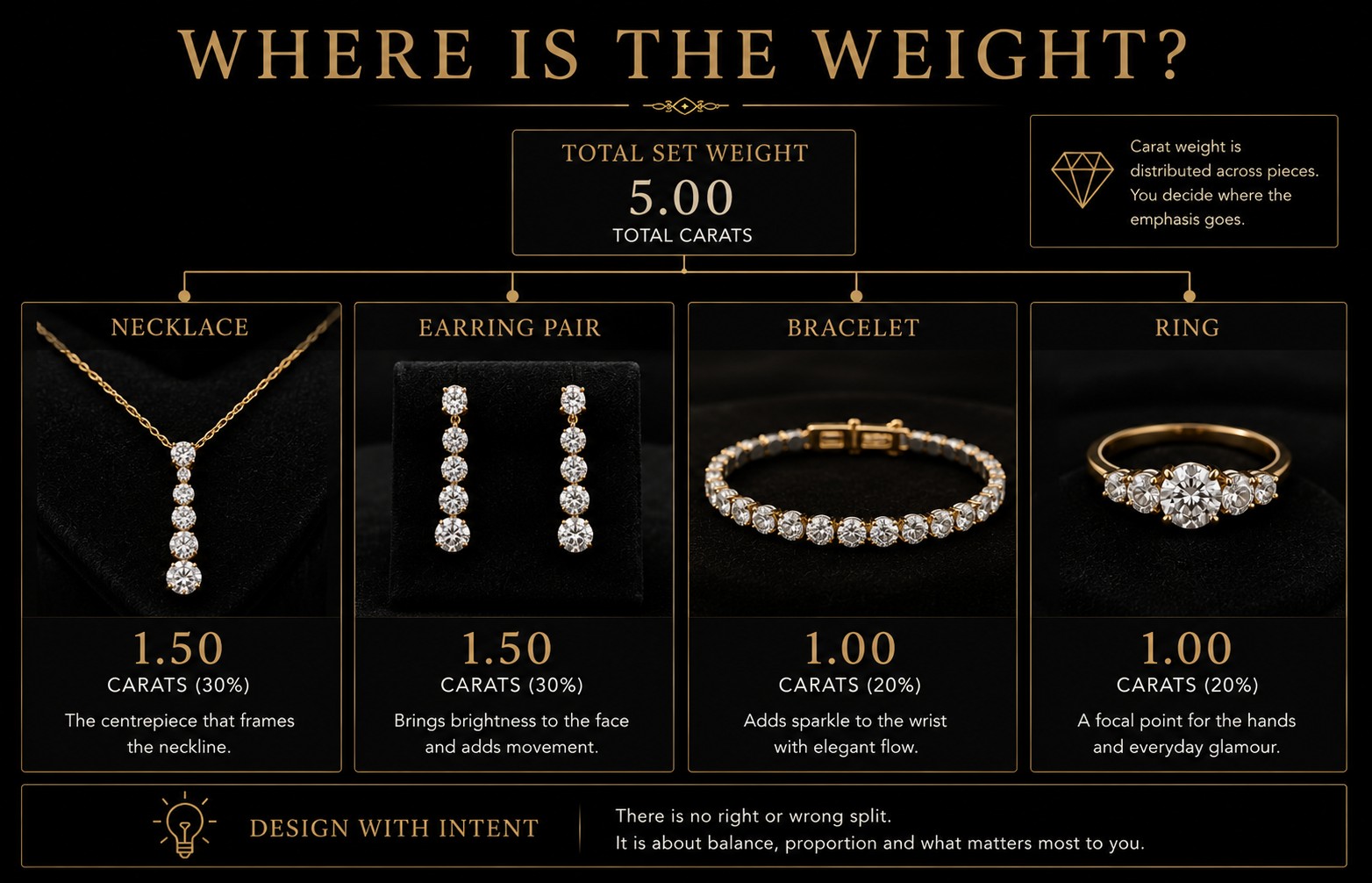
The biggest mistake: treating the set as one headline carat number instead of checking what is included and how diamonds, dimensions and functionality are distributed across the individual pieces.
Frequently Asked Questions
What is a lab-grown diamond jewellery set?▼
It is a coordinated group of jewellery pieces using laboratory-grown diamonds, such as a necklace with matching earrings or a necklace, earrings and bracelet combination.
What should I check before buying a jewellery set?▼
Check exactly what is included, how the pieces coordinate, how total carat weight is divided, physical dimensions, metal, fastenings, documentation, availability and set-specific terms.
Does a jewellery set always include every piece shown in the photograph?▼
No. Confirm the stated product contents rather than relying on styled imagery.
Does a necklace-and-earring set always include the chain?▼
No. The product description should clearly state whether the chain is included.
What is the difference between a pendant set and a necklace set?▼
A pendant may be sold with or without a chain. A complete necklace includes the neck-worn structure.
Should the earrings and necklace be identical?▼
No. They should coordinate, but different scales can be intentional.
What does total carat weight mean for a jewellery set?▼
It may describe the combined diamond weight across all included pieces. The product should make the scope clear.
Does 3 ct jewellery set mean the necklace contains 3 ct?▼
Not necessarily. The stated total may include the earrings and other components.
Should component carat weights be listed separately?▼
They are very useful when carat distribution could affect how the set looks.
What does earring carat weight mean in a set?▼
Check whether the figure is per diamond, per earring or for the complete pair.
Can two sets have the same TCW but look different?▼
Yes. Diamond allocation and component dimensions can be completely different.
What measurements should I check?▼
Check necklace length, pendant dimensions, earring dimensions and any bracelet dimensions where applicable.
Should the necklace and earrings use the same metal?▼
They may, but this should be confirmed rather than assumed.
Does a diamond report cover the whole jewellery set?▼
Not automatically. A report normally applies only to the diamond identified by that document.
Does a hallmark verify the diamonds?▼
No. Hallmarks concern precious-metal fineness.
Should both earrings look matched?▼
Yes. A pair should look intentionally coordinated in size, design and overall appearance.
Should the jewellery set work when worn separately?▼
Ideally, yes if versatility matters to you.
Can a jewellery set be returned one piece at a time?▼
That depends on the retailer's confirmed policy. Do not assume partial returns are allowed.
Are jewellery sets containing earrings automatically non-returnable?▼
Do not assume a blanket rule. Check the retailer's actual lawful policy and any applicable hygiene conditions.
Does buying a set always save money?▼
No. A coordinated set does not automatically include a bundle discount.
Does one warranty automatically cover every component?▼
Do not assume so. Check the actual after-sales terms.
Does joining the Aurelia waitlist reserve the jewellery set?▼
Under the proposed Aurelia waitlist model, no. It should register interest only.
What is the biggest mistake when buying a matching jewellery set?▼
Treating the set as one headline carat number instead of checking what is included and how the diamonds, dimensions and functionality are distributed across the individual pieces.
Final Answer: How Should You Choose a Lab-Grown Diamond Jewellery Set?
Start with the contents. Know exactly which components are included and whether a necklace component includes its chain. Then evaluate the coordination. The pieces should share enough design language to look intentional together, but they do not need to be identical in scale.
Next, separate the diamond weight by component. Do not stop at the complete-set TCW. Understand how much diamond weight belongs to the necklace, earrings and any other component, and clarify whether earring figures apply per stone, per earring or per pair. Then compare the physical dimensions. Check necklace length, pendant dimensions and the actual size or drop length of the earrings.
After that, verify the metal and construction of each component. Then review the documentation. Make sure any laboratory report is connected to the correct diamond and do not assume one report covers the complete set. Finally, confirm availability and policies at set level.
For necklace-versus-pendant terminology, read Diamond Necklace vs Diamond Pendant: What Is the Difference?
For necklace design types, use How to Compare Different Diamond Necklace Designs
For earring styles, use How to Compare Different Diamond Earring Designs
For earring selection overall, continue with How to Choose Lab-Grown Diamond Earrings
For total carat weight, read Total Carat Weight Meaning in Diamond Jewellery
For final product verification, use What to Check Before Buying Lab-Grown Diamond Jewellery
Where an Aurelia Royale jewellery set does not yet have an approved direct-purchase price, Join the Waitlist or submit an enquiry. This should register interest only and should not be presented as an order, reservation or preorder.
Explore Aurelia Royale Lab-Grown Diamond Jewellery Sets
Contents + coordination + carat allocation + dimensions — find the set that suits you.
Stay Connected
Get Our Latest Updates
Be first to discover new collections, exclusive events, and the quiet privileges reserved for our inner circle.