Questions to Ask Before Buying Coloured-Stone Diamond Jewellery
Journal • Published July 16, 2026
Save written replies with order transaction documents to confirm specification levels.
A good question does more than produce a reassuring answer. It reveals whether the seller knows the exact piece, distinguishes evidence from assumption and is willing to put important details in writing.
The following 25 questions cover the coloured stone, lab-grown diamond accents, construction, imagery, reports and purchase terms. Ask only those not already answered clearly on the product page—and save the replies with your order.
Quick answer
Before buying, ask for the coloured stone’s exact identity, natural or laboratory-created status, treatments, dimensions and weight; the diamonds’ origin, count, total weight and quality range; the metal, complete dimensions and setting; whether images show the exact item; what any report covers; and the delivered-price, production, return, warranty and care terms. A complete answer should be specific, item-matched and supported by the invoice, laboratory report or written policy—not vague terms such as “genuine”, “premium” or “certified”.
The five-question shortlist
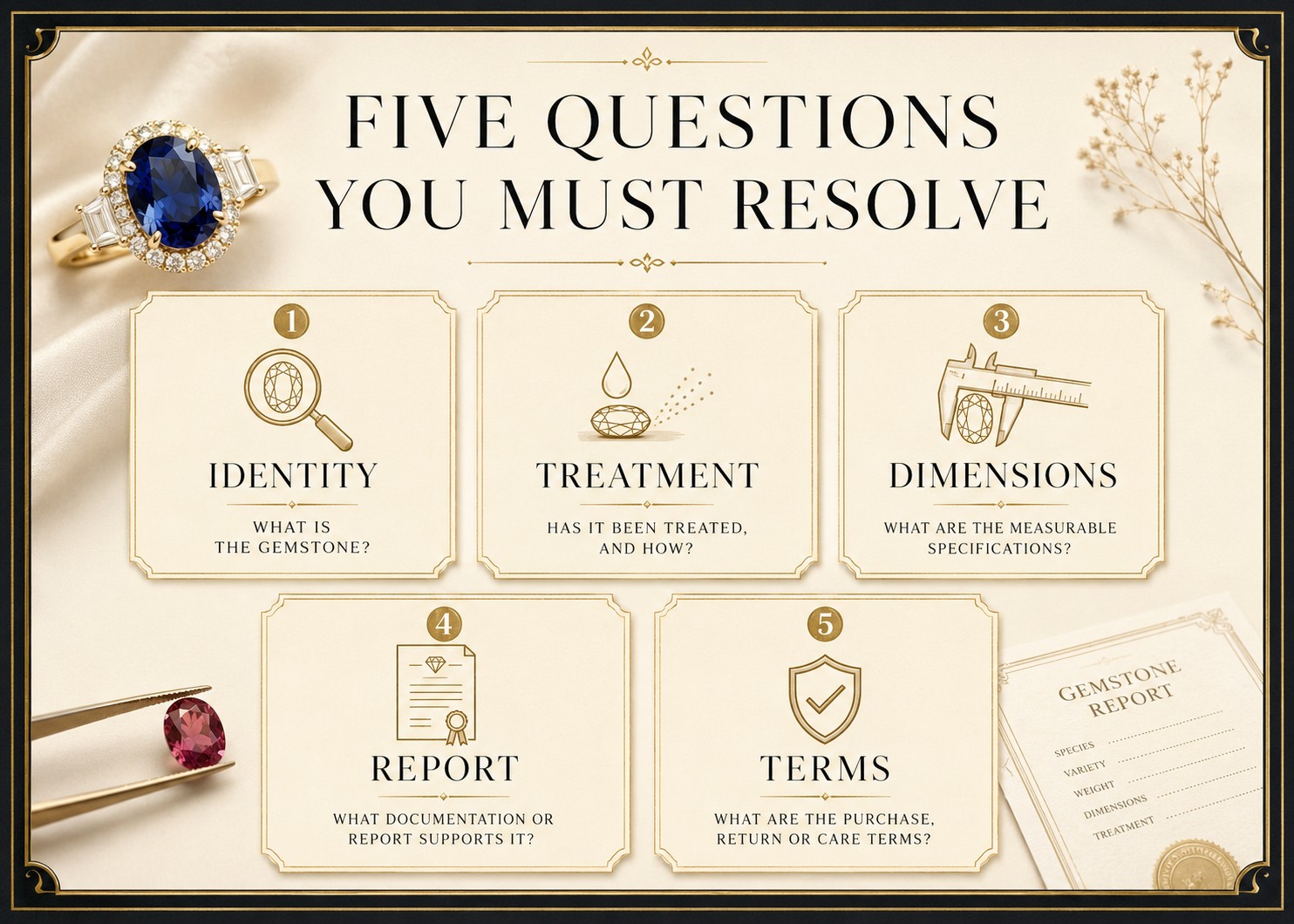
If you ask only five questions, use these:
- What is every gemstone, and is each natural, laboratory-created, composite or an imitation?
- What treatments are known or detected, and how do they change care?
- What are the centre-stone dimensions and weight, and what is the separate diamond accent total?
- Does a verifiable report match this exact stone or finished piece, and what does it cover?
- What is the final delivered price, return position and warranty for my country and selected configuration?
Questions about the coloured stone

Verifying exact species and variety definitions keeps purchase records accurate.
1. What is the exact gemstone species or variety? Look for mineral varieties (e.g. sapphire, emerald). Avoid marketing color titles.
2. Is the stone natural, laboratory-created, composite or an imitation?
Confirm the exact category. For lab-grown details, see how lab-grown diamonds should be described and disclosed.
3. Has the coloured stone been treated? Identify treat names like heat, filling, coatings, or dyeing rather than a general 'enhanced'.
4. What does the treatment change about care or repair?
Obtain clean limits before cleaning. See care steps at how to care for coloured stones and diamonds.
5. Are the photographs of the exact stone? Identify unique listing items vs stock design variation allowances.
6. How is the colour described beyond one word? Verify hue saturation properties under daylight environments.
7. What are the stone’s millimetre dimensions?
Verify millimetre outlines separately. Consult size charts at carat weight versus visible diamond size.
8. Is the carat weight measured or estimated? Confirm if weights represent loose scales or mounted math estimates.
Questions about the diamond accents

Confirming individual accent shapes and weights clarifies size footprints.
9. Are the diamonds laboratory-grown or natural? Verify origin directly. Accents describe design roles, not material.
10. How many diamond accents are there, and what shapes are they? Record stone counts to check setting density.
11. What is the combined diamond accent total carat weight?
Separate accent totals from center weights. Review guides at total carat weight in diamond jewellery.
12. What colour and clarity range is stated for the accents?
Audit stated group parameters. For grading guides, see the 4Cs of lab-grown diamonds.
13. Are the accents matched in visible appearance? Ask if sorting steps ensure uniform layout colors and sizes.
Questions about construction and wear
14. What metal and fineness are used?
Check alloy percentages and hallmark stamps. Read metal guides at how to check the metal used in diamond jewellery.
15. What are the complete jewellery dimensions and weight? Measure band widths, heights, chain drops, and total item weights.
16. How is the coloured stone protected by the setting? Check if bezels protect gem tips from daily impact paths.
17. Which parts move, open or detach? Verify bail connections, clasp security links, and hinge points.
18. Is this piece suitable for how I plan to wear it? Match gem durability to daily wear schedules.
Questions about images and documents
19. Can I see front, side, back, macro, on-body and movement views? Request multi-angle captures under neutral lighting environments.
20. What type of report is supplied? Confirm if documents represent loose gems or finished items.
21. Which exact components does the report cover?
Mounted reports are limited by settings. For details, see what certified lab-grown diamond jewellery means.
22. Can I verify the report independently? Enter report numbers directly into official laboratory lookups.
Questions about the transaction
23. What exactly is included in the delivered price? Confirm VAT, duties, shipping fees, and local customs responsibilities.
24. Is the item ready-made, made-to-order or personalised? Confirm timeline durations and cancellation boundaries before paying.
25. What are the return, warranty and repair terms for this exact order? Confirm return windows, return postage coverage, and sizing limitations.
The answer-quality test

Scoring answer specificity confirms seller credibility.
| Test | Strong answer | Weak answer |
|---|---|---|
| Specific | Names the material, status and treatment | Uses “genuine” or “premium” |
| Item-matched | Refers to the exact SKU, stone or configuration | Gives a collection-wide promise |
| Evidenced | Links to report, specification or policy | Says “trust us” |
| Durable | Appears on invoice or saved written reply | Exists only in a disappearing chat |
Copy-and-send message for the seller
Template query
Keep a pre-purchase evidence file
- the product page and selected options;
- original images and video links;
- seller answers;
- report and official verification result;
- delivered-price calculation;
- return and warranty policy;
- expected production and delivery date; and
- order confirmation and invoice.
The Aurelia Royale standard
Aurelia Royale resolves specification details on product pages directly. Browse collection at Aurelia Royale jewellery or contact Aurelia Royale to request specific specifications.
Final verdict
What is the first question to ask about a coloured stone?▼
Ask for the exact material identity and whether it is natural, laboratory-created, composite or an imitation.
Does natural mean the gemstone is untreated?▼
No. Natural formation and treatment status are separate facts, so ask about both.
Should a jeweller disclose gemstone treatments?▼
Yes. Treatments can affect comparison, durability, cleaning and repair and may not be visually apparent.
Why should I ask for gemstone dimensions?▼
Carat measures weight rather than visible size. Millimetre dimensions clarify face-up scale.
What should I ask about diamond accents?▼
Ask origin, count, shapes, combined total weight, quality range and report scope.
Does one certificate cover the entire jewellery piece?▼
Not necessarily. Check whether it covers a loose centre stone, finished item or specific components.
Can mounted gemstones receive reports?▼
Yes, but the setting may restrict observation or measurement, and the report should state limitations.
Should seller answers be in writing?▼
Yes. Save item-specific answers and ask for the essential description to appear on supplied documents.
What should I ask about product photographs?▼
Ask whether they show the exact stone and request front, side, back, macro, on-body and movement views.
What should I ask about made-to-order jewellery?▼
Confirm production time, variation, approval stages, cancellation point, return exclusions and warranty.
What is a warning sign in a seller's answer?▼
Vague language, conflicting documents, unverifiable reports, missing dimensions or refusal to provide facts in writing.
Do I need to ask all 25 questions?▼
No. Ask what the page does not answer, but always resolve identity, treatment, size, report scope and terms.
Consult Our Experts
Aurelia Royale details every design spec and report parameter directly. Contact our support team for documentation.
Stay Connected
Get Our Latest Updates
Be first to discover new collections, exclusive events, and the quiet privileges reserved for our inner circle.