
How to Compare Different Diamond Earring Designs
Studs, Hoops and Drops by Movement, Scale, Fastening and Everyday Wear • Published September 10, 2026
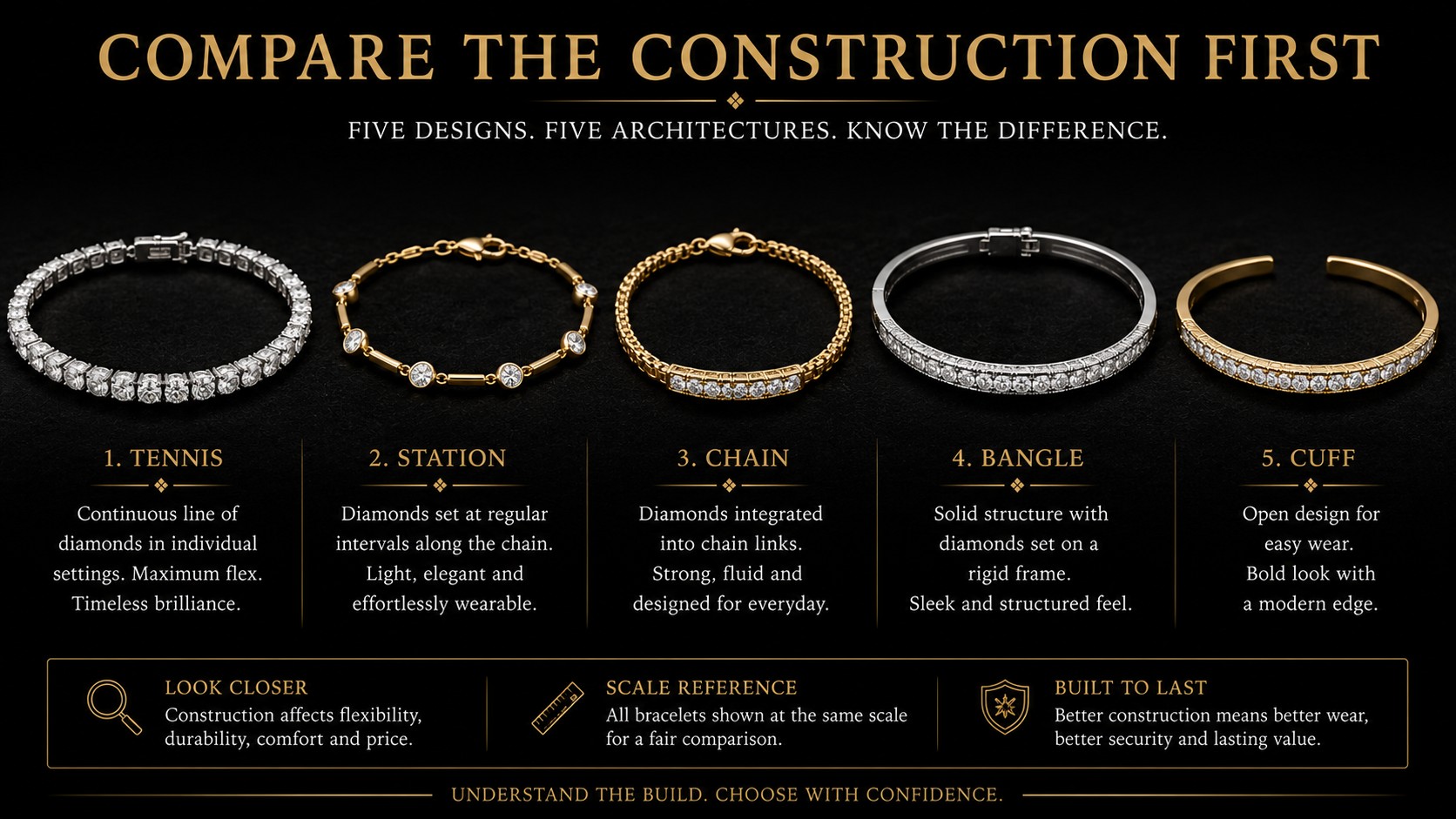
The right comparison is not simply which earring contains the most diamond — it is which design has the right combination of scale, movement, fastening and visual presence.
Diamond earrings can look dramatically different on the ear even when they contain similar amounts of diamond weight. A stud sits close to the lobe and places most of the visual emphasis around one compact area. A hoop creates a circular or curved outline around the ear. A drop earring introduces vertical length and movement below the lobe.
Those differences affect more than style. They change how the earrings feel during wear, how much they move, how important the fastening becomes, how the diamond weight is distributed, how easy the earrings are to combine with other jewellery and whether they suit everyday use or more occasional dressing.
The right comparison is therefore not simply: Which earring contains the most diamond? It is: Which design has the right combination of scale, movement, fastening and visual presence for the way I want to wear it?
Stud vs Hoop vs Drop Diamond Earrings: Quick Comparison
| Factor | Diamond Studs | Diamond Hoops | Diamond Drops |
|---|---|---|---|
| Position | Close to the earlobe | Curves around or below the lobe | Extends below the lobe |
| Movement | Usually very low | Low to moderate | Moderate to high |
| Visual scale | Compact | Determined strongly by hoop diameter | Determined strongly by drop length |
| Fastening importance | Very high because the back supports the earring | High; often integrated into hoop construction | High; depends on stud, hook or hinged top |
| Diamond distribution | Concentrated around one focal area | Distributed around part or all of the hoop | Distributed vertically or around a suspended element |
| Everyday versatility | Usually high | Depends strongly on diameter and profile | Depends strongly on length and movement |
| Best comparison measurement | Width/diameter + pair carat weight | Hoop diameter + width | Full drop length + width |
| Main buying risk | Misreading pair carat weight or scale | Underestimating hoop diameter | Underestimating length, weight or movement |
None of the three designs is universally better. They solve different wearing preferences.
Diamond Stud Earrings: Compact, Stable and Diamond-Focused
Stud earrings place the decorative element close to the ear. In the simplest diamond stud, the diamond itself becomes the main visual feature, supported by a relatively small setting and post. Because the earring has little hanging length, movement is normally limited. This can make studs appealing for people who prefer jewellery that feels stable during the day rather than moving with every turn of the head.
Their compact structure also makes them easier to combine with necklaces, glasses, additional piercings and other jewellery without automatically dominating the entire look. GIA describes diamond studs as a long-standing jewellery staple and notes that the setting and backing are both important parts of choosing a pair.
What Changes the Look of a Diamond Stud?
Two products can both be called diamond studs and still look completely different. A simple solitaire stud concentrates attention on one diamond. A halo stud surrounds the centre with smaller stones and creates a larger finished outline. A bezel-set stud frames the diamond with more visible metal. A cluster can create the visual impression of a broader earring using several diamonds rather than one dominant stone. The term stud therefore describes how the earring sits rather than telling you exactly how large, simple or diamond-heavy it will appear.
Stud Setting Comparison
| Stud Design | Visual Effect | Metal Visibility | Relative Movement | What to Check |
|---|---|---|---|---|
| Prong solitaire | Diamond-forward | Low | Very low | Prong condition and stone security |
| Bezel stud | Clean, framed outline | Higher | Very low | Even bezel and finished diameter |
| Halo stud | Larger visual footprint | Moderate | Very low | Centre vs total carat distribution |
| Cluster stud | Broad sparkle from several stones | Varies | Very low | Stone count, total size and alignment |
A prong setting can expose more of the diamond, while a bezel surrounds more of the stone with metal. GIA notes that bezel settings can provide greater physical protection around a stud diamond, while open prongs expose more of its surface. Neither is automatically higher quality. The better design depends on whether the buyer prioritises an open diamond appearance, a more defined metal outline or additional physical coverage around the stone.
Stud Earring Fastenings Matter More Than They First Appear
The fastening sits behind the ear, so it receives much less attention than the diamond. But for stud earrings, it determines how securely and comfortably the product sits. Common stud systems can include friction backs, screw backs and locking backs.
GIA notes that screw and locking backs can offer greater security for valuable diamond studs, while also cautioning that some wearers find thicker threaded screw-back posts less comfortable. That creates a useful trade-off. A theoretically more secure fastening is not automatically the best design for someone who finds it difficult or uncomfortable to use.
Stud Back Comparison
| Fastening Consideration | Why It Matters |
|---|---|
| Security | Helps reduce the risk of accidental loss |
| Post thickness | Can affect comfort through the piercing |
| Ease of use | Important when fastening earrings without a mirror |
| Back size | Can affect how well a heavier stud sits |
| Familiarity | Some wearers strongly prefer a system they already use |
GIA also notes that larger or heavier studs can droop if the backing is too small to support them properly. This means stud quality is not simply: diamond + setting. It is: diamond + setting + post + backing + overall balance on the ear.
Diamond Hoop Earrings: Diameter Changes Everything
A diamond hoop introduces a completely different visual structure. Instead of concentrating diamonds around one point, the earring follows a circular or curved form. That means hoop diameter becomes one of the most important measurements. A small hoop sitting close to the ear can behave almost like a compact everyday earring. A much larger hoop changes the silhouette of the entire side of the face. These two earrings may use the same general term—diamond hoop—while serving very different purposes.
This is why close-up product photography is particularly unreliable for comparing hoops. A small 12 mm hoop can fill the entire product image. A much larger 30 mm hoop can be photographed at exactly the same displayed size. The photograph tells you the design. The millimetre measurement tells you the scale.
Small vs Medium vs Larger Hoops
Rather than treating diameter categories as fixed universal standards, compare how increasing diameter changes the wearing experience.
| As Hoop Diameter Increases | Likely Effect |
|---|---|
| Visual presence | Becomes stronger |
| Movement | Usually increases |
| Distance below lobe | Usually increases |
| Interaction with hair/clothing | Can increase |
| Everyday subtlety | Generally decreases |
| Need to check fastening and weight | Becomes more important |
These are design tendencies, not rigid rules. A lightweight large hoop can still feel easier to wear than a small but heavy construction. Actual measurements and construction matter more than the category label.
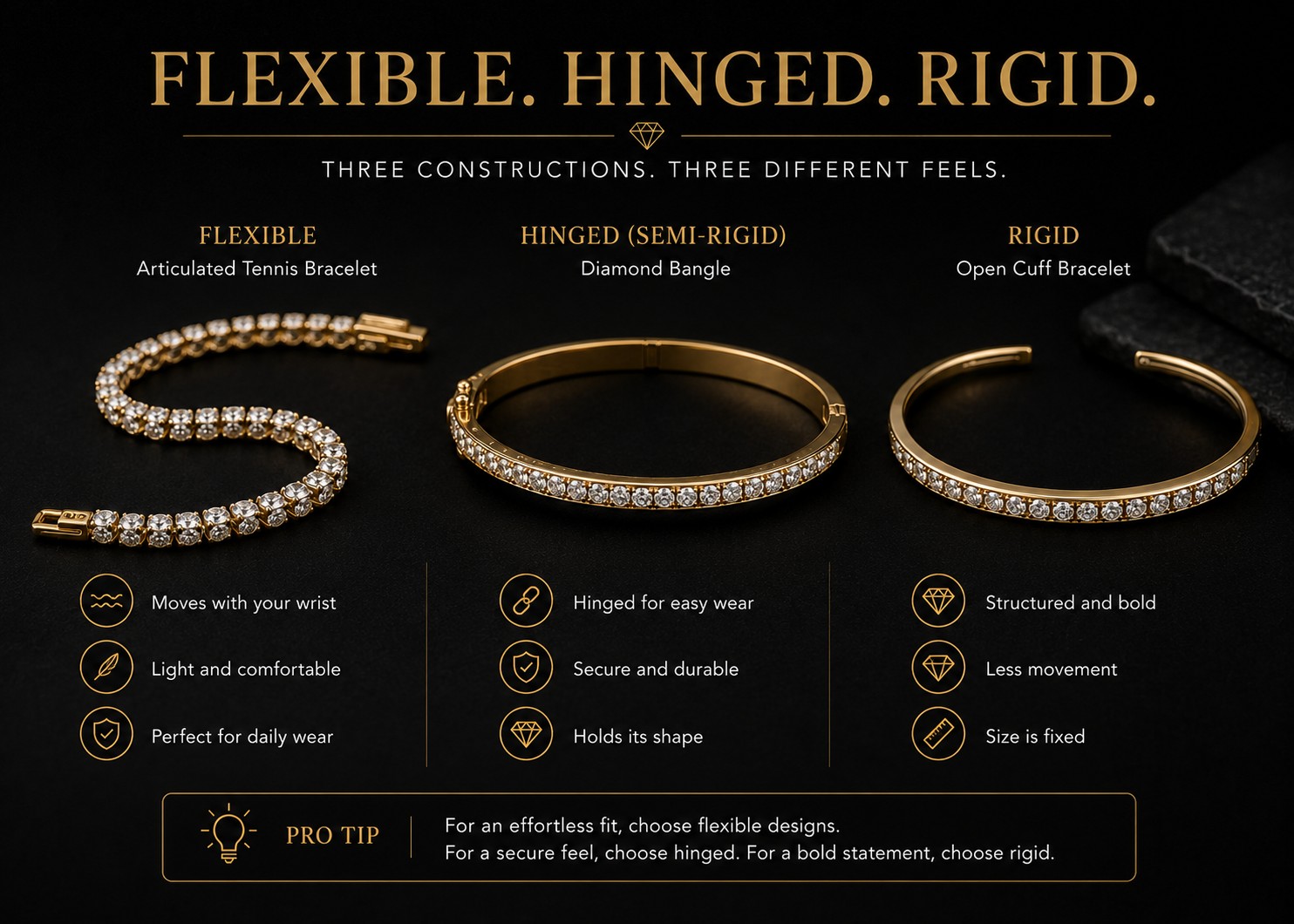
Hoop diameter is the most important measurement — photography cannot reliably show whether a hoop is 12 mm or 30 mm.
Huggies vs Larger Hoops
A small close-fitting hoop is often described as a huggie. Its defining visual characteristic is that it sits much closer to the earlobe than a large traditional hoop. That can create a compact look while preserving the curved form that distinguishes a hoop from a stud. A larger hoop creates much more visible negative space inside the circle and becomes a stronger part of the wearer's overall silhouette.
| Comparison | Huggie / Small Hoop | Larger Hoop |
|---|---|---|
| Position | Close to lobe | Extends further away |
| Movement | Low | Usually higher |
| Visual impact | Refined and compact | Stronger |
| Hair interaction | Usually lower | Potentially greater |
| Stacking with multiple piercings | Often easy | Depends on available space |
| Main measurement | Inner/outer diameter | Outer diameter + width |
Do not assume an Aurelia hoop is a huggie, hinged hoop or another specific construction unless the product specification confirms it.
Diamond Coverage Changes the Character of a Hoop
Not every diamond hoop is diamond-set all the way around. Some designs place diamonds across the front-facing section only. Some cover the outer surface. Some may incorporate diamonds along the inside-front section so additional stones remain visible from the side. Others use only a small diamond accent. That means two hoops with identical diameters can have very different: diamond weight, appearance, price, and metal visibility. The product description should therefore identify the actual diamond distribution rather than relying on the term diamond hoop alone.
Diamond Drop Earrings: Movement Becomes Part of the Design
Drop earrings extend below the earlobe. That vertical construction creates the clearest distinction from studs and most hoops: the jewellery is designed to occupy space below the ear. Some drops are relatively short and controlled. Others extend significantly and move freely. Some have one suspended diamond. Others use a chain, articulated links or several diamond-set sections. The useful comparison measurement is therefore usually the full drop length, not simply the size of the largest diamond. A 5 mm centre stone attached to a 30 mm articulated drop creates a completely different wearing experience from a 5 mm stud.
Drop Length Matters More Than Product Photography
Close-up photography can make short and long drop earrings look similar because both may be framed tightly around the product. Always identify the real physical length. For a drop earring, that normally means measuring from the top of the earring construction to its lowest point. If the design includes several articulated sections, that total length is usually much more useful than the dimensions of one individual diamond.
| Factor | Short Drop | Longer Drop |
|---|---|---|
| Visual movement | Lower | Higher |
| Presence below lobe | Subtle | Strong |
| Interaction with hair/clothing | Lower | Potentially higher |
| Suitability for understated daily wear | Often easier | More style-dependent |
| Impact in occasion dressing | Refined | More dramatic |
| Critical measurement | Overall drop | Overall drop + widest point |
Again, longer does not mean better. It means more visually and physically present.
Drop Earrings Can Be Rigid or Articulated
Two earrings with the same 30 mm length can still behave differently. A relatively rigid design may move mainly as one component. An articulated drop can contain several joints and move much more freely. That movement affects: sparkle, comfort, noise, interaction with hair, and the overall sense of formality. A buyer who likes jewellery to remain close to the body may prefer a controlled drop. Someone who enjoys visible movement may deliberately choose an articulated design. The correct comparison therefore looks beyond dimensions and asks: How is the earring constructed to move?
Stud vs Hoop vs Drop: Which Moves the Most?
Movement generally increases as more of the earring extends away from the lobe and as more articulated components are introduced.
| Design | Typical Movement | How It Usually Feels |
|---|---|---|
| Stud | Very low | Stable, close to ear |
| Huggie/small hoop | Low | Compact curved movement |
| Larger hoop | Moderate | More noticeable movement |
| Short drop | Moderate | Some movement below lobe |
| Long/articulated drop | High | Movement becomes part of design |
This table describes typical behaviour rather than every possible product. Construction can change the result. A heavy rigid drop may move less than an extremely fine large hoop.
Which Earring Design Is Most Comfortable?
Comfort is personal. A stud has relatively little movement but can still be uncomfortable if the post or backing does not suit the wearer. A hoop avoids a traditional stud back in some constructions but may move more. A drop can feel elegant and light if carefully engineered, or noticeable if the piece is long and heavy. The most useful comfort variables are: finished weight, fastening, post or hook construction, scale and movement. Diamond carat alone cannot answer the comfort question.
Finished Weight Matters More as Earrings Become Larger
Earring weight can influence whether the jewellery sits upright, pulls downward or becomes uncomfortable during extended wear. GIA's stud guidance specifically notes that larger earrings can droop when their backing does not adequately support them. With hoops and drops, the issue is slightly different because more of the mass may sit away from the piercing. That can change how noticeable the earring feels as the wearer moves. Finished gram weight, where supplied, can therefore be useful context. But it should not be treated as a quality score. A lightweight earring is not automatically cheap. A heavy earring is not automatically luxurious.
Which Design Works Best for Everyday Wear?
There is no universal everyday winner. A compact stud is often easy to wear because it has limited movement. A small diamond huggie can provide more visible shape while remaining close to the ear. A short drop may work perfectly for someone whose everyday wardrobe is more expressive. A large hoop can also be an everyday signature for someone accustomed to wearing that scale. The phrase daily wear should therefore be interpreted through the wearer's own habits rather than through a universal size rule.
| Priority | Design Worth Considering First |
|---|---|
| Minimum movement | Stud |
| Compact but more visible shape | Huggie / small hoop |
| Visible movement without long length | Small hoop / short drop |
| Strong styling presence | Larger hoop |
| Vertical elegance | Drop |
| Multiple-piercing styling | Small stud / huggie |
This is a decision aid, not a hierarchy.
Which Design Works Best for Events and Formal Dressing?
Occasion wear can support more scale, movement and visible diamond coverage, but that does not mean occasion earrings must be large. A high-quality solitaire stud can work with formal clothing precisely because it is restrained. A drop can create greater vertical emphasis and movement. A hoop can create a stronger contemporary silhouette. The best choice depends on whether the wearer wants the earrings to: support the outfit, or: become one of its main visual features. This is a style question rather than a gemmological one.
Hair Can Change How Earring Designs Read Visually
Hair length and hairstyle affect how much of an earring remains visible. Studs can become partially hidden by hair. Larger hoops may remain visible because of their outline. Long drops can appear and disappear as the wearer moves. That does not create a rule about which design suits which hairstyle. It simply means jewellery scale should be considered in the context in which it will actually be worn. A product photograph on a white background does not provide that context.
Glasses Can Also Affect the Wearing Experience
Someone who wears glasses regularly may prefer earrings that do not compete physically with the arms of the frame. Studs and small hoops usually occupy less space around the side of the head. Large hoops and elaborate drops can still work perfectly well, but the wearer may want to consider how the pieces interact visually and physically. Again, there is no universal prohibition. The objective is to compare the actual jewellery with the wearer's normal routine.
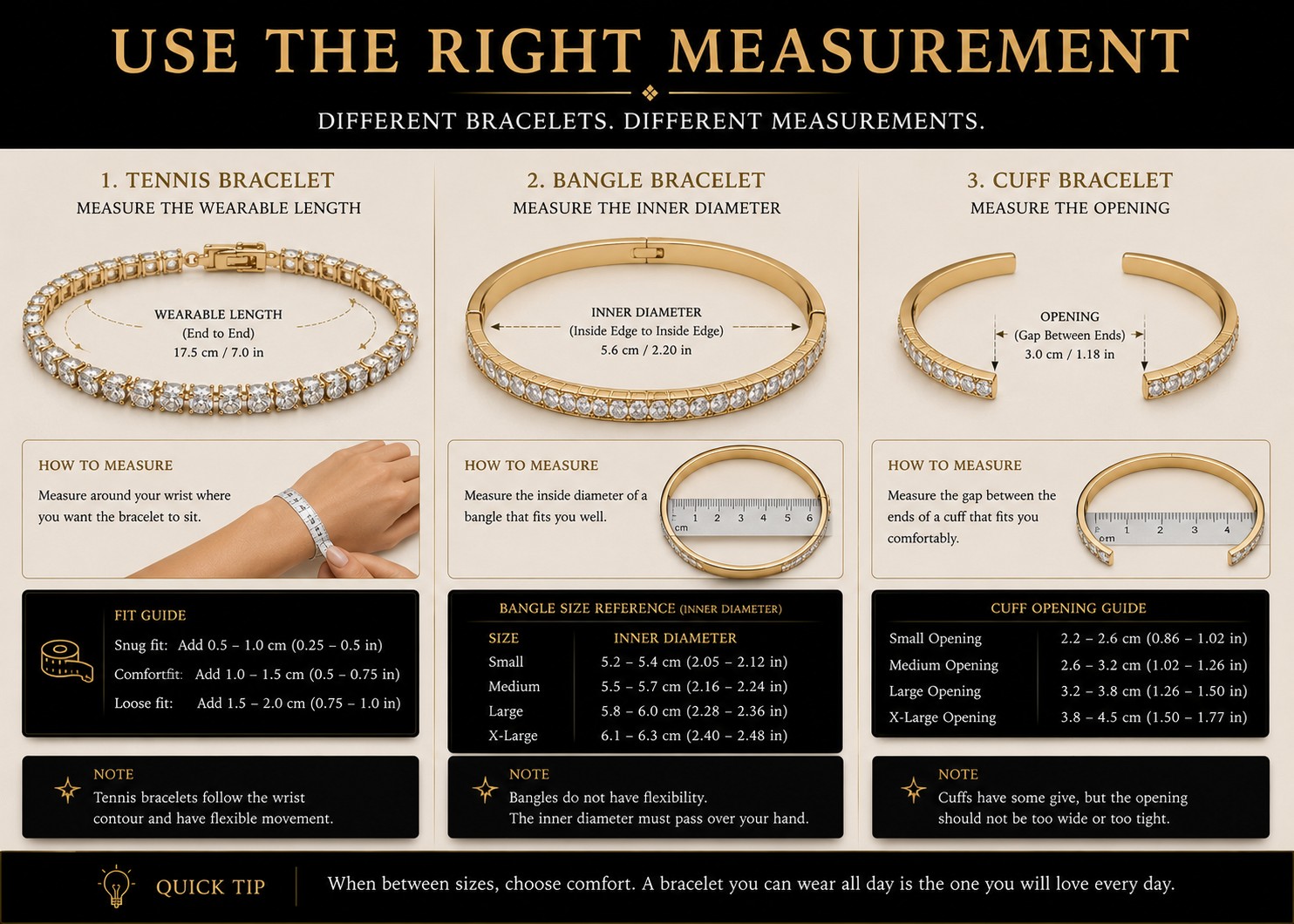
Carat measures diamond weight — use diameter, hoop diameter, or full drop length to understand actual earring scale.
Compare Physical Size Before Comparing Carat Weight
Diamond earrings create an especially common specification mistake because buyers often try to judge scale from total carat weight. Carat measures diamond weight. It does not directly tell you the finished dimensions of the earring. For studs, compare overall width or diameter. For hoops, compare hoop diameter and width. For drops, compare full length and maximum width. Then use carat weight to understand the diamond content. That sequence produces a much clearer picture of what the product will look like.
Pair Carat Weight vs Per-Earring Carat Weight
A pair described as 1.00 ct total weight does not necessarily contain a one-carat diamond in each ear. In a simple matched pair, the total might be distributed approximately across the two earrings. Likewise, a hoop or drop design can distribute diamond weight across multiple stones. Always identify whether a headline figure refers to: one diamond, one earring, the complete pair or all diamonds combined.
For the dedicated explanation, use Total Carat Weight Meaning in Diamond Jewellery
Same Carat Weight, Completely Different Design
Imagine three fictional earring products, all containing 1.00 ct total diamond weight. These figures are illustrative only.
| Fictional Design | Diamond Distribution | Finished Appearance |
|---|---|---|
| Stud pair | Two major diamonds, approximately 0.50 ct each | Concentrated sparkle |
| Hoop pair | Many smaller diamonds distributed along hoops | Curved diamond line |
| Drop pair | Small top stones plus suspended diamonds | Vertical sparkle and movement |
All three contain the same fictional TCW. They do not provide the same visual scale, diamond size or wearing experience. This demonstrates why total carat weight is not an earring design category.
Diamond Shape Can Affect Studs, Hoops and Drops Differently
Shape is most immediately obvious in solitaire studs because the outline of the diamond often becomes the outline of the earring. Round, oval, pear, emerald and other shapes therefore create clearly different silhouettes. In hoops, individual diamond shape may be less visually dominant when many smaller stones form one continuous line. In drops, shape can become important again when a larger diamond forms the suspended focal point. The influence of shape therefore depends on the architecture of the earring.
Setting Style Changes the Design as Well as Stone Security
A setting does not merely hold the diamond. It changes how much metal you see. Prongs generally reveal more diamond surface. Bezels create a stronger metal outline. Pavé allows many small stones to form a continuous surface. GIA's guidance for studs notes the trade-off between open prong settings, which expose more diamond, and bezel settings, which surround more of the stone. That same design principle applies more broadly. When comparing two earrings, identify whether you prefer: a diamond-dominant look, a metal-defined look, or: a dense multi-stone surface.
Fastening Comparison Across Earring Designs
The fastening question changes with the design itself.
| Design | Fastening Issue to Check |
|---|---|
| Stud | Post thickness, back type, support and security |
| Huggie | Hinge/latch alignment and ease of opening |
| Hoop | Integrated closure security and how smoothly it engages |
| Drop with stud top | Stud backing plus weight of suspended section |
| Hook-style drop | Hook length, retention system and intended wear |
Aurelia should identify the actual fastening on each product where it materially affects use. Do not assume every stud has a butterfly back or every hoop has the same hinge system.
Which Design Is Easiest to Put On?
This depends partly on dexterity and familiarity. A conventional friction-back stud may feel effortless to someone who has worn that system for years. A screw back provides a different level of security but requires more rotation. A hinged hoop can be convenient when the mechanism is easy to align. A hook-style drop may be physically simple but can use an additional retention element depending on the design. The easiest fastening is therefore the one the wearer can operate confidently and comfortably.
Which Design Is Least Likely to Snag?
No earring design can be declared snag-proof. However, projection and surface structure influence how easily an earring can interact with hair, scarves or clothing. Compact studs generally project less than long articulated drops. Smooth hoops may have fewer protruding elements than elaborate multi-section drops. But a poorly finished prong on a stud can still snag. Actual workmanship matters.
For the complete finished-jewellery quality assessment, link to What Makes Lab-Grown Diamond Jewellery High Quality?
How Workmanship Changes the Comparison
A well-made stud should sit correctly and have secure stone setting and fastening. A hoop should open and close properly, maintain alignment and carry its stones consistently. A drop should have controlled joins and articulation so that movement looks intentional rather than unstable. This means design category should never replace workmanship assessment. A technically simple stud can be excellent jewellery. A complicated drop can be poorly executed. Complexity and quality are different things.
Which Earring Design Is Best for Multiple Piercings?
Small studs and huggies are commonly useful in multi-piercing arrangements because they occupy relatively little space. A larger hoop or long drop can become the focal point while smaller earrings fill neighbouring piercings. The key consideration is physical spacing between piercings and the relationship between the pieces. Do not assume all ears provide the same amount of room. If the buyer intends to build an ear stack, dimensions matter more than generic product-category labels.
Which Earring Design Is Best as a Gift?
Earrings are relatively easy to gift because ring sizing is not required, but design preference still matters. Studs can be easier to choose when the recipient prefers understated jewellery. Hoops require confidence about preferred diameter. Drops require confidence about length, movement and occasion style. For a gift, the recipient's existing earrings are usually stronger evidence than general fashion rules.
For the dedicated gift decision, use How to Choose Lab-Grown Diamond Earrings as a Gift rather than duplicating the full gifting article here.
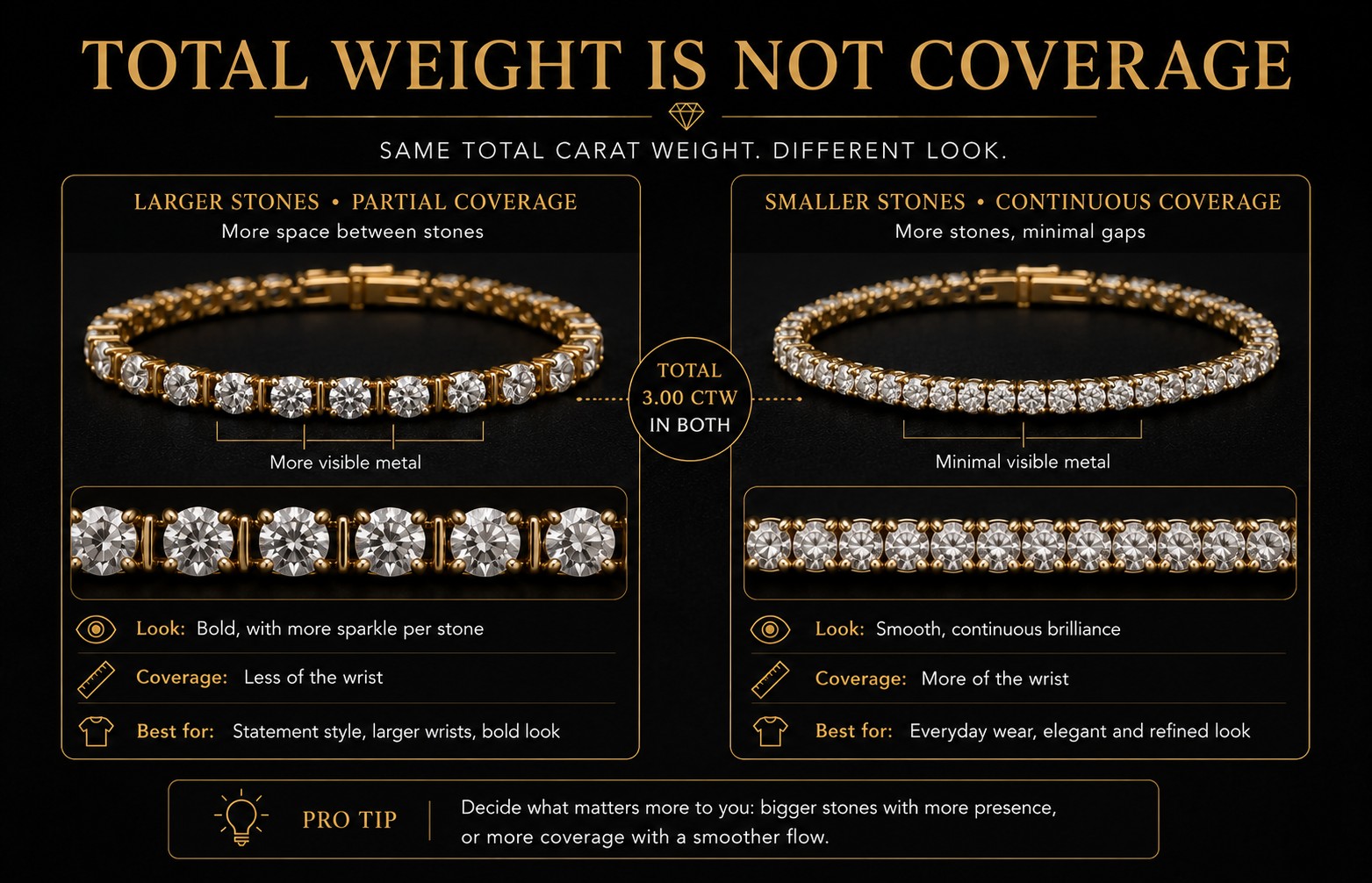
Match the design to the wearing experience — then compare specifications within the chosen category.
Stud vs Hoop vs Drop: Which Should You Choose?
The final choice is easier when you match the design to the wearing experience.
| If You Prioritise... | Consider First | Why |
|---|---|---|
| Very little movement | Stud | Sits close to ear |
| Compact everyday styling | Stud or small huggie | Low visual bulk |
| Visible curved silhouette | Hoop | Diameter becomes part of the look |
| Vertical movement | Drop | Extends below lobe |
| Maximum focus on one main diamond | Solitaire stud | Diamond becomes central focal point |
| Diamond line around ear | Hoop | Stones follow curved structure |
| Statement movement | Longer drop | Articulation and length become visible |
| Easy multi-piercing combination | Stud / huggie | Smaller spatial footprint |
| Strong occasion presence | Hoop or drop | Greater scale and movement possible |
The table narrows the design category. The product specifications then determine whether a particular pair suits you.
A Fictional Side-by-Side Example
Imagine three fictional lab-grown diamond earring pairs. The figures below are educational examples only and do not represent Aurelia inventory or pricing.
| Specification | Pair A | Pair B | Pair C |
|---|---|---|---|
| Design | Stud | Hoop | Drop |
| Pair TCW | 1.00 ct | 1.00 ct | 1.00 ct |
| Physical scale | 5 mm face-up width | 18 mm hoop diameter | 28 mm total drop |
| Movement | Very low | Moderate | High |
| Fastening | Post + back | Hinged closure | Stud top + articulated drop |
| Visual emphasis | Two focal diamonds | Curved diamond line | Vertical movement |
| Likely use | Versatile/everyday | Everyday to occasion | Occasion/style-led |
The same total diamond weight produces three completely different pieces. That is why earring-design comparison needs to happen before deciding whether one carat total is "large enough".
What to Compare Before Looking at Price
Two earring pairs should not be treated as equivalent merely because both contain lab-grown diamonds. First compare the design category. Then compare: physical dimensions, pair total carat weight, diamond distribution, setting, metal, fastening, and finished weight where available. Only after those specifications are reasonably comparable should price become the main differentiator.
For price-factor analysis, use What Determines the Price of Lab-Grown Diamond Jewellery?
Should Certification Decide Which Earring Design You Choose?
No. Laboratory documentation can be important when significant individual diamonds are being sold with reports. But certification or reporting should not dominate this page because it does not answer whether you should choose a stud, hoop or drop. A pair of well-documented studs and a pair of well-documented drops still provide completely different wearing experiences. Check documentation as part of the final product verification.
For the complete report and product check, use What to Check Before Buying Lab-Grown Diamond Jewellery
Do All Earring Diamonds Need Individual Reports?
No. A stud pair containing significant individually identified diamonds may be sold with individual laboratory documentation. A pavé hoop containing many smaller diamonds will normally create a different reporting situation. The correct documentation depends on the product. That issue should be verified once the buyer has selected the design category, rather than repeated throughout this comparison.
What if You Are Buying Earrings Online?
Online photography is useful for understanding: shape, setting, design, and styling. It is much weaker at communicating real physical scale. Macro photography can make a small stud and a long drop both fill the same screen. Always compare the actual measurements. For studs, use diameter or finished width. For hoops, use diameter and width. For drops, use full drop length.
For the broader remote-inspection process, use How to Choose Diamond Jewellery Without Seeing It in Person
What if Aurelia Does Not Display a Price?
Do not estimate one. Where an Aurelia design is not currently offered through an approved priced checkout process, use Join Waitlist or Enquire About This Piece. Joining the waitlist should register interest only. It should not mean: a purchase has been made, the earrings are reserved, a price has been accepted, or: production has started.
Frequently Asked Questions
What are the main types of diamond earrings?▼
For this comparison, the main structural categories are studs, hoops and drops, with subtypes such as huggies, halos, clusters and articulated drops.
What is the difference between studs and drops?▼
Studs sit close to the earlobe. Drops extend below it and usually introduce more visible movement.
What is the difference between hoops and studs?▼
A stud concentrates the visual design around the piercing. A hoop creates a circular or curved outline around the ear.
What is the difference between hoops and drop earrings?▼
Hoops create a curved form, while drops emphasise vertical length.
Which earrings move the least?▼
Studs generally move the least.
Which earrings move the most?▼
Long or articulated drops usually create the most visible movement, although actual construction matters.
Are studs best for everyday wear?▼
They can be very practical because of their compact form, but everyday style depends on the wearer's preferences.
Are hoops suitable for everyday wear?▼
Yes, particularly when the diameter and weight suit the wearer.
Are drop earrings only for formal events?▼
No. Short or understated drops can also work as everyday jewellery.
What is a huggie earring?▼
A huggie is a small hoop designed to sit relatively close to the earlobe.
How do I compare hoop sizes?▼
Use the actual diameter in millimetres rather than the displayed photograph size.
How do I compare drop earring sizes?▼
Use the full drop length and maximum width.
How do I compare stud sizes?▼
Use finished diameter or width alongside the diamond dimensions.
Is carat weight the same as earring size?▼
No. Carat measures diamond weight.
Does 1 ct earrings mean one carat in each ear?▼
Not automatically. The figure may refer to the combined pair weight. Check the product specification.
Can two earring pairs have the same TCW and look completely different?▼
Yes. The diamond weight can be distributed between two large focal stones, many small hoop stones or several diamonds in a drop design.
What earring back is safest for diamond studs?▼
GIA notes that screw and locking backs can offer strong security, although comfort and usability also matter.
Are screw backs always better?▼
No. GIA also notes that some wearers find thicker threaded posts uncomfortable.
Why do large studs droop?▼
Support depends partly on the earring's weight and the size of the backing. GIA notes that larger earrings may droop when the backing is too small.
Are bezel studs better than prong studs?▼
Neither is universally better. Bezels surround more of the stone, while prongs expose more of it.
Which design is easiest to stack with other ear piercings?▼
Studs and small huggies often require less space, but actual piercing placement determines what works.
Should I compare finished earring weight?▼
Yes where it is supplied and comfort matters, but weight is not a quality grade.
Are bigger earrings better?▼
No. Physical scale should match intended use and personal style.
Do earrings need individual diamond reports?▼
Not always. It depends on the stones and product configuration.
What should I check before buying any of these designs?▼
Verify the physical measurements, diamond distribution, total carat weight, metal, fastening, applicable documentation and whether the product image shows the exact or a representative item.
Final Answer: Should You Choose Diamond Studs, Hoops or Drops?
Choose stud earrings when you want a compact design with minimal movement and concentrated diamond presence. Choose hoops when you want the earring's curved outline to become a stronger part of the design and are comfortable choosing the correct diameter. Choose drop earrings when you want vertical length and movement to contribute to the jewellery's appearance.
After choosing the category, compare physical scale. For studs, check diameter or finished width. For hoops, check diameter and width. For drops, check total length and maximum width. Then compare movement and comfort. Ask how far the earring extends from the lobe, how much it moves and how its finished weight may feel during wear. Next, examine the fastening. The front of an earring determines how it looks. The fastening determines how it stays on the ear.
Finally, compare the diamonds. Separate pair total carat weight from per-stone weight and remember that equal TCW can create completely different visual effects across studs, hoops and drops. The strongest earring choice is therefore not simply the pair with the most carats. It is the pair whose: design, scale, movement, fastening and diamond distribution match how you actually intend to wear it.
For choosing earrings as a present, continue with How to Choose Lab-Grown Diamond Earrings as a Gift
For earring dimensions and physical scale, use How to Check Jewellery Dimensions and Weight Online
For total carat weight, read Total Carat Weight Meaning in Diamond Jewellery
For finished-piece workmanship, use What Makes Lab-Grown Diamond Jewellery High Quality?
For remote product evaluation, read How to Choose Diamond Jewellery Without Seeing It in Person
For the final product verification, use What to Check Before Buying Lab-Grown Diamond Jewellery
Where an Aurelia Royale earring design does not yet have an approved direct-purchase price, Join the Waitlist or submit an enquiry. That should register interest only and should not be presented as an order, reservation or preorder.
Explore Aurelia Royale Lab-Grown Diamond Earrings
Compare design, scale, movement and fastening — then choose the pair that suits you.
Stay Connected
Get Our Latest Updates
Be first to discover new collections, exclusive events, and the quiet privileges reserved for our inner circle.