How to Check Whether a Coloured Stone Is Natural, Treated or Laboratory-Created
Journal • Published July 16, 2026
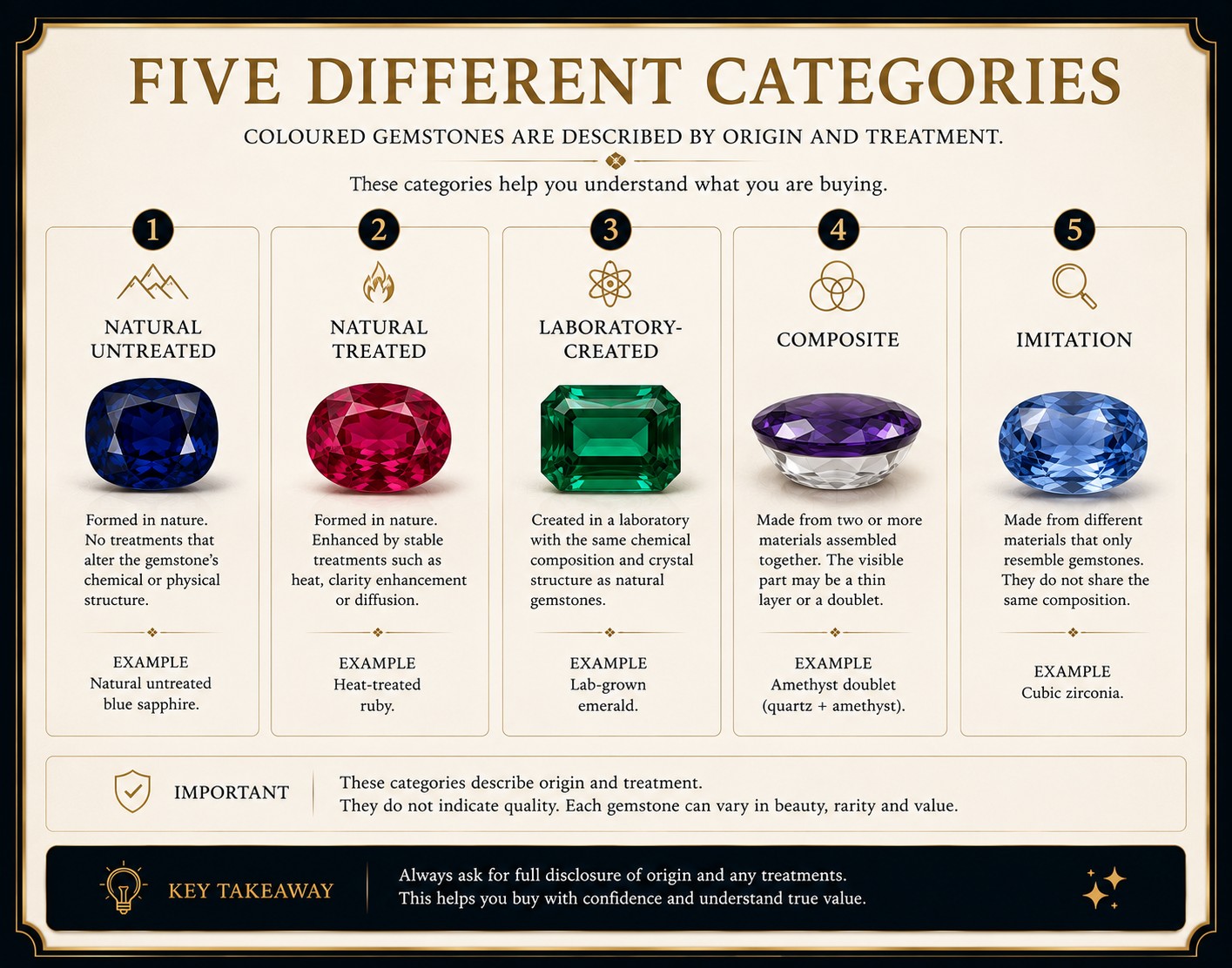
Appearance alone cannot reliably prove origin or treatment. Use precise product disclosures.
A coloured stone can be natural and untreated, natural and treated, laboratory-created, composite or an imitation. These categories are not interchangeable, and colour alone cannot tell you which one you are viewing.
The reliable method is documentary and gemmological: require precise product language, match it across the invoice and report, verify the report with its issuing laboratory, and commission independent testing when the value or uncertainty justifies it.
Quick answer
You usually cannot confirm natural origin or treatment from a photograph, price, loupe or home test. First, require the exact gemstone species or variety, natural or laboratory-created status and all known treatments in writing. Then check whether an independent coloured-stone identification report matches the stone or mounted piece and states detectable treatments. Verify the report number directly with the issuing laboratory. If the stone is valuable, undocumented or the descriptions conflict, ask a qualified independent gemmologist or laboratory to test it.
Understand the five categories first

Chemical properties overlap between natural and lab-created counterparts, requiring clear disclosures.
| Category | Meaning | Key disclosure needed |
|---|---|---|
| Natural, untreated | Formed naturally; no treatment detected or stated beyond cutting and polishing | Exact identity and report wording |
| Natural, treated | Formed naturally, then altered to affect colour, clarity or another property | Identity, treatment and care implications |
| Laboratory-created | Grown by a manufacturing process and sharing essentially the relevant properties of its natural counterpart | Clear non-natural origin wording |
| Composite or assembled | Made from two or more joined components | Construction and component identities |
| Imitation or simulant | Resembles another gem without being that material | Actual material and what it imitates |
Natural does not automatically mean untreated
Confirm exact treatment and origin statuses. For details on lab designations, see how lab-grown diamonds should be described and disclosed.
Why appearance cannot prove the answer
Internal inclusions exist in both natural and lab-grown stones: visual assessments are not proof. Expert spectroscopic analyses are needed.
Use this five-level evidence ladder
Level 1: Precise product-page disclosure
- Accepted gemstone species or variety.
- Natural or laboratory-created origin.
- Composite or imitation status where applicable.
- Known or detected treatments.
- Stone dimensions and weight.
- Whether the pictured stone is the exact stone.
- Care restrictions connected to material or treatment.
Level 2: Matching transaction documents
Level 3: An appropriate laboratory report

Understanding finished jewellery report limits compared to loose gemstone certificates is essential.
| Document | What it may establish | What it does not automatically establish |
|---|---|---|
| Coloured-stone identification report | Material identity, natural/lab-created status and detectable treatments within scope | Retail value or universal quality grade |
| Origin report | Identification plus supported geographic origin for eligible stones | Mine, ownership history or ethical provenance |
| Finished-jewellery report | Mounted stones and mounting details as examination permits | Same precision as every stone tested loose |
| Appraisal | Stated value for a defined purpose | Independent gem identity unless testing is included |
| Seller certificate | Seller’s own description or guarantee | Independent laboratory testing |
Verify certificate scope parameters. For report validations, see what certified lab-grown diamond jewellery means.
Level 4: Verify the report directly
Level 5: Independent re-testing
What treatment wording should tell you
- What was detected or disclosed? Request the actual treatment name.
- How certain is the conclusion? Some reports use careful wording when detection has limits.
- Is it stable? Treatments can vary in permanence.
- What care changes? Heat, chemicals, light, abrasion, ultrasonic cleaning or steam may be unsuitable.
What “no indications of treatment” means
This specifies that no treatment traces were detected under laboratory conditions: it does not mean untreated in all possible ways.
Mounted stones have testing limitations
Metal settings block girdle and inclusion observations. Keep stones in their mounts; do not risk damage with loose home testing.
Geographic origin is a different question
Country assignments are expert opinions based on chemical traces in natural stones. Origin alone is not a quality grade.
Home tests to avoid
Avoid heat burning, ultraviolet exposure, scratch tests, or density calculations at home. These can fracture the gemstone setting.
Red flags on a product page
- only a colour name instead of a gemstone identity;
- “natural-looking”, “created”, “genuine” or “precious” without definition;
- treatment information hidden in generic terms;
- one certificate claimed to cover an entire collection;
- no report number or issuing laboratory;
- mismatched dimensions or photographs;
- geographic origin used without laboratory support;
- a “certificate” that is actually an appraisal or warranty;
- pressure to waive returns before verification; or
- care instructions that ignore treatment sensitivity.
A buyer’s verification worksheet

Cross-checking report numbers against invoice lines secures transaction safety.
| Question | Seller’s answer | Document that confirms it |
|---|---|---|
| What is the exact material? | Product specification/report | |
| Natural or laboratory-created? | Invoice/report | |
| Composite or imitation? | Disclosure/report | |
| What treatments are known or detected? | Report/comments | |
| Loose or mounted when tested? | Report description | |
| Does the report number verify? | Official laboratory database | |
| Does the item match the report? | Dimensions/photo/weight | |
| What care restrictions apply? | Treatment-specific care card |
The Aurelia Royale standard
Aurelia Royale separates gemstone types, detailing origins and treatment scopes with report numbers. Browse options at Aurelia Royale jewellery or contact Aurelia Royale to request specific specifications.
Final verdict
Can I tell if a gemstone is natural by looking at it?▼
Usually not reliably. Natural, treated and laboratory-created stones can overlap in appearance, and professional testing may require advanced instruments.
Does “natural gemstone” mean untreated?▼
No. Natural describes geological origin. A natural gemstone may also have been treated.
Is a laboratory-created gemstone fake?▼
It is manufactured rather than naturally formed, but it may share essentially the relevant properties of its natural counterpart. It must be disclosed clearly.
Is an imitation the same as a lab-created gemstone?▼
No. An imitation resembles another gem but is a different material; a laboratory-created counterpart shares the relevant identity and properties.
Can inclusions prove that a stone is natural?▼
Not by themselves. Natural, treated and laboratory-created stones can all show internal features. Interpretation requires expertise and sometimes instruments.
Can a jeweller identify gemstone treatment?▼
Some jewellers and gemmologists can recognise certain features, but many treatment conclusions require a qualified laboratory.
What report should I request for a coloured stone?▼
Request an independent identification report appropriate to the loose or mounted item, stating identity, origin category and detectable treatments.
How do I verify a coloured-stone report?▼
Use the issuing laboratory’s official report-check service and match the number, identity, dimensions, photograph and comments to the item.
Does a report always identify every treatment?▼
Reports state findings within their methods and scope. Read the exact wording and limitations; detection can vary by treatment and material.
Can a mounted gemstone be tested?▼
Often yes, but the setting may restrict observation or measurement. The report should identify mounted status and relevant limitations.
Does country of origin prove a gemstone is natural?▼
Geographic-origin opinions apply to eligible natural stones, but verify the complete report. A seller’s unsupported country claim is not proof.
What should I do if the invoice and report disagree?▼
Stop the purchase or contact the seller within the return period. Request correction and, where appropriate, independent re-testing.
Shop with Confidence
Aurelia Royale provides verified GIA/IGI reports and full treatment disclosures for every colored stone design. View our guarantee.

Stay Connected
Get Our Latest Updates
Be first to discover new collections, exclusive events, and the quiet privileges reserved for our inner circle.