
How to Choose a Trustworthy Online Diamond Jeweller
40 Checks: Identity, Claims, Reviews, Returns and Accountability • Published September 10, 2026
A trustworthy online diamond jeweller should make it easy to answer two different questions: What exactly am I being offered? and: Who is accountable if the product, service or transaction does not match what was promised?
A polished website, attractive product photography or a row of trust badges can create confidence, but none of them independently establishes that a retailer is reliable. A stronger assessment looks at the evidence behind the business.
Can you identify who operates the website? Can you contact them? Are important diamond and metal claims specific enough to verify? Are return, cancellation and delivery terms clear? Are reviews presented credibly? If a laboratory report is mentioned, can that report actually be checked? If the retailer makes environmental, manufacturing or lifetime-service claims, is the scope of those claims explained?
Trust online should therefore come from verifiable identity, consistent product information, transparent commercial terms and accountability, rather than from branding alone.
Quick Answer: How Can You Tell Whether an Online Diamond Jeweller Is Trustworthy?
Start with the business itself. A credible online jeweller should provide enough information for you to establish who you are dealing with and how to contact them.
Then examine the product claims. If a diamond is described as laboratory-grown, that origin should be clear. If the jeweller claims an IGI report exists, the report should relate to the specific stone or jewellery item being sold. If the product is described as 18ct gold, the metal information should support that claim.
Next, review the commercial terms. Understand pricing or the enquiry process, availability, returns, cancellation conditions, production or delivery expectations and how problems are handled.
Finally, consider outside evidence such as independent reviews—but use reviews as one signal rather than the entire trust decision. The most useful rule is: important claim → suitable evidence → clear scope → accountable seller.
1. Establish Who Actually Operates the Website
Before evaluating diamond grades, establish the identity of the business selling them. For UK distance sales, current government guidance says businesses must provide consumers with information including the business name, contact details and address before an order is placed. Online sellers must also provide an email address and relevant transaction information.
This is more useful than merely seeing: "Luxury jewellers since…" or: "Trusted by thousands." Those are marketing statements. You should be able to determine which business is legally or commercially responsible for the transaction. Where a company claims a specific registration, trading identity or physical business location, that information should be capable of independent checking.
2. Make Sure There Is a Real Way to Contact the Seller
A contact form alone is not always enough to establish accountability. For a significant jewellery purchase, look for usable contact information and test it if necessary. Ask a genuine product question. The quality of the response can itself tell you something. A strong seller should be able to answer specific questions about the product or clearly say when a detail is unavailable.
Be cautious when every technical question receives only generic sales language such as: "All our diamonds are premium quality." That does not answer a question about a report number, total diamond weight, setting dimensions or metal fineness. The FTC similarly advises online buyers to check seller contact information, research the seller and keep important answers in writing.
3. Check Whether the Business Information Is Consistent
Trust weakens when different parts of the website tell different stories. For example, if the footer identifies one business but the terms and conditions identify an unrelated name, investigate. If the contact page lists one country while the returns address unexpectedly points elsewhere, understand why. If a site claims decades of history but appears to provide no identifiable business information at all, do not let the history claim replace verification.
An inconsistency does not always prove wrongdoing. Businesses can use trading names, fulfilment partners and different registered addresses. But significant inconsistencies should be explainable.
4. Check What the Jeweller Is Actually Claiming About the Diamond
Jewellery marketing uses many high-impact terms: certified; premium; ethical; sustainable; investment quality; conflict-free; laboratory-grown; D colour; VVS clarity; IGI certified.
Each statement creates an expectation. The FTC Jewelry Guides state that sellers should represent characteristics such as gemstone type, quality, quantity, metallic content, size, weight, cut, colour, treatment, origin, price and value truthfully. That means retailer trust can be assessed by asking whether those claims become more specific when you investigate them—or less specific.
The Claim → Evidence → Scope Test
Use this framework for any important product or brand claim. Claim: What exactly is being promised? Evidence: What information supports it? Scope: What does that evidence actually establish?
For example: Claim: "IGI reported laboratory-grown diamond." Evidence: An IGI report associated with the specific stone. Scope: The report documents the diamond characteristics covered by that laboratory service. It does not automatically prove the retailer's customer service quality, return policy or lifetime workmanship.
Another example: Claim: "18ct gold." Evidence: Verified product information and, where applicable, recognised precious-metal hallmarking. Scope: This supports a metal claim. It does not grade the diamond. The strongest retailers keep claims within the scope of their evidence.
5. Make Sure Laboratory-Grown Origin Is Clear
A lab-grown diamond should not be marketed in a way that makes buyers assume it is mined. US FTC guidance specifically says sellers of laboratory-created diamonds should use clear qualifying terminology such as laboratory-grown or laboratory-created, with the disclosure sufficiently close to the diamond claim.
For a trustworthy product page, you should not have to discover the origin only after reading a distant education page. The gemstone identity belongs close to the product itself.
6. Do Not Treat "Certified" as a Complete Trust Signal
The word certified is often given far more meaning than it deserves. Ask: Who issued the report? Which stone or jewellery article does it describe? What information does it contain? Can it be independently retrieved or verified?
IGI currently provides report services that identify natural or laboratory-grown origin and document relevant diamond characteristics. A genuine report can be useful evidence. But the existence of a grading report does not certify the retailer's: delivery performance; customer service; returns; pricing; workmanship; or commercial honesty. Evaluate the diamond and seller separately.
7. If an IGI Report Is Claimed, Verify It
For a significant individually reported diamond, a seller should be able to provide the relevant report information. You can then check the report through IGI's official verification system. But there is an important second step: report found does not automatically mean physical diamond matched.
The retrieved report should correspond with the stone being offered. Useful matching information can include: shape; carat weight; measurements; reported grades; and girdle inscription where applicable.
For the detailed stone-matching process, use How to Verify an IGI Certificate Number.
8. Compare the Product Page With the Report
Trust is easier to establish when independent evidence and seller information agree. Imagine the retailer says: 1.50 ct oval lab-grown diamond; F colour; VS1 clarity while the linked laboratory report describes: 1.02 ct round brilliant; G colour; VS2 clarity. Those details cannot all describe the same centre stone. That is a contradiction.
Possible explanations include a data-entry mistake, outdated page, incorrect uploaded report or wrong stone association. The important trust signal is what happens next. A credible seller should investigate and correct the discrepancy rather than simply tell you not to worry about it.
9. Distinguish Missing Information From Contradictory Information
This distinction prevents overreacting to ordinary omissions while still recognising serious problems. If growth method is not listed, the information may simply be unconfirmed. If a chain length is not stated, that is an omission. If a product says "1.50 carats" without identifying whether it means one stone or total diamond weight, that is ambiguous. But if the retailer claims a 1.50 ct centre diamond while the corresponding report says 1.01 ct, that is a contradiction.
These situations should not be treated equally. Trustworthiness is not about publishing every possible field. It is about giving accurate answers to material questions and resolving genuine conflicts.
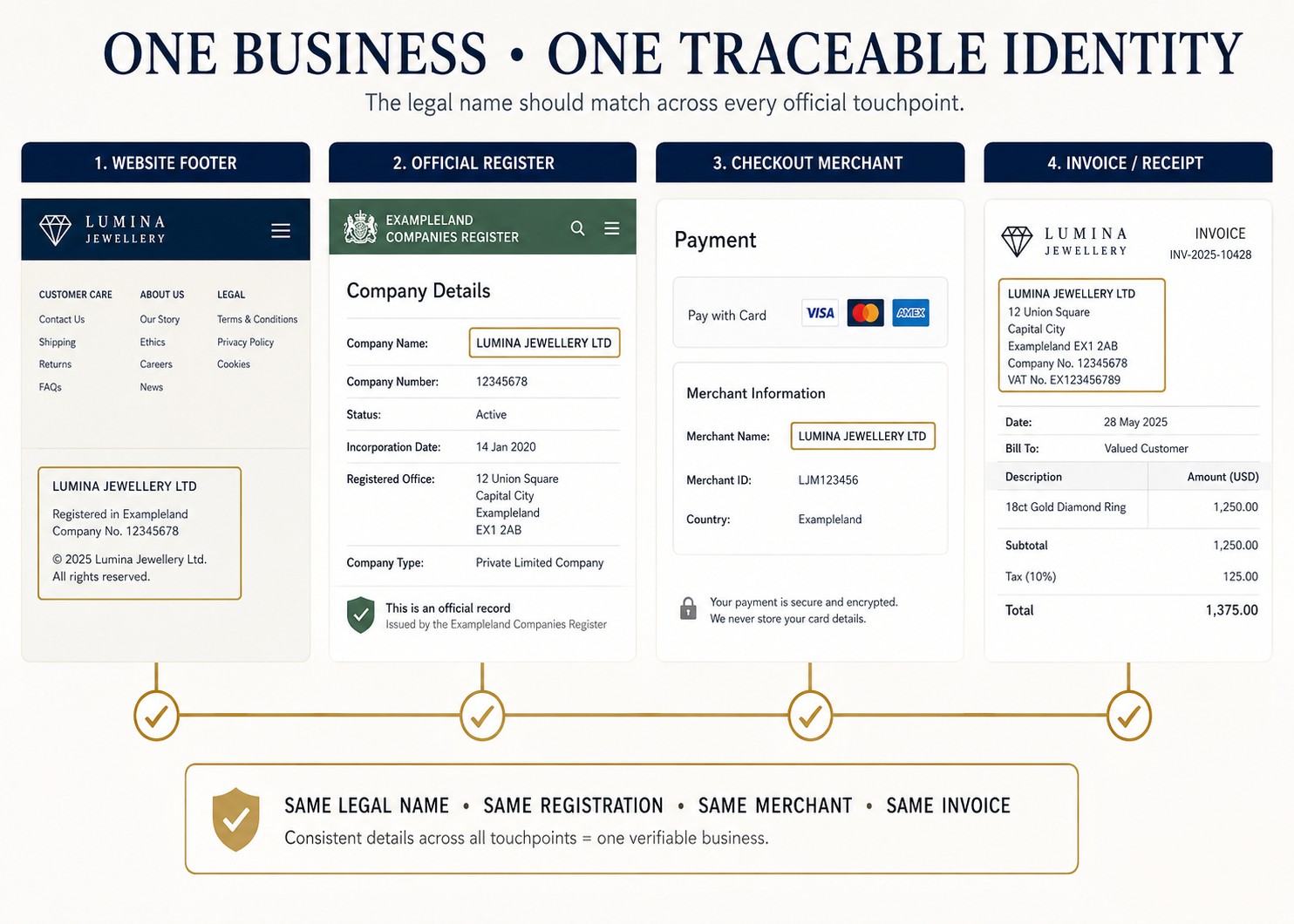
Product claims need evidence and scope — the strongest retailers keep each claim within what the available evidence actually establishes.
10. Check Whether Product Specifications Are Precise Without Creating False Precision
Reliable product information can be: exact; minimum; ranged; or: approximate. These are all legitimate when used properly. For example: Centre Diamond: 1.03 ct could be an exact stone-specific measurement. Diamond Clarity: VS2 or better is a minimum specification. Accent Diamond Colour: F–G is a range. Total Diamond Weight: approximately 1.50 ct is an approximate specification.
A trustworthy jeweller does not quietly turn: F–G into: F or: VS2 or better into: VS1 because the latter sounds stronger. The wording should reflect the evidence available.
11. Check Total Carat Weight Carefully
Multi-stone jewellery creates one of the easiest opportunities for consumer misunderstanding. Suppose a ring contains a one-carat centre diamond and half a carat of accent stones. The total diamond weight might be approximately 1.50 carats. That does not make the centre diamond 1.50 carats.
The FTC's jewellery guidance specifically requires care when advertising diamond weight, including precision around decimal and fractional descriptions. A trustworthy jeweller should distinguish: centre-stone carat weight from: total diamond weight when the distinction is material.
For the full explanation, read Total Carat Weight Meaning in Diamond Jewellery
12. Verify Metal Claims Separately From Diamond Claims
A loose-diamond report does not automatically tell you whether the ring is made from 18ct gold, platinum or plated silver. Metal needs separate evidence. If the product is sold into the UK, applicable hallmarking can provide independent information about qualifying precious-metal fineness. But a hallmark does not grade the diamond.
For metal checking, use How to Check the Metal Used in Diamond Jewellery.
13. Look for Real Product Dimensions
Remote jewellery buying becomes much easier when the retailer provides actual physical measurements rather than relying entirely on enlarged photography. Useful dimensions depend on the item: for earrings, diameter or drop may matter; for necklaces, chain length and pendant dimensions matter; for rings, band width or setting height may matter; for bracelets, overall wearable length matters.
Dimensions do not prove quality. But they significantly reduce uncertainty.
For the dedicated guide, read How to Check Jewellery Dimensions and Weight Online
14. Understand Whether You Are Seeing the Exact Product
Product photography can show: the exact item; the exact centre diamond; a representative example; or: a digital rendering. Those are not equivalent. A reputable retailer should not encourage buyers to think a generic rendering shows the exact unique diamond being supplied if individual stones vary. Representative photography can be perfectly legitimate. What matters is transparency about what is representative.
For remote inspection, continue with How to Choose Diamond Jewellery Without Seeing It in Person.
15. Check the Returns and Cancellation Terms Before Committing
Policies matter most when something goes wrong. For UK distance selling, current GOV.UK guidance says businesses must explain cancellation rights and relevant conditions before an order is placed. Standard distance-sale rules generally provide a 14-day cancellation period after delivery for eligible goods, subject to applicable exceptions.
Do not assume all jewellery has identical return rights. Personalised or genuinely custom-made goods can be treated differently. Also distinguish statutory consumer rights from any additional commercial return policy offered by the retailer. A trustworthy retailer should make the terms understandable before payment—not only after a customer asks to return something.
16. Check What Happens With Made-to-Order Jewellery
Made-to-order is not automatically synonymous with personalised. A standard jewellery design manufactured after an order is placed may have a different legal and commercial position from an item uniquely engraved or customised for one customer. The seller should explain the actual process.
Before proceeding, understand whether the piece already exists, whether production begins after payment, what can vary and how cancellation or returns operate. Vague use of the word custom should not be used to remove ordinary consumer expectations without explanation.
17. Check Pricing—or Understand the Enquiry Model
A normal online transaction should make pricing and unavoidable charges understandable. Current UK online-selling guidance requires businesses to give the total price or explain how it will be calculated, along with delivery costs and payment information.
However, some high-value jewellery operates through consultation, quotation or enquiry rather than immediate checkout. That can be legitimate. The trust issue is whether the process is described accurately. If there is no fixed purchasable price, the site should not create the impression that clicking a button immediately buys the item. For Aurelia's currently unpriced designs, Join Waitlist or Enquire About This Piece is more accurate than an active Add to Cart flow.
18. Check Sale and Discount Claims
A retailer's apparent generosity should not substitute for product evaluation. Statements such as: 50% off or: was £4,000, now £1,999 are meaningful only when the reference price itself has a genuine basis.
UK online-selling rules require sellers to be honest and transparent about promotions, while the CMA's current unfair-commercial-practices guidance addresses misleading actions and omissions in consumer transactions. Do not assume the largest discount equals the best diamond value. Compare what is actually being sold.
19. Check Delivery Information Before Payment
A trustworthy retailer should explain whether a product is: in stock; made to order; subject to production; or unavailable for immediate purchase. Then distinguish production time from dispatch and delivery.
Current UK distance-selling guidance requires businesses to give consumers delivery arrangements, costs and expected timing before an order is placed. It also states that goods should generally be delivered within 30 days unless another timeframe has been agreed. Do not interpret that statutory framework as a guarantee that a particular jeweller will deliver every piece within a specific shorter period. The retailer's actual commitment should be clearly stated.
20. Check Whether Important Policies Are Easy to Find
A policy technically existing somewhere on a website is less useful if the customer cannot reasonably locate it before buying. Important commercial terms should be accessible and understandable. That includes: returns; cancellation; delivery; payment; privacy; and any significant warranty or after-sales conditions being promoted.
A trustworthy seller should not require customers to discover important restrictions only after completing the transaction.
21. Read Warranty Claims Carefully
A statement such as: lifetime warranty sounds reassuring. But it raises several questions. What does "lifetime" mean? What parts are covered? Does it include normal wear? Accidental damage? Loose stones? Resizing? Shipping? Inspections?
A useful warranty has terms. The headline alone is not enough. Do not treat an undefined warranty badge as equivalent to practical after-sales protection.
22. Distinguish Laboratory Reports From Warranties and Appraisals
An IGI report is not the same thing as a seller warranty. IGI itself states that its report is not a guarantee, appraisal or warranty. That distinction matters. A laboratory report can provide gemmological information about the submitted stone or jewellery article. The retailer remains responsible for its own commercial promises.
Similarly, an appraisal concerns value and should not be confused with a grading report.
23. Check Reviews—but Do Not Trust the Star Rating Alone
Online reviews can reveal patterns in customer experience, particularly around delivery, description accuracy, communication and problem resolution. But review systems can also be manipulated.
The FTC advises buyers to read reviews across multiple sources, consider where reviews are posted and examine the reviewer's history instead of relying solely on star ratings. For a significant jewellery purchase, search both: brand name + reviews and: brand name + complaints. One negative comment does not establish that a business is unreliable. Look for repeated patterns.
24. Genuine Negative Reviews Are Not Automatically a Bad Sign
A business with some criticism can still be trustworthy. In fact, a review system containing genuine positive and negative experiences may be more informative than one displaying only flawless praise.
Current CMA guidance says review publishers should present consumers with the full picture and should not suppress genuine negative reviews merely because they are unfavourable. The key question is therefore not: "Does this retailer have five stars?" It is: "Does the review environment appear credible, and how does the business respond when problems occur?"
25. Be Alert to Fake or Selectively Presented Reviews
The UK's rules around reviews have strengthened materially. The CMA published dedicated fake-review guidance in April 2025, and its current guidance explains businesses' obligations around preventing and presenting fake or misleading reviews. The CMA has also continued enforcement activity in this area.
That means a large number of reviews should not automatically create trust. Ask where they come from, how they are collected and whether the presentation appears balanced.
26. Do Not Treat Influencer Content as Independent Verification Automatically
A social-media endorsement may be genuine. But it may also result from a paid relationship, gifted product, affiliate arrangement or other incentive. That does not automatically make the recommendation false. It simply means you should understand whether the person is acting as an independent reviewer or participating in marketing.
Use influencer content as supplementary evidence, not as the only basis for an expensive purchase.
27. Check Sustainability and Ethical Claims
Jewellery brands increasingly use words such as: ethical; eco-friendly; sustainable; responsible; and: conscious. These claims need scope and evidence.
The fact that a diamond was grown in a laboratory establishes its origin. It does not automatically establish the electricity source used during growth, the carbon footprint, metal sourcing, cutting conditions, manufacturing practices, transport footprint or complete supply-chain performance.
Current CMA guidance says environmental claims should be supported and sufficiently clear, and its January 2026 supply-chain guidance specifically applies to retailers, brands, manufacturers and suppliers. If a retailer says: "sustainable jewellery" ask: Which part, compared with what, and based on what evidence?
28. Do Not Trust Green Visuals Instead of Evidence
Green leaves, earthy backgrounds, recycled-looking boxes and environmental icons are design signals. They are not environmental evidence. CMA consumer guidance explicitly warns shoppers not to rely on vague green slogans or environmental-looking presentation and recommends looking for evidence supporting the specific claim. The same principle applies to diamond jewellery. Judge the evidence, not the colour palette.
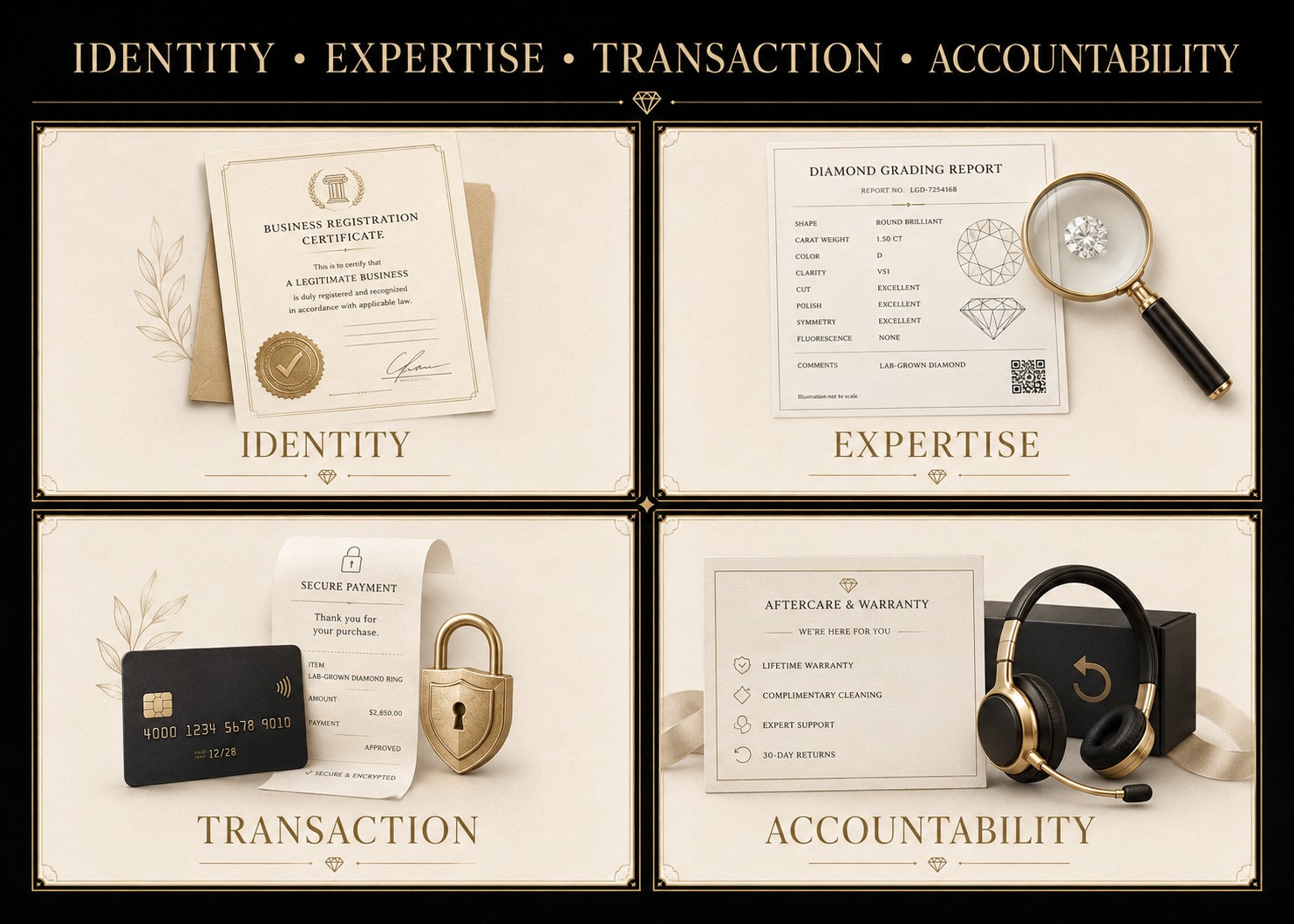
Environmental claims need scope and evidence — a green visual is a design signal, not environmental proof.
29. Check Manufacturing and Location Claims
Statements such as: Made in Britain; Crafted in London; Made in our own workshop; or: Manufactured in-house are factual claims. They should be supported. Do not infer manufacturing origin from a company's office address. A business can be headquartered in one place and manufacture elsewhere.
Similarly: designed in London and: made in London are not interchangeable claims. A trustworthy jeweller should use the wording that actually matches its process.
30. Check Whether "Own Factory" or "Direct Manufacturer" Is Verifiable
Statements about owning production facilities can be commercially powerful because buyers may assume they imply better pricing, quality control or traceability. But each assumption needs evidence. Even if a retailer does operate its own factory, that fact alone does not establish: better workmanship; lower prices; higher diamond grades; or: superior sustainability.
Treat the factual claim separately from the marketing conclusions attached to it.
31. Be Careful With Resale and Investment Claims
A trustworthy diamond jeweller should not imply that grading documentation guarantees future value. Claims such as: guaranteed investment; will appreciate; always retains value; or: guaranteed resale deserve scrutiny. Future resale depends on market conditions, buyer demand, product characteristics and available resale channels. A grading report describes a diamond. It does not guarantee an unknown future selling price.
For lab-grown diamonds specifically, see Do Lab-Grown Diamonds Have Resale Value?
32. Check Whether "Premium" Has a Defined Meaning
Words such as: premium; luxury; exceptional; best; and: elite can communicate positioning without necessarily conveying a technical grade. If a jeweller says: Premium Cut Diamond ask whether Premium is a formal grading term, an internal quality category or simply marketing language.
Do not assume the word means: D colour; VVS clarity; Ideal cut; or any other specific grade unless the retailer defines it.
33. Check Whether Trust Badges Can Be Verified
A page covered in logos can look extremely authoritative. But each logo has a different scope. A laboratory logo may relate to diamond reporting. A payment-security badge may relate to transaction technology. A trade-association logo may indicate membership. A hallmark symbol relates to precious-metal fineness.
None should be stretched beyond its actual meaning. If a membership or certification badge influences your purchase decision, verify the claimed status through the organisation where practical.
34. HTTPS Is Necessary but Not Proof of Legitimacy
The padlock symbol tells you that data transmitted between your browser and the site is encrypted. It does not prove that the retailer itself is trustworthy. The FTC explicitly warns consumers that scammers can use encrypted HTTPS websites too. So: HTTPS = secure connection does not mean: HTTPS = reputable jeweller.
35. Check How Payment Is Requested
The transaction method can also affect risk. The FTC recommends safer payment methods such as credit cards for online purchases because they can provide dispute protections and warns consumers to be cautious when sellers insist on difficult-to-recover payment methods. The practical trust signal is whether the retailer uses a normal, transparent payment process rather than pressuring customers into an unusual route solely to avoid buyer protections.
36. Keep Important Answers in Writing
If the retailer confirms something material outside the product page, retain the message. Examples might include: exact ring size; diamond report number; production specification; agreed delivery requirement; customisation; or: an explanation of a discrepancy.
The FTC recommends keeping purchase records, return information, shipping promises and communication with the seller. For significant jewellery, this is particularly sensible because many products involve individual specifications.
37. Accountability Matters More Than Perfection
Even excellent businesses make mistakes. A wrong ring size can be shipped. An old image can remain on a page. A certificate can be uploaded against the wrong product. A courier can experience a delay. The stronger trust signal is whether the business has a clear process for taking responsibility and resolving legitimate problems.
Ask yourself: Can I contact someone? Can the problem be explained? Is there a written policy? Does the seller correct inaccurate information? Will I know what happens next? Accountability turns transparency into practical trust.
38. Check How Complaints Are Handled
Reviews become particularly useful when they show how a business responds when something goes wrong. Look beyond the original complaint. Was it ignored? Was the customer given a generic response? Or did the business investigate and explain a resolution? A trustworthy jeweller does not need to agree with every complaint. But it should have a credible route for dealing with legitimate concerns.
39. Be Wary of Pressure That Prevents Verification
High-pressure selling can undermine an otherwise professional experience. Examples include insisting that you must pay immediately before being allowed to see documentation, refusing to provide a claimed report number or repeatedly avoiding straightforward product questions.
Urgency can sometimes be genuine because a unique item may sell. But urgency should not prevent reasonable verification of material claims. If a purchase is significant enough to require confidence, take the time needed to understand what is being offered.
40. Do Not Assume the Cheapest Seller Is the Safest—or the Most Expensive Is the Best
Price positioning does not establish reliability. A lower-priced jeweller may operate efficiently. A high-priced jeweller may provide extensive service. Or the reverse may be true. Trust should come from evidence, documentation and accountability. Evaluate the product and seller separately from the emotional signal created by price.
A Practical Trust-Verification Framework
| Retailer claim or signal | What to verify | What it does not automatically prove |
|---|---|---|
| Lab-grown diamond | Clear origin disclosure; appropriate report where applicable | Sustainability or high quality |
| IGI reported | Specific corresponding IGI report | Retailer reliability |
| F / VS1 | Applicable stone-specific report | Workmanship of complete jewellery |
| 18ct gold | Metal specification and applicable hallmark evidence | Diamond quality |
| 1.50 ct | Whether this is centre weight or total weight | Physical size |
| Sustainable | Evidence and defined scope | Entire supply chain is environmentally superior |
| Made in London | Verifiable manufacturing information | Every component originated there |
| Lifetime warranty | Full warranty terms | Every loss or damage is covered |
| Five-star reviews | Collection and moderation credibility | Every buyer will have the same experience |
| Secure website | HTTPS/payment security | Seller legitimacy |
| Sale price | Genuine reference-price basis | Better value than competitors |
| Fast delivery | Actual dispatch/delivery commitment | Product is already in stock |
The point is not to collect the maximum number of trust signals. It is to make sure each important signal proves what you think it proves.
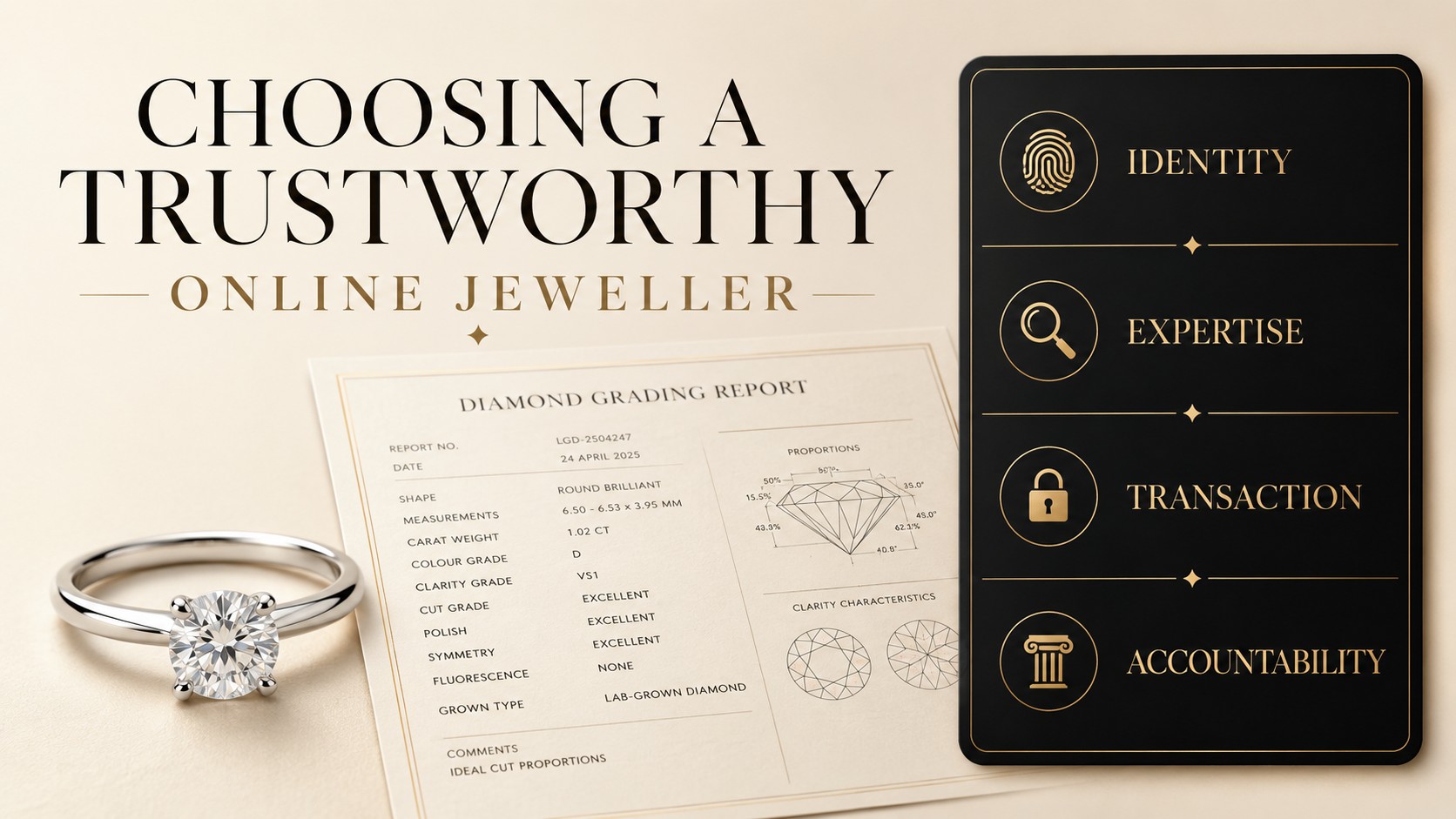
The strongest test: Claim → Evidence → Scope → Accountability. When those four have clear answers, you have a much stronger basis for your decision.
What Are the Biggest Red Flags?
The most important warning sign is usually not one missing specification. It is a pattern of important claims that become impossible to verify. Examples include a supposedly reported diamond with no usable report information, material contradictions between the page and laboratory document, laboratory-grown origin hidden behind vague terminology, unclear business identity, policies that cannot be found before purchase, unexplained payment pressure, environmental claims without evidence or persistent refusal to answer specific questions about the item.
Another significant warning sign is when marketing language consistently expands the scope of the available evidence. A diamond report becomes "the entire ring is certified". A hallmark becomes "the diamond is authenticated". A sustainability statement about one component becomes "the entire brand is zero impact". A review score becomes "guaranteed customer satisfaction". Trustworthy retailers keep those boundaries clear.
What If Some Information Is Missing?
Missing information should trigger a proportional response. If a detail does not materially affect your decision, you may not need it. If it could change your purchase, ask.
For example, if pendant weight is irrelevant to you, an omitted gram figure may not matter. If you need a ring to sit beside a wedding band, missing setting-height information might matter considerably. If a significant centre diamond is sold with a specific laboratory report, missing report information matters. Focus on material uncertainty, not perfect information.
The Verified / Disclosed / Unconfirmed Test
A useful way to review a product or retailer claim is to place it in one of three categories. Verified means appropriate evidence supports the claim. Disclosed means the retailer has clearly stated the claim, but you are relying on seller or manufacturer information. Unconfirmed means the available information is insufficient.
For example: IGI report-linked diamond weight — Verified, where properly matched. Chain length stated by the manufacturer — Disclosed. "Handmade in London" with no evidence available — Unconfirmed until established. The framework simply prevents a retailer statement from being mistaken automatically for independent verification.
The Omission / Ambiguity / Contradiction Test
These three problems require different responses. An omission means the information is absent. An ambiguity means the wording allows multiple interpretations. A contradiction means two pieces of information cannot both be correct.
For example: Omission: chain length not supplied. Ambiguity: "2 carat earrings" without explaining whether this means per earring or total per pair. Contradiction: product page says 2.00 ct centre stone while the attached report says 1.01 ct. This framework is particularly useful for expensive remote purchases because it helps you decide when clarification is merely useful and when it is essential.
How do I know if an online jewellery store is trustworthy?▼
Check business identity, contact information, product documentation, commercial policies, external reviews and whether important claims can actually be verified.
Can I trust an online diamond jeweller with good reviews?▼
Reviews are useful but should be combined with other evidence. Examine several sources rather than relying only on one star rating.
Are perfect reviews suspicious?▼
Not automatically, but a perfect score does not prove reliability. Consider how reviews are collected and whether genuine criticism appears to be presented fairly.
Are fake reviews illegal in the UK?▼
Current UK consumer law includes specific prohibitions and obligations relating to fake reviews, supported by CMA guidance introduced in 2025.
Is an IGI certificate proof that a jeweller is trustworthy?▼
No. An IGI report provides information about the submitted diamond or jewellery article within its scope. The retailer must be assessed separately.
How do I verify an IGI report?▼
Use IGI's official report-verification service and then compare the retrieved information with the physical stone being offered.
Does a genuine IGI report prove the diamond in the listing matches it?▼
Not automatically. The physical diamond should correspond with the report's identifiable characteristics.
Is lab-grown diamond origin supposed to be disclosed?▼
Yes. US FTC guidance specifically says laboratory-created origin should be communicated clearly so buyers are not misled into assuming the stone is mined.
Is a UK hallmark proof the diamond is real?▼
No. Hallmarking concerns qualifying precious-metal fineness, not diamond identity.
Is HTTPS proof an online jeweller is legitimate?▼
No. HTTPS indicates an encrypted connection. The FTC explicitly notes that scammers can also use encrypted websites.
What should I check in the returns policy?▼
Check eligibility, time limits, exclusions, return costs and any different rules for personalised or custom-made products.
Should the seller show its business address?▼
Current UK distance-selling guidance requires businesses to provide their business name, contact information and address before an order is placed.
What if the jeweller does not publish prices?▼
An enquiry or quotation model can be legitimate if it is explained clearly. The site should not imply immediate checkout when no fixed purchase process exists.
Are sustainability claims proof that a jeweller is ethical?▼
No. Look for evidence explaining exactly which environmental claim is being made and its scope.
Does lab-grown automatically mean sustainable?▼
No. Laboratory-grown origin alone does not establish the complete environmental footprint of the finished jewellery.
Should I trust "Made in London" or "own factory" claims automatically?▼
No. These are factual claims and should be supported if they materially influence your purchase.
Is an expensive jeweller automatically more trustworthy?▼
No.
What if the product and report do not match?▼
Ask the seller to resolve the discrepancy before proceeding.
Is missing information always a red flag?▼
No. Distinguish ordinary omissions from ambiguity and direct contradictions.
What is the strongest trust signal?▼
Consistency between what the retailer claims, the evidence supporting it, the terms of the transaction and the seller's willingness to take responsibility when something needs clarification or correction.
Final Answer: What Makes an Online Diamond Jeweller Trustworthy?
A trustworthy online diamond jeweller does not ask you to rely on branding alone. You should be able to identify the business behind the website and contact it. The product should be described clearly enough to understand what you are buying. Laboratory-grown diamond origin should be disclosed accurately. Important stone specifications should correspond with applicable documentation. Metal claims should have their own supporting information.
Where a laboratory report applies, it should be possible to verify the report and establish that it corresponds with the stone being offered. Commercial transparency matters just as much. You should be able to understand the price or enquiry process, returns and cancellation terms, product availability, delivery expectations and any meaningful warranty or after-sales promise before committing.
The strongest test is therefore: Claim → Evidence → Scope → Accountability. What is being claimed? What supports it? What does that evidence actually prove? And who is responsible if the claim or transaction turns out to be wrong? When those four questions have clear answers, you have a much stronger basis for choosing an online diamond jeweller.
For evaluating the product itself, continue with What to Check Before Buying Lab-Grown Diamond Jewellery.
For remotely inspecting images, measurements and documentation, use How to Choose Diamond Jewellery Without Seeing It in Person.
For the overall online purchase process, read How to Buy Certified Lab-Grown Diamond Jewellery Online.
For verifying an IGI report, use How to Verify an IGI Certificate Number.
For checking precious-metal claims, read How to Check the Metal Used in Diamond Jewellery.
Where an Aurelia Royale design is not currently available through an approved direct-purchase process, Join the Waitlist or submit an enquiry to register your interest.
Explore Aurelia Royale Lab-Grown Diamond Jewellery
Claim → Evidence → Scope → Accountability — the four questions that establish real trust.

Stay Connected
Get Our Latest Updates
Be first to discover new collections, exclusive events, and the quiet privileges reserved for our inner circle.